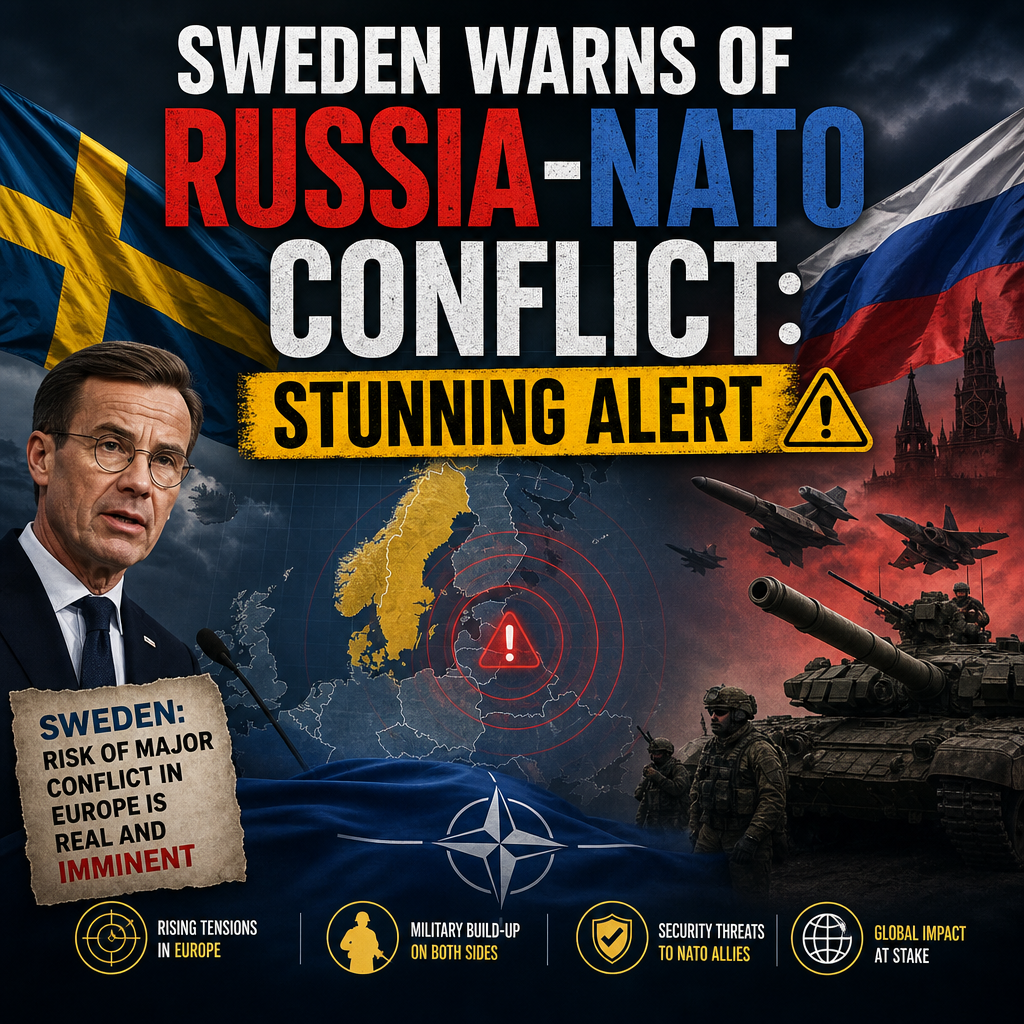
Sweden Warns of Russia-NATO Conflict: Stunning Alert


Russia-NATO conflict warnings have taken on new urgency after Sweden’s latest alarm about rising tensions between Moscow and the Western alliance, but the bigger picture is more complicated than a single headline suggests. Across international coverage, the story is being framed through very different lenses: some outlets emphasize Sweden’s security concerns and the risk of escalation in the Baltic region, while others stress Russia’s view that NATO expansion is itself a threat. What emerges is less a prediction of imminent war than a stark reminder that Europe’s security environment has become far more fragile.
Why Sweden’s warning matters
Sweden is not speaking from the sidelines. Since joining NATO, the country has become part of the alliance’s frontline posture in Northern Europe, especially as military activity around the Baltic Sea has intensified. That alone gives its warnings weight. Swedish officials have repeatedly pointed to the need for stronger preparedness, not because they expect a conflict tomorrow, but because they believe the cost of complacency would be high.



In reports touching on the issue, the central concern is not a single incident but a pattern: Russian military pressure, sabotage fears, airspace intrusions, cyber risks, and the broader uncertainty created by the war in Ukraine. For countries like Sweden, these are not abstract geopolitical talking points. They affect defense spending, civil defense planning, energy security, and public readiness.
There is also a psychological element to Sweden’s message. Governments often warn in firm terms when they want to shift public debate from “whether” a threat exists to “how prepared” the country is. In that sense, the alert is as much about resilience as it is about danger. Sweden appears to be signaling that the European security order is no longer stable enough to assume peace by default.




Russia and NATO: two narratives, one dangerous gap
The most striking thing about the current debate is how differently the main players describe the same reality.
From NATO capitals and many Western newsrooms, the concern is straightforward: Russia’s actions have already shown a willingness to use force, test borders, and exploit divisions. That view sees Sweden’s warning as a logical response to a larger pattern of coercion. The alliance’s supporters argue that deterrence works only if members acknowledge risk clearly and respond with unity, readiness, and military capability.
Russia, by contrast, routinely describes NATO enlargement and military buildup near its borders as a provocation. In that framing, Sweden’s membership in NATO is not protection but part of the problem. Russian state-backed media and officials have often argued that the alliance is the side increasing instability by expanding eastward and deepening its footprint around the Baltic and Arctic regions.
That gap matters because it creates a security dilemma: one side says it is defending itself, while the other side sees aggression in that defense. Each round of reinforcement can therefore look destabilizing to the other party. The result is a feedback loop in which warning signs multiply and trust disappears.
What the sources seem to agree on
Despite their differences, the sources point to several shared realities:
– The risk of miscalculation is real, even if neither side wants a full-scale war.
– The Baltic region is strategically important and therefore especially sensitive.
– Military signaling, public warnings, and preparedness measures are becoming more common.
– The war in Ukraine continues to shape every discussion about European security.
That common ground is important because it suggests that the danger lies not only in deliberate escalation, but also in accidents, misunderstandings, and overreaction. In a tense environment, even a limited incident can spiral if communication is poor and political rhetoric is heated.
Beyond the headlines: is conflict actually likely?
It would be a mistake to read Sweden’s warning as proof that war between Russia and NATO is inevitable. Most governments, including those in NATO, are careful not to say that open conflict is expected. Instead, they are preparing for a long period of heightened tension.
That distinction matters. A serious warning is not the same as a forecast. Sweden’s message appears aimed at readiness, not panic. It reflects a broader European view that the post-Cold War assumption of lasting stability has ended. Defense policy is being reshaped accordingly, with more attention to territorial defense, hybrid threats, and rapid response capabilities.
At the same time, it is fair to ask whether public warnings can sometimes become self-reinforcing. The more leaders speak about possible confrontation, the more populations may come to see war as unavoidable. That can narrow diplomatic room and harden public attitudes. Responsible reporting and careful policymaking should therefore avoid both extremes: minimizing the threat on one side and sensationalizing it on the other.
A cautious conclusion
The most balanced reading of Sweden’s alert is that it reflects genuine concern, not theater. Europe is facing a security environment that is more volatile than at any point in decades, and the Russia-NATO relationship remains deeply adversarial. Sweden’s position adds another clear voice to the growing chorus urging preparedness.
Still, the available reporting does not support a simple conclusion that conflict is imminent. What it does support is a more sober one: the risk of escalation is real enough that governments are treating it as a planning assumption. That is a troubling sign, but also a necessary one. In a region where military power, political mistrust, and strategic fear all overlap, realism may be the only responsible response.