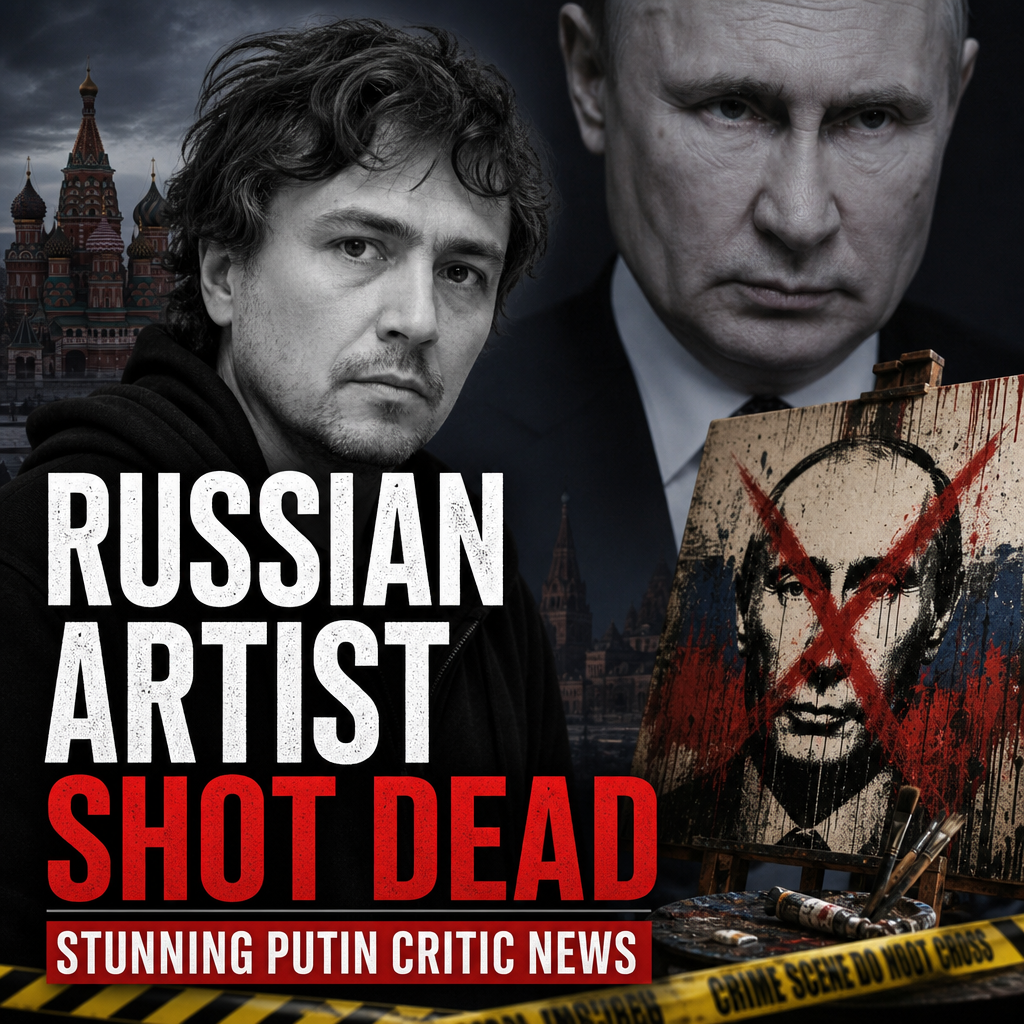
Russian Artist Shot Dead: Stunning Putin Critic News


Russian artist shot dead near his home in Poland has become the latest shocking reminder that the conflict around Vladimir Putin’s rule is not only fought on the battlefield or in diplomatic halls, but also in the lives of exiled critics scattered across Europe.
The killing of the Russian painter and outspoken Kremlin critic, reported near Warsaw, has triggered grief, suspicion and a familiar question: was this a random act of violence, or another attack shaped by politics, fear and the long shadow of Russia’s war culture? At this stage, the answer is not fully clear. What is clear is that the case sits at the intersection of exile, dissent and security concerns that have followed many Russians who left their country after opposing the invasion of Ukraine.



What is known so far about the Russian artist shot dead
According to initial reporting, the artist was found shot near his home in Poland, a country that has become one of the main refuges for Russians who oppose the Kremlin. The victim had been known for criticism of Putin, which immediately raised concern that the death could be politically motivated.
But investigators have not yet publicly established a motive. That matters. In cases like this, the difference between a targeted assassination, a personal dispute, or an unrelated criminal act can be significant — not only for the case itself, but for how it is understood internationally.




Polish authorities, at least in the public reporting available so far, have not confirmed that the killing was linked to the victim’s politics. That caution is important, because the early hours after a high-profile death often bring speculation faster than evidence.
A few facts are worth keeping in view:
– The victim was a Russian artist and critic of Putin.
– He was shot near his home in Poland.
– The motive has not been officially confirmed.
– The incident has intensified worries about the safety of Russian dissidents abroad.
That uncertainty is part of the story. It is also part of what makes the news so unsettling.
Why this case resonates beyond one death
For many observers, the killing immediately recalls a broader pattern: Russians who speak against the Kremlin often describe feeling vulnerable even after leaving the country. Some fear surveillance, online harassment or threats from nationalist networks. Others worry that the war has created an atmosphere in which political hatred can spill into real-world violence.
Al Jazeera’s wider reporting on the region and the war has often highlighted how Russia’s full-scale invasion of Ukraine has widened the climate of fear across Europe, especially for those who openly oppose Moscow. The war has deepened mistrust, intensified nationalist rhetoric and made exile less like safety and more like a fragile pause.
Sky’s reporting on the death framed the victim through his criticism of Putin, which naturally pushes attention toward the possibility of a political message. That framing reflects a legitimate concern: dissidents, artists and journalists have long been targets of intimidation, and the line between hostility and violence can be disturbingly thin.
Still, a responsible reading has to leave room for caution. Without confirmed evidence, the fact that a victim was anti-Putin does not by itself prove a Kremlin-linked attack. That distinction is crucial, especially in a moment when misinformation, propaganda and geopolitical suspicion can quickly harden into certainty.
The Russian artist shot dead: three competing ways to read the case
The strongest way to understand this story is to hold several possibilities in tension at once.
1. A political killing is plausible
This is the most alarming interpretation, and the one many readers will naturally lean toward. A Russian critic of Putin, living in Europe, is shot dead near home — the pattern is ominous. If proven, it would reinforce the fear that opponents of the Kremlin remain at risk even outside Russia.
2. The evidence is still incomplete
A more careful view notes that early reports rarely tell the full story. Police investigations often uncover details that reporters and commentators do not have immediately. Until authorities identify a suspect or motive, it is premature to present the death as a confirmed political assassination.
3. The case may become a propaganda battleground
This is the part that is easy to overlook. Incidents involving Russian dissidents are often seized on by competing media ecosystems. Western outlets may see evidence of repression reaching beyond Russia’s borders. Russian state-aligned coverage, including the broader tone often seen in RT, tends to push back against immediate assumptions and emphasize the need for proof before conclusions are drawn. In practice, that means the same tragedy can be used to support very different narratives.
That does not mean every narrative is equally credible. It means the public should be careful not to confuse suspicion with proof.
A tragedy that exposes a bigger problem
Even if the motive turns out to be unrelated to politics, the death still exposes a painful reality: exiled Russians who oppose the Kremlin live with real anxiety. They may have left the country, but they have not necessarily left the conflict behind.
That is why this case matters so much. It is not only about one life lost. It is about whether Europe can genuinely protect those who flee authoritarian pressure, and whether criticism of a powerful state can ever be safely voiced across borders.
For now, the fairest conclusion is also the most restrained one: a Russian artist critical of Putin has been killed in Poland, and the circumstances are deeply troubling, but the motive remains unproven. The public should resist jumping ahead of the investigation while still taking seriously what this death represents — a world in which political fear can travel far beyond Russia’s frontiers.
Until investigators provide more, uncertainty is the honest answer. But so is concern.