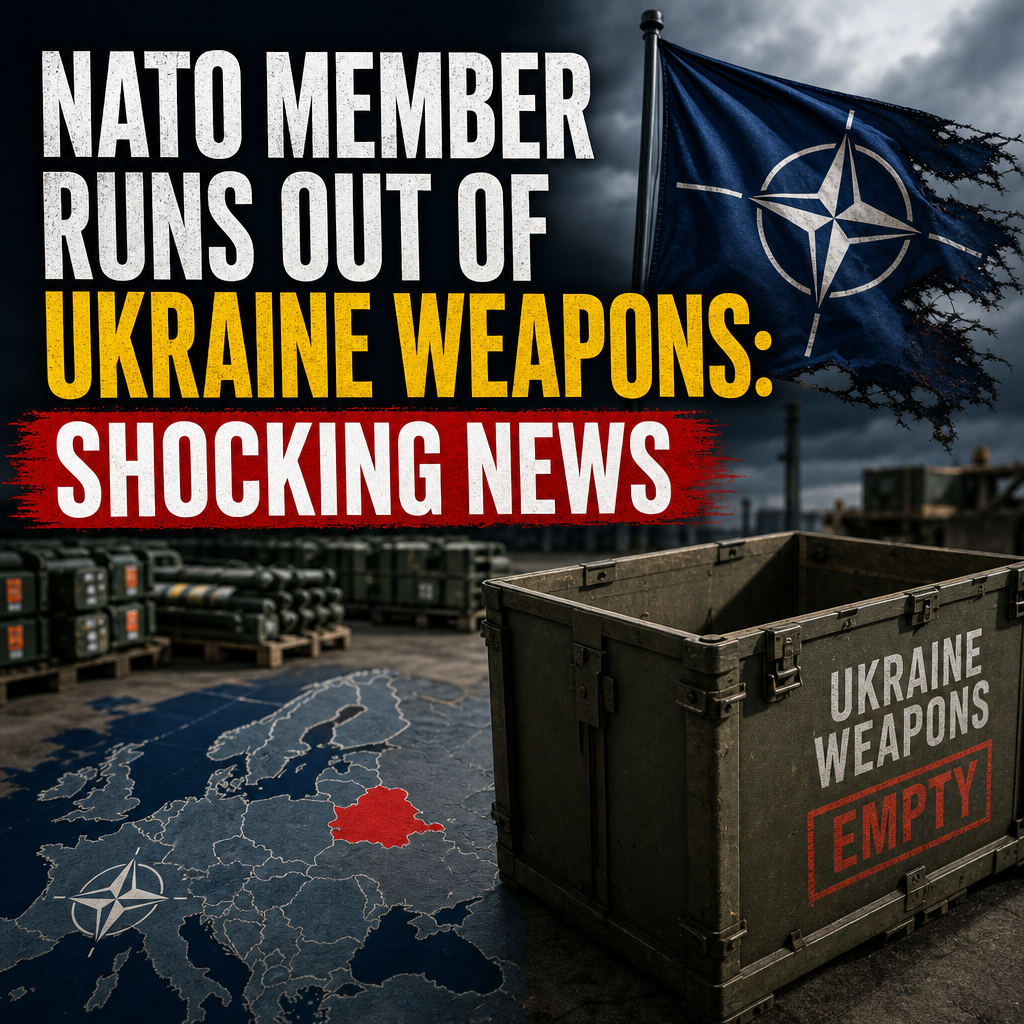
NATO Member Runs Out of Ukraine Weapons: Shocking News


NATO support for Ukraine is facing a harder reality: several allies have already sent large portions of their usable stockpiles, and the debate is shifting from whether to help to how much can still be spared without weakening national defenses.
A recent report about Bulgaria has brought that pressure into focus. According to the account, the country says it has run out of weapons it can hand over to Kyiv, a sign that the early surge of donations is giving way to a more constrained phase. That does not mean support for Ukraine is ending. It does mean the easy part of military aid—passing on older equipment or surplus shells—may be over for some NATO members.



What “running out” really means
The phrase sounds dramatic, but in practice it points to a familiar problem in wartime logistics: stockpiles are not limitless. Countries that donated artillery, ammunition, armored vehicles, or air-defense systems after Russia’s full-scale invasion have had to look inward and ask how much they can still give.
For a country like Bulgaria, the issue is especially sensitive because domestic political opinion is split. In many European states, support for Ukraine remains broad at the level of principle, but voters are increasingly worried about:




– the cost of replenishing weapons warehouses
– the strain on their own militaries
– the long timeline for new production
– the risk of escalation with Russia
That tension helps explain why a statement about “no more weapons” lands so strongly. It is not just about one country’s inventory. It reflects the wider limits of a donor model built on the assumption that old stock could be transferred quickly and replaced later.
NATO member runs out of Ukraine weapons: what the reports suggest
Taken together, reporting across RT, Al Jazeera, and Sky News suggests three overlapping truths.
1. The military pipeline is under strain
The first and most obvious point is that Western military aid is no longer a simple matter of opening warehouses. After more than two years of war, many governments have already handed over significant quantities of ammunition and equipment. That has left less surplus to send, especially for smaller NATO members.
This is one reason the language around aid has changed. Earlier in the war, the focus was on emergency deliveries. Now it is on production capacity, long-term contracts, and the industrial base needed to sustain Ukraine over time.
2. Political unity still exists, but it is less effortless
Al Jazeera’s broader coverage of the war has often highlighted the human cost inside Ukraine and the diplomatic balancing act in Europe. That larger context matters here. Most NATO states still say they support Ukraine’s right to defend itself, but they do not all agree on pace, scale, or risk.
Some governments want faster deliveries of advanced systems. Others prefer incremental support paired with tighter oversight. A few are openly more cautious, arguing that weapons transfers must not leave their own forces exposed or deepen domestic backlash.
In that sense, Bulgaria’s reported shortage is part of a broader political reality: solidarity has not disappeared, but it is being tested by fatigue, elections, budgets, and military readiness.
3. Arms production is becoming as important as arms donation
Sky News coverage of NATO debates has repeatedly pointed to the mismatch between battlefield demand and Western production capacity. Ukraine consumes ammunition at a pace that peacetime industry was never designed to sustain. That leaves allies trying to do two things at once: keep Kyiv supplied now while expanding factories for later.
That’s a difficult balance. Even when governments approve new military assistance, the equipment may take months—or longer—to arrive. So a country that has already emptied its shelves cannot simply substitute promises for hardware in the short term.
The bigger question: what happens when donors are tapped out?
This is where the story becomes less about one NATO member and more about the future of Western support.
If more allies reach the same point as Bulgaria, the alliance will need a different model. That could mean:
– faster restocking and joint procurement
– more direct purchases from defense companies
– shared manufacturing across Europe and North America
– prioritizing the most urgently needed systems rather than broad aid packages
There is also a strategic risk for Ukraine if support becomes uneven. A donor shortage does not automatically weaken Kyiv’s position, but it can create gaps in ammunition, air defense, and artillery supplies at exactly the wrong moment. On the battlefield, delays matter.
At the same time, it would be too simplistic to treat “running out” as a sign that NATO is backing away. In many cases, it is the opposite: allies gave so much so quickly that they now need to rebuild. The question is not whether support exists, but whether it can be sustained without hollowing out national arsenals.
A realistic reading of the moment
The most responsible conclusion is that this is neither a collapse of solidarity nor a harmless technical hiccup. It is a warning that the war has entered a longer, harder phase.
Ukraine still has allies. NATO governments still largely agree that helping Kyiv matters militarily and politically. But the easy surplus has been used up in several places, and that changes the debate. Future aid will depend less on what is sitting in a warehouse and more on what Western industry can produce, what governments can afford, and how much political patience remains.
So the shocking part of the news is not that one NATO member has no more weapons to send. It is that this may be the first clear sign that the entire aid system is reaching its limits—and that sustaining Ukraine will require a far more durable plan than emergency donations alone.