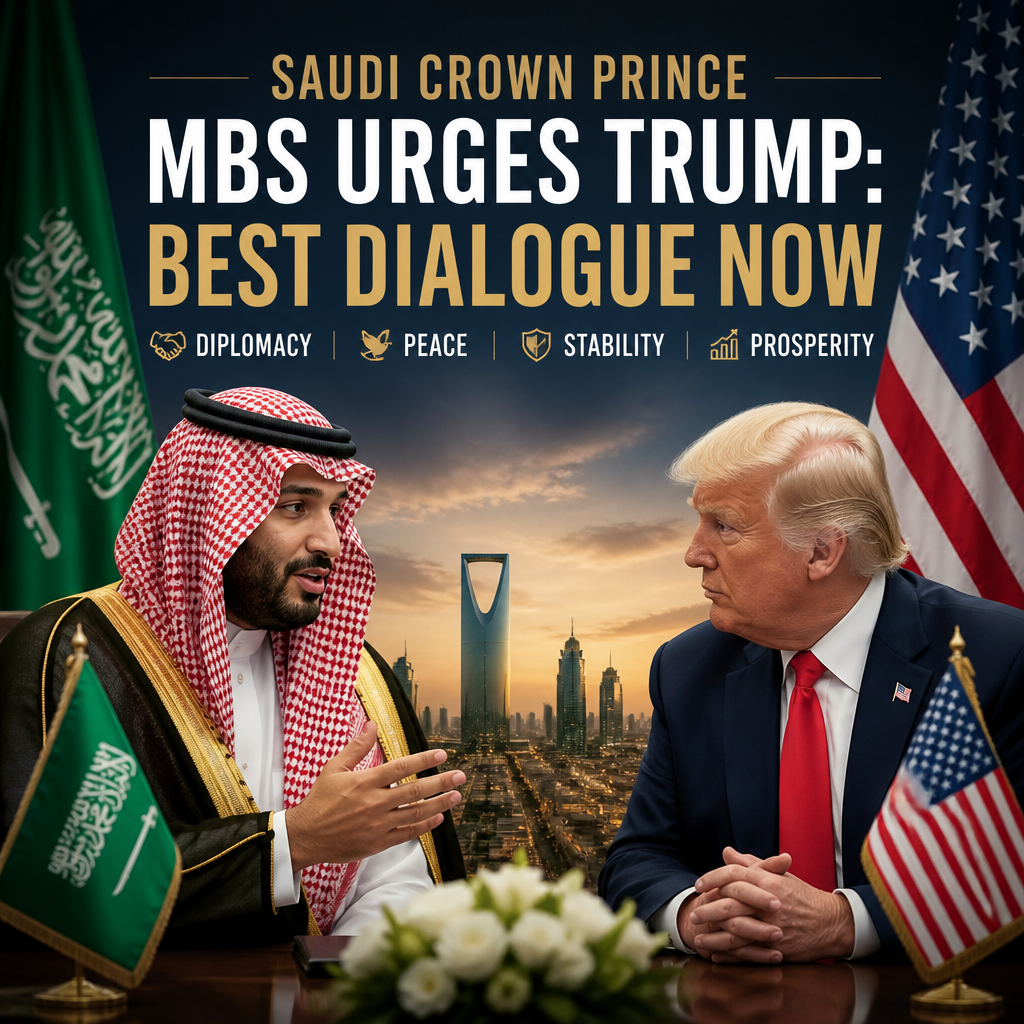
Saudi Crown Prince MBS Urges Trump: Best Dialogue Now


Saudi Crown Prince MBS has put diplomacy back at the center of one of the Middle East’s most dangerous flashpoints, urging Donald Trump to prioritize dialogue over escalation as tensions between the United States and Iran intensify. The message matters not just because it comes from Riyadh, but because Saudi Arabia has long been one of the region’s most exposed players whenever Washington and Tehran move closer to confrontation.
At face value, the prince’s appeal is straightforward: war would be costly, unpredictable, and difficult to contain. But the wider significance is more complicated. The call for talks reflects a broader Gulf reality in which leaders may distrust Iran, but they also understand that a direct U.S.-Iran clash could shake oil markets, threaten shipping routes, and destabilize the region far beyond the battlefield.



Why Saudi Arabia is pushing for dialogue
Saudi Arabia’s preference for de-escalation is not new, but the timing gives it extra weight. In recent years, Riyadh has worked to reduce regional friction, including through diplomatic engagement with Tehran. That shift does not mean the two countries have become friends. It does suggest that Saudi leaders increasingly see managed competition as less dangerous than open conflict.

That position is echoed in the way different news outlets frame the moment. Al Jazeera’s reporting emphasizes the diplomatic urgency and the risk that a hardline U.S. posture could widen the conflict. From that perspective, MBS is not simply offering advice to Trump; he is signaling that Gulf states would prefer a negotiated outcome to another round of regional military escalation.




Sky News, meanwhile, tends to place more emphasis on the strategic calculation behind such appeals. A Saudi request for dialogue is not naïve idealism. It is a practical attempt to protect national interests in a volatile environment. Saudi Arabia depends on stability for investment, energy exports, and the success of its long-term modernization plans. A war involving Iran would immediately jeopardize all three.
There is also a domestic dimension. Saudi leadership has spent years trying to present the kingdom as a forward-looking regional power, not just an oil state responding to crises. Supporting diplomacy fits that image. It allows Riyadh to appear statesmanlike while also keeping a safe distance from any confrontation that could drag in its own territory.
The Trump factor and the risk of mixed signals
Trump’s return to the center of this issue adds another layer of uncertainty. His foreign policy style has often combined threats, unpredictability, and deal-making language, which can make allies and rivals alike wonder what comes next. A message from MBS urging “best dialogue now” is therefore as much about shaping Trump’s instincts as it is about addressing Iran.
RT’s coverage, predictably, frames the story through a critical lens toward U.S. interventionism. From that angle, Saudi Arabia’s call reinforces the idea that even America’s traditional partners understand the danger of military pressure. RT often highlights the consequences of U.S. policy abroad, and this issue fits neatly into that narrative: a confrontation with Iran could spiral, and regional allies may be left to absorb the fallout.
Still, it would be too simple to say every actor wants the same thing. The United States may prefer deterrence, not war. Iran may welcome talks, but only on terms it finds acceptable. Saudi Arabia may want calm, but it also wants assurances that Iranian influence will not grow unchecked. In other words, “dialogue” is not a magic word; it is a starting point with very different meanings for each side.
What the main viewpoints suggest
Across the coverage, three broad perspectives stand out:
– Saudi/Gulf perspective: prevent escalation, protect regional stability, and keep economic transformation on track.
– Western security perspective: maintain pressure on Iran while trying to avoid a direct military conflict.
– Critical/international perspective: question whether U.S. coercion has ever produced lasting stability in the region.
These viewpoints do not completely contradict one another, but they do reveal the same underlying truth: nobody benefits from a large-scale war, even if many actors believe force or pressure can improve bargaining positions.
A cautious opening, not a solution
The most important thing about MBS’s intervention is that it reflects a narrow but real window for diplomacy. That window exists because the costs of war are obvious to nearly everyone involved. Markets would react immediately, regional security would deteriorate, and civilian suffering would likely rise fast.
But caution is still warranted. Calls for dialogue can be sincere and still fail. The history of U.S.-Iran relations is full of talks that stalled, promises that unraveled, and crises that deepened because neither side was willing to give ground at the right moment. Saudi Arabia knows this history better than most, which is why its emphasis on negotiation should be read as pragmatic, not optimistic.
The broader lesson is that regional powers are trying to influence the rules before the situation hardens. Riyadh wants to steer Trump toward bargaining, not bombing. Tehran wants relief and leverage. Washington wants control and credibility. Those goals overlap only partially, which is why the path forward remains uncertain.
For now, MBS’s message is best understood as a warning dressed as diplomacy: the time to talk is before events outrun the politicians. Whether Trump, Iran, and other regional players are willing to act on that warning is another question entirely.