Trump Iran Deal: Stunning Rift Over Tomorrow Signing


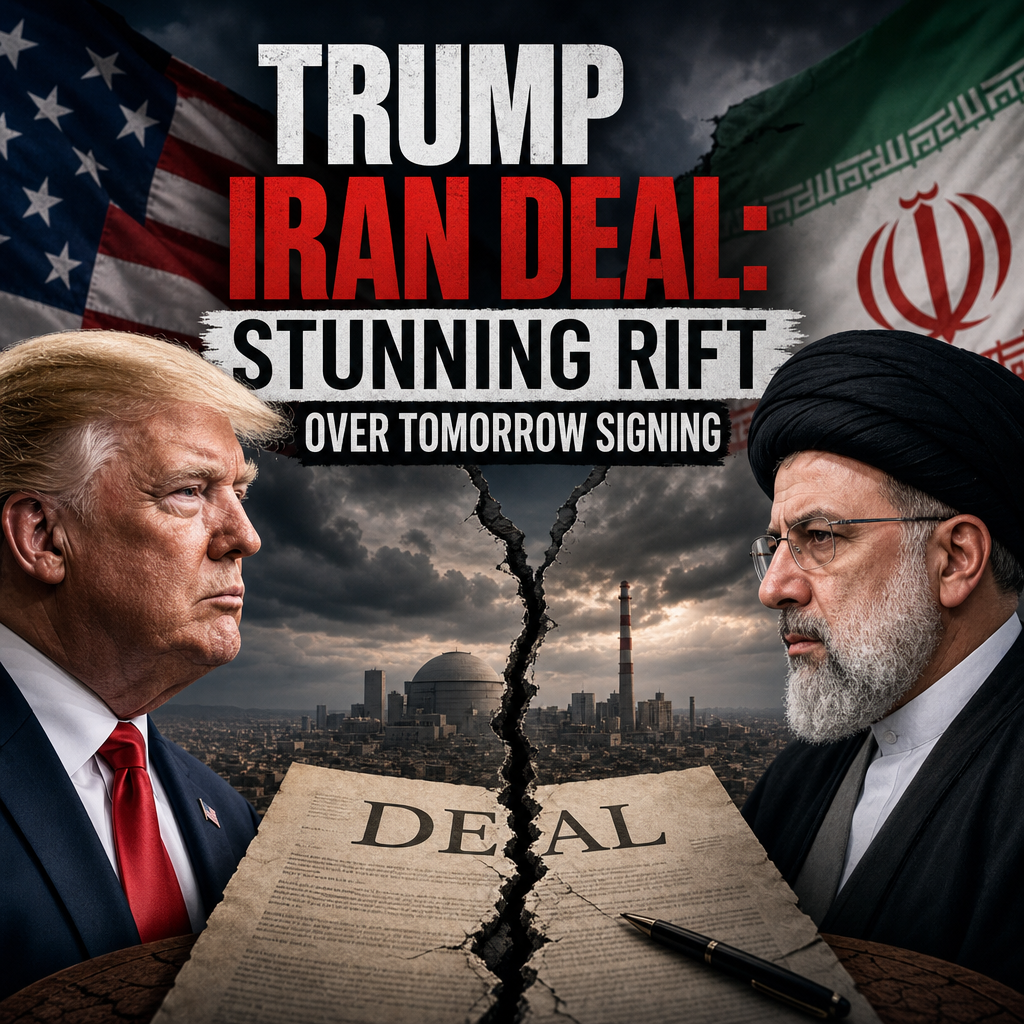
Trump Iran Deal talks have once again exposed how quickly diplomacy can collide with politics, with President Donald Trump saying an agreement would be signed “tomorrow” even as an Iranian official publicly pushed back on the claim.
What makes the latest episode striking is not only the disagreement itself, but the way it reflects a familiar pattern in U.S.-Iran relations: grand announcements, conflicting signals, and a deep credibility gap on both sides. At this stage, the most responsible reading is that a deal may be closer than before—or may simply be the subject of competing political messaging. Either way, the uncertainty is real.



Trump Iran Deal: the announcement and the contradiction
According to reporting from Al Jazeera, Trump told audiences that an Iran deal was set to be signed the following day. That statement immediately drew attention because it appeared to suggest a major breakthrough was imminent. But an Iranian official contradicted the claim, signaling that Tehran was not publicly confirming the same timeline or, possibly, even the same understanding of what had been negotiated.
That tension matters. In diplomacy, timing is never just timing. When a leader says an agreement will be signed “tomorrow,” it can signal confidence, a negotiating tactic, or an attempt to shape public expectations. When the other side refuses to echo that message, the result is confusion—and often suspicion.




A few points stand out:
– Trump’s statement suggests progress, but not necessarily finality.
– Iran’s contradiction suggests either disagreement over details or disagreement over the political framing.
– The gap between the two is large enough to cast doubt on how close any formal signing actually is.
In other words, the dispute is not simply about one sentence. It is about whether both sides are even talking about the same deal.
Why this standoff feels familiar
The Trump-Iran relationship has long been defined by abrupt shifts and high-stakes signaling. Previous negotiations over Iran’s nuclear program showed how quickly optimism could be followed by breakdowns, reversals, or accusations that the other side was negotiating in bad faith.
That broader history is important because it shapes how the latest claim is being interpreted. Some observers will see Trump’s comment as evidence that a real breakthrough is near. Others will view it as another example of overselling progress before the details are settled. Iranian officials, for their part, have every incentive to avoid appearing cornered into accepting an American narrative.
This is why the reaction from multiple news outlets is useful. Al Jazeera’s framing highlights the contradiction and the political sensitivity around it. Sky News coverage of the broader world context, as with many international outlets, tends to place emphasis on the implications for regional stability and Western diplomacy. RT’s angle, by contrast, often reflects a more skeptical view of U.S. claims and can underscore the possibility that Washington is using the announcement for strategic leverage rather than presenting a completed agreement.
Taken together, those perspectives do not produce a single clean answer. They do, however, reveal the central issue: the public story is not yet aligned with the diplomatic reality.
What a “deal” might actually mean
One reason this story is so hard to parse is that the word “deal” can mean very different things depending on who is speaking.
A deal could mean:
– a tentative framework
– an informal understanding
– a finalized text awaiting signatures
– a political signal meant to test reactions
– or a real breakthrough that still lacks full public disclosure
That ambiguity creates room for conflicting statements. Trump may be referring to a near-final arrangement that has not yet been formally announced by Iran. Iranian officials may be signaling that no binding agreement exists on their side, or that key terms remain unsettled. Either way, the public is left reading tea leaves.
This is where caution is essential. It would be premature to treat the announcement as proof of a finished agreement. At the same time, it would be equally premature to dismiss it entirely. In international negotiations, especially involving Iran, substance often lags behind rhetoric, and announcements sometimes come before the paperwork is complete.
The bigger stakes behind the headlines
The stakes here go far beyond one day’s news cycle. Any U.S.-Iran agreement touches on nuclear restrictions, sanctions relief, regional security, and domestic politics in both countries. Even a limited deal can have ripple effects across the Middle East, affecting allies, rivals, and global energy markets.
For Trump, a successful agreement could be framed as proof of dealmaking strength. For Iran, any settlement must be defensible at home and consistent with its strategic interests. That creates a narrow corridor for compromise. Both sides want to avoid looking weak, and that can make even modest progress look unstable.
There is also the question of trust. Iran has long argued that U.S. policy can change abruptly with a new administration. American critics, meanwhile, often say Iran uses delay and ambiguity to buy time. In that environment, a single contradictory statement is enough to reopen old doubts.
A cautious conclusion
The most balanced interpretation is that the Trump Iran Deal story is less about a finished agreement than about a contested diplomatic moment. Trump is projecting confidence. Iran is not validating that confidence. News coverage from different outlets reinforces that split: some emphasize momentum, others skepticism, and others the wider geopolitical consequences.
For now, the honest conclusion is that there is no fully reliable public consensus on what, exactly, will be signed—or whether signing is imminent at all. What is clear is that both sides understand the power of the announcement itself. In a relationship built on distrust, even the promise of a deal can become a battleground.
Until the documents appear and the terms are made public, the safest reading is simple: there may be movement, but the rift over what happens tomorrow shows that diplomacy is still unfinished.