Lebanon Attacks: Stunning Risk to US-Iran Deal


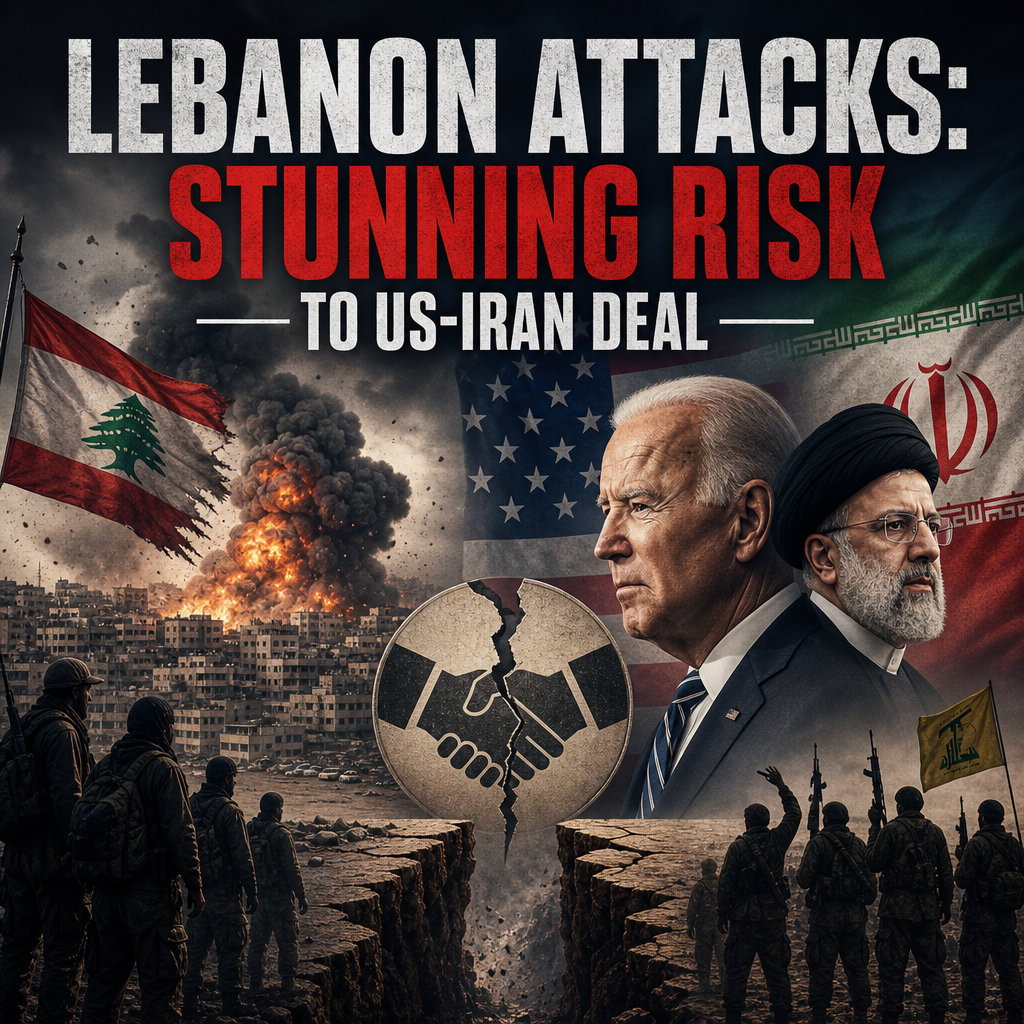
Lebanon Attacks: Stunning Risk to US-Iran Deal is becoming more than a headline — it is a reminder that fragile diplomacy in the Middle East can be derailed quickly when military escalation outpaces political negotiation.
The immediate concern is not just what happened in Lebanon, but what it signals: a widening regional confrontation that could make any behind-the-scenes US-Iran understanding harder to preserve. Across the reporting and commentary, one theme stands out clearly: even if Washington and Tehran are not close to a formal agreement, the space for compromise shrinks sharply when violence spreads and domestic pressure rises on both sides.



Why Lebanon matters so much in the US-Iran equation
Lebanon has long been one of the most sensitive pressure points in the broader US-Iran relationship. Iran’s influence over Hezbollah, the armed and political group deeply embedded in Lebanese life, means that any major attack there can quickly be interpreted as part of a wider contest rather than a local incident.
That is what makes the current situation especially dangerous. If attacks in Lebanon are seen as linked to the conflict between Israel and Hezbollah, then every side has incentives to harden its position. The US may feel pressure to support deterrence and protect its regional partners. Iran may feel pressure to respond indirectly through allies or by raising the diplomatic cost of cooperation. And Lebanese civilians, already caught in the middle, bear the largest share of the damage.




A key takeaway from the coverage is that escalation in Lebanon can undermine diplomacy in two ways at once:
– it creates more room for miscalculation on the ground;
– it reduces political flexibility in Washington and Tehran.
That matters because any US-Iran deal — whether formal, partial, or quiet and indirect — depends on restraint. Even limited progress becomes harder when leaders are forced to show toughness at home.
Different readings of the crisis: deterrence, leverage, and risk
The sources reflect at least three distinct viewpoints on what the attacks could mean.
1. The deterrence view
One view suggests the violence may be meant to deter further attacks or shift the balance of power. From this angle, strikes in Lebanon are not just about military targets; they are about signaling that the cost of escalation will be high. Supporters of this interpretation often argue that strong pressure can force actors back toward negotiation.
But that logic has limits. Deterrence can work when all sides believe the other side still wants to avoid a broader war. Once the conflict becomes emotionally and politically charged, the same pressure can produce the opposite result: retaliation, escalation, and less room for compromise.
2. The diplomatic leverage view
Another reading is that the crisis could be used as leverage in wider negotiations. In the Middle East, military events often bleed into diplomacy. A rise in tension can sometimes push parties to seek channels for de-escalation, especially if the costs of conflict become too high.
This is where the idea of a potential US-Iran deal becomes most complicated. If talks are already fragile, a spike in violence may create urgency — but urgency does not guarantee agreement. It can also narrow the agenda, force delays, or make concessions politically impossible.
3. The skepticism view
A more cautious perspective argues that expectations for a US-Iran deal may already be overstated. Under this reading, the Lebanon attacks are not so much the cause of diplomatic collapse as evidence that the underlying regional conflict was never resolved in the first place. In other words, talks may have been vulnerable even before the latest escalation.
That skepticism is important. It reminds readers that diplomatic progress in this arena is often partial, reversible, and highly dependent on quiet channels that do not always survive public escalation.
What the reports suggest about the bigger picture
Taken together, the reporting points to a fairly clear conclusion: the attacks in Lebanon are a serious threat to diplomatic momentum, even if they do not automatically kill it.
A few facts stand out:
– Lebanon is a frontline state in the broader US-Iran-Israel triangle.
– Hezbollah’s role makes the country strategically linked to Iran’s regional posture.
– Escalation tends to strengthen hardliners and weaken pragmatic voices.
– Any prospective deal between Washington and Tehran is likely to be indirect, limited, and vulnerable to spoilers.
The most useful way to understand the situation is not as a simple yes-or-no test for diplomacy, but as a stress test. If talks survive this moment, they will likely do so because both sides still see value in avoiding a wider war. If they fail, the reason may be less about one single attack and more about the cumulative effect of mistrust, domestic politics, and regional proxy conflict.
The real risk: misunderstanding the signal
The biggest danger may be in reading the attacks too narrowly. Some may view them as a local confrontation with limited diplomatic relevance. That would be a mistake. Others may assume they prove diplomacy is dead. That may also be too absolute.
The more balanced conclusion is that Lebanon is where several conflicts overlap: security, influence, deterrence, and negotiation. When those pressures rise together, the odds of a US-Iran breakthrough fall, but they do not disappear entirely. Diplomacy in such moments usually becomes less visible, more indirect, and far more fragile.
For now, the attacks in Lebanon are not just a military event. They are a warning that any US-Iran deal would have to survive a region where one flare-up can quickly reshape the whole strategic landscape.