
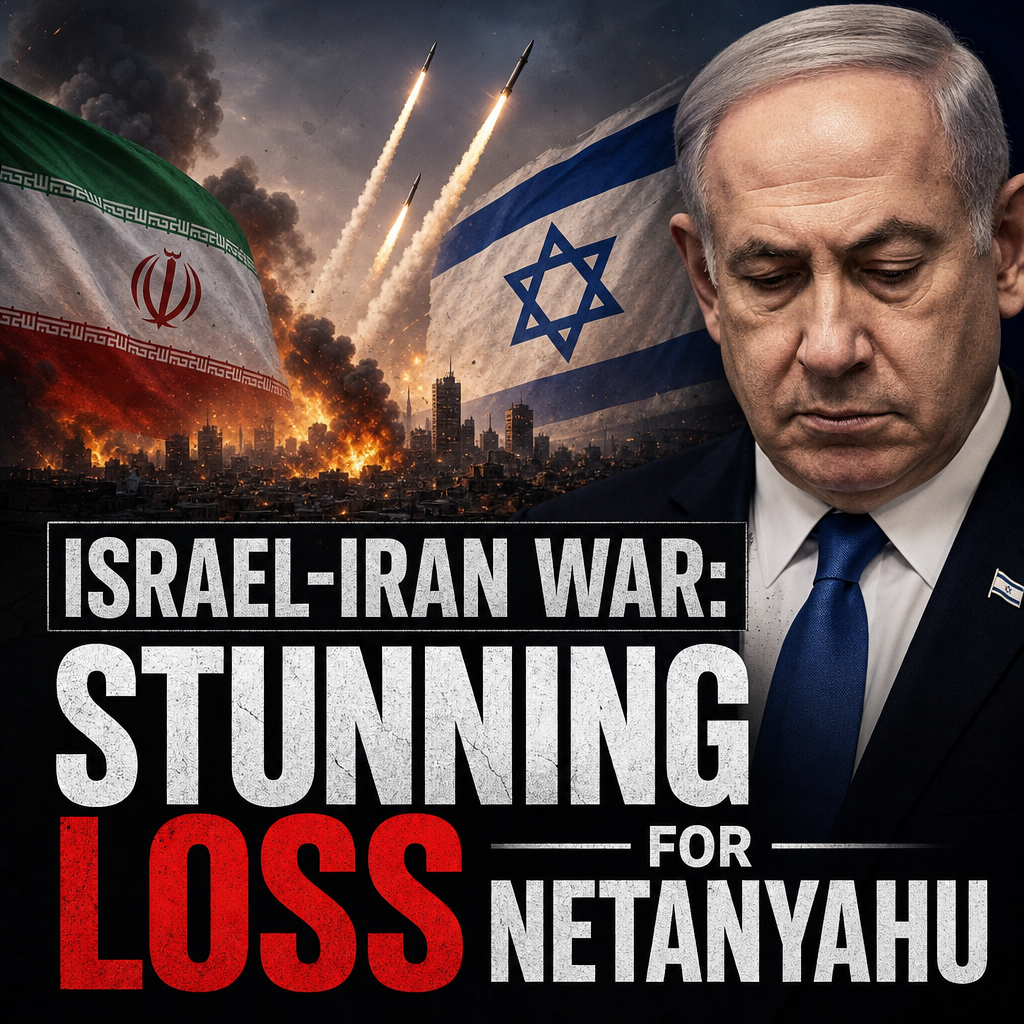
Israel-Iran War: Stunning Loss for Netanyahu


Israel-Iran war has exposed a sharp gap between Israel’s military ambitions and the political realities facing Prime Minister Benjamin Netanyahu.
What began as a campaign framed around deterrence, security, and restoring Israeli credibility has increasingly been judged through a different lens: whether the fighting has actually improved Israel’s strategic position, or instead deepened its isolation, expanded its risks, and weakened Netanyahu at home. Across international coverage, one theme stands out clearly even when the interpretations differ — the war may have delivered tactical blows, but the political outcome is far less certain.



A military campaign with an uncertain political payoff
Supporters of Israel’s approach argue that confronting Iran directly was always meant to send a message. Tehran’s regional influence, its backing of armed groups, and its missile and drone capacity have long been seen in Israel as a growing threat. From that perspective, the war can be presented as a necessary display of force, intended to disrupt Iran’s confidence and show that Israel will not absorb attacks indefinitely.
But the harder question is whether such a campaign translated into durable gains. Even when Israeli strikes are effective, they do not automatically create security. They can also trigger retaliation, widen the conflict, and place civilian populations under prolonged threat. That is where the political critique of Netanyahu has sharpened. A leader who promised strength and safety is now judged not only by battlefield performance, but by whether the war has made Israelis more secure in the medium term.




Several news perspectives point to the same tension: Israel may have demonstrated reach, yet it has not eliminated the underlying confrontation with Iran. That leaves Netanyahu vulnerable to the charge that the war is less a solution than an escalation.
Why the domestic political cost may be the bigger story
At home, Netanyahu’s opponents are likely to argue that the war has magnified, not resolved, the leadership crisis around him. He has long relied on a reputation as Israel’s most experienced security hawk, but wars are risky tests of that image. If the public sees a conflict that is costly, open-ended, or diplomatically damaging, the same strength narrative can quickly flip into a weakness.
There are several reasons this matters:
– Public fatigue: prolonged conflict can erode confidence, especially if civilians remain exposed to missile threats or emergency conditions.
– Leadership scrutiny: wartime decisions are judged more harshly when results are unclear.
– Coalition pressure: Netanyahu has to keep together a fragile political base while responding to military demands and public anxiety.
– Strategic doubts: some Israelis may ask whether direct confrontation with Iran improves security or simply expands the list of enemies.
That does not mean the war has been a straightforward political disaster for Netanyahu. In times of war, leaders often benefit from a rally-around-the-flag effect. But that effect is usually temporary. If the conflict drags on without a convincing victory, the political costs can become more visible than the initial surge of national unity.
International reactions reveal the deeper divide
Israel-Iran war and the battle over interpretation
One of the most revealing aspects of the coverage is that different media outlets frame the same conflict in sharply different ways. Al Jazeera’s analysis tends to emphasize the human and political costs of escalation, especially for Palestinians and regional stability. Its reporting often places Netanyahu within a broader critique of Israeli military policy and the long-term consequences of using force as the primary tool of strategy.
By contrast, Sky News coverage is more likely to focus on the immediate military and diplomatic implications: the risk of further strikes, the possibility of regional spillover, and the pressure on Western governments to respond. This framing usually treats the war as a serious security crisis first, and a political story second.
RT, meanwhile, often highlights the wider geopolitical fallout and the hypocrisy or double standards of major powers. Its perspective can be more skeptical of Western narratives about legitimacy and self-defense, and more willing to underline how the conflict reflects a broader collapse in regional trust.
Taken together, these viewpoints help explain why Netanyahu’s position is so unstable. To his critics, the war shows the limits of military power and the dangers of political overreach. To his defenders, it is a necessary if painful response to an existential threat. Both camps can point to evidence — which is exactly why the final judgment remains contested.
What remains uncertain
The biggest uncertainty is whether the conflict will produce a strategic recalibration or simply another cycle of retaliation. If Israel succeeds in degrading Iranian capabilities while avoiding further regional escalation, Netanyahu could claim that the campaign was justified. If, however, the war expands, drags on, or fails to deliver clear security benefits, the political cost could be severe.
There is also the question of credibility. Leaders often frame war as proof of deterrence, but deterrence is not measured by rhetoric alone. It is measured by whether opponents become less willing to act. If Iran and its allies conclude that the confrontation only proves Israel is trapped in a cycle of escalation, then Netanyahu’s gamble may have weakened the very deterrent posture it was meant to strengthen.
A victory that may not feel like one
The irony is that Netanyahu may still claim tactical success while suffering a deeper strategic loss. That is the paradox at the heart of the Israel-Iran war: a government can strike hard, speak forcefully, and still end up looking less secure than before. For a prime minister who has built much of his political identity on hardline credibility, that is a dangerous outcome.
What makes this moment so consequential is not just the violence itself, but the possibility that the war has exposed the limits of force as political strategy. If the public concludes that Netanyahu has taken Israel into a fight that neither neutralizes Iran nor improves Israeli safety, then the loss will be larger than a battlefield setback. It will be a judgment on leadership.

























