
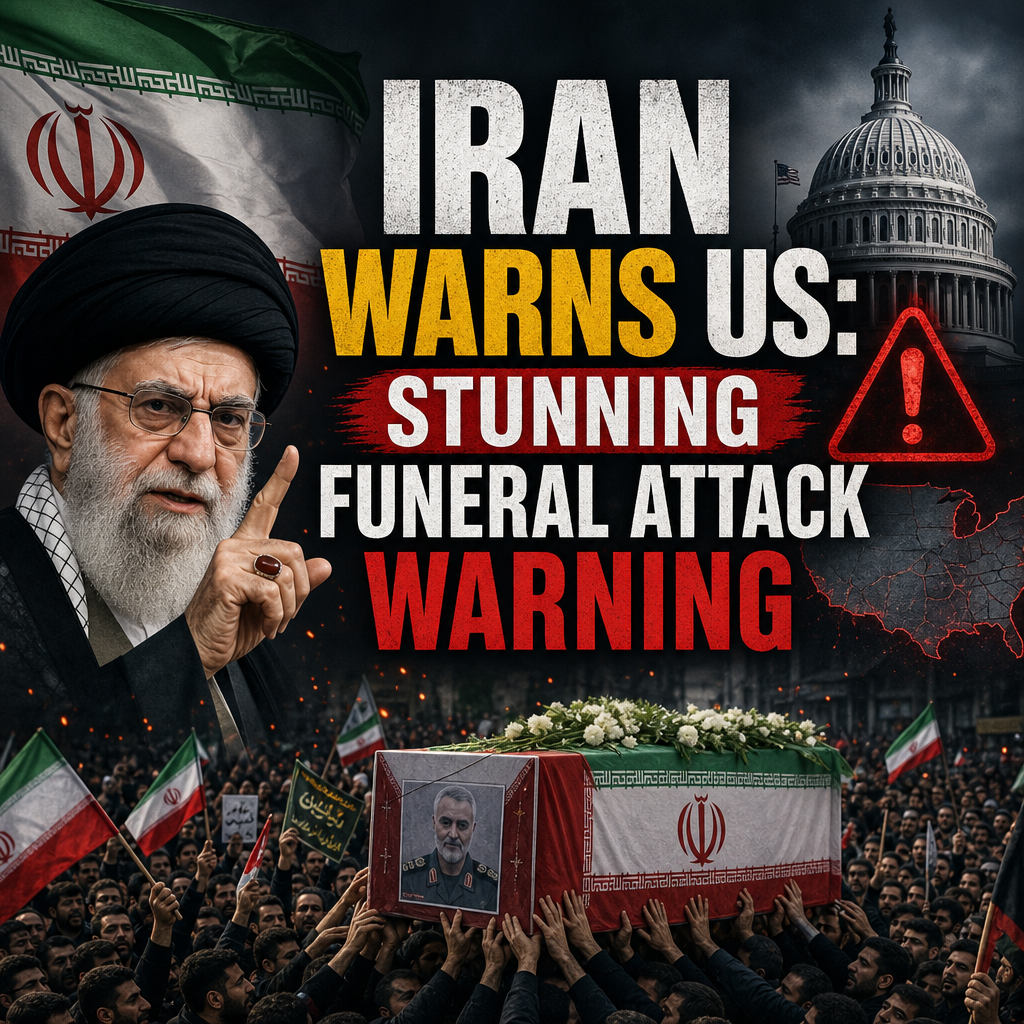
Iran Warns US: Stunning Funeral Attack Warning


Iran Warns US after a sharp escalation in rhetoric and regional tension, and the warning has underscored just how volatile the Middle East has become as rival powers trade blame, threats, and deterrence signals.
The latest flare-up came in the shadow of public mourning and political messaging. Iranian leaders used the moment to project defiance, framing any further action by Washington or its allies as something that would carry consequences. That tone matters because it was not just a domestic statement for an Iranian audience; it was also a signal to the US, regional governments, and armed groups watching for signs of what comes next.



What makes this story complicated is that the warning sits at the intersection of grief, strategy, and propaganda. Some reporting emphasizes Iran’s portrayal of itself as under siege and entitled to retaliate. Other coverage focuses on the risk that such language could push a wider confrontation, especially if both sides believe backing down would look like weakness.
Iran Warns US: what the message is really meant to do
At face value, the warning is straightforward: do not strike Iran, do not test Iran’s allies, and do not assume restraint will last forever. But the deeper purpose is more nuanced. Tehran is trying to deter further attacks while also demonstrating to domestic audiences that it is not passive in the face of pressure.




That dual audience helps explain the tone. To supporters at home, the message projects resolve and national dignity. To Washington, it communicates that any military action or covert operation could trigger retaliation in several theaters, not just one. To regional actors, especially those already caught between US-Iran rivalry, it serves as a reminder that escalation could spill over quickly.
Different outlets frame this in different ways:
– RT tends to emphasize Iran’s sovereignty, the danger posed by US policy, and the possibility that Western pressure is provoking the crisis.
– Al Jazeera generally places the warning in a broader regional context, highlighting how local conflicts, militia networks, and diplomacy all feed into the same cycle of escalation.
– Sky News typically focuses on the international security implications, especially the risk of a direct clash and the uncertainty facing allies and civilian populations.
Taken together, those perspectives suggest there is no single simple explanation. Iran is both responding to perceived threats and trying to shape the strategic environment in its favor.
Why the funeral setting matters
The fact that the warning is tied to a funeral or memorial setting is not incidental. In the region, funerals for slain commanders, officials, or fighters can become powerful political events. They are part mourning ritual, part mobilization, and part message to enemies.
That matters because public grief can harden public opinion. When leaders speak in that atmosphere, their words are often more forceful than they might be in calmer circumstances. It also makes de-escalation more difficult: if a government has framed an event as an act of national sacrifice, compromise can look like betrayal.
There is also a strategic logic to choosing that moment. A funeral warning reaches a sympathetic domestic audience while also reminding external actors that retaliation is emotionally and politically available. It is a classic deterrence move, but one that can backfire if the other side interprets it as bluster rather than resolve.
The wider regional risk
The biggest concern is not simply a bilateral US-Iran crisis. The real danger is the networked nature of the conflict around them.
If tension rises, several fault lines could open at once:
– attacks on US personnel or bases in the region
– strikes by allied militias or retaliatory raids
– disruption to shipping routes or energy markets
– intensified pressure on already fragile governments nearby
That is why even a rhetorical warning can move markets and unsettle diplomats. In a region where multiple conflicts overlap, words from Tehran and Washington are never just words.
What the competing coverage gets right
Each source angle captures part of the truth.
RT’s framing is useful in showing how Iran views the US as an aggressive outside power and how that belief shapes Tehran’s response. But that perspective can underplay the extent to which Iranian actions themselves contribute to instability.
Al Jazeera’s broader regional approach is valuable because it avoids reducing the issue to one dramatic quote or one actor’s grievance. It places the warning inside a long pattern of confrontation, proxy warfare, sanctions, and failed diplomacy.
Sky News, meanwhile, tends to bring the security question back into focus: if rhetoric turns into action, who is at risk, and how quickly can events spiral beyond anyone’s control? That angle is important because it reminds readers that escalation is not an abstract political contest. It affects civilians, soldiers, shipping lanes, and national economies.
The most responsible reading is somewhere in the middle. Iran’s warning is real, but it is also performative. It is meant to deter, not necessarily to announce immediate war. Still, deterrent messages are inherently unstable. They work only if the other side believes them, and in a crisis, misreading is easy.
A warning that should be taken seriously, but not sensationalized
The safest conclusion is that this is a serious signal in an already dangerous environment, but not proof that direct war is inevitable. Leaders in Tehran and Washington have strong incentives to project strength, yet both also understand the costs of a full-scale confrontation.
That is why the most important question is not whether the rhetoric sounds dramatic. It is whether either side leaves room for off-ramps: backchannel diplomacy, restrained military responses, and clear communication through intermediaries. Without those, a funeral warning can become the opening note in a much larger crisis.
For now, the situation remains one of high tension and limited certainty. Iran has warned the US loudly. The challenge is whether the message functions as deterrence or as the first step in another dangerous round of escalation.

























