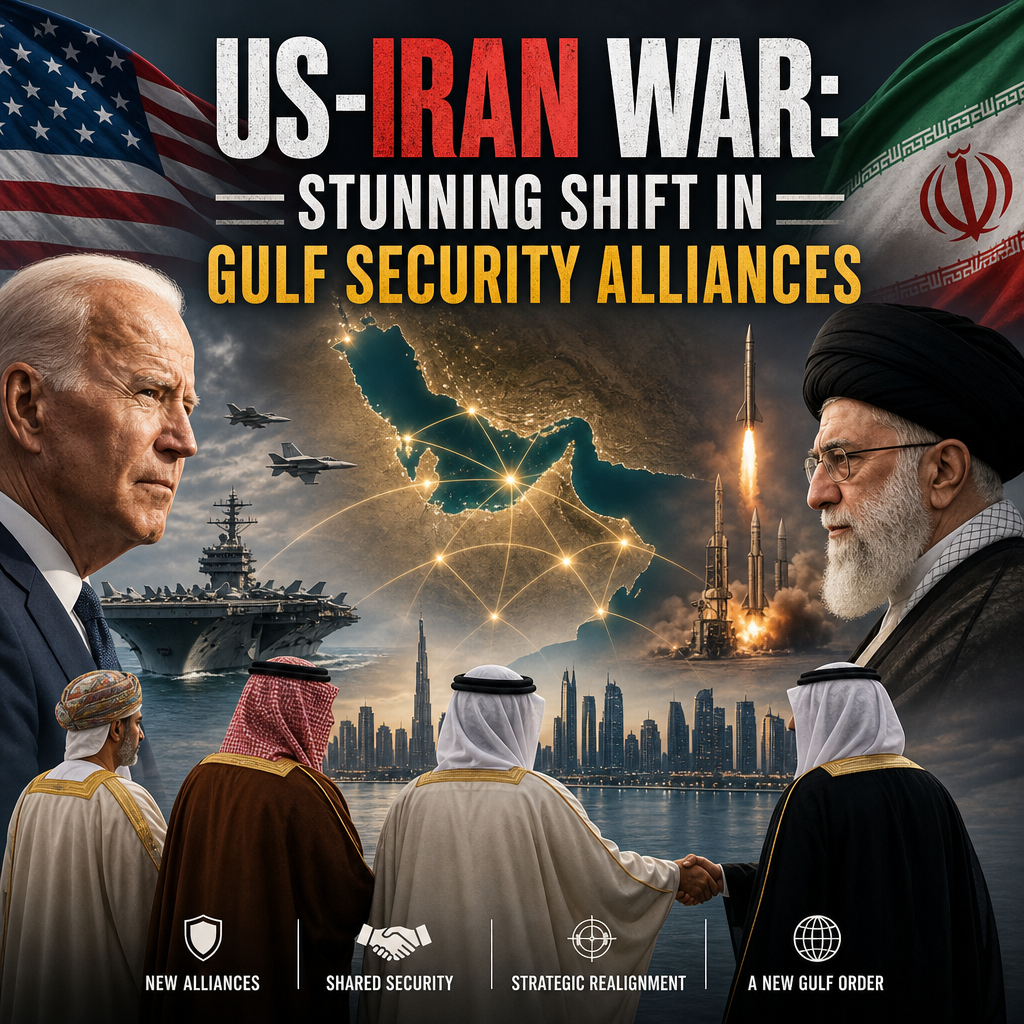
US-Iran War: Stunning Shift in Gulf Security Alliances


US-Iran war has jolted Gulf capitals into a hard reality: the region’s long-standing reliance on Washington for security may no longer feel sufficient, predictable, or even politically wise.
For decades, Gulf monarchies built their defense posture around a simple assumption: the United States would remain the ultimate backstop against major threats, especially from Iran. But as fighting escalates and the costs of direct confrontation grow, that assumption is being tested. Across the region, officials and analysts are increasingly talking not just about military balance, but about risk management, strategic hedging, and the need to avoid being pulled into a wider war.



The emerging picture is not one of an outright break with the US. It is more subtle than that. Gulf states still depend on American air power, missile defense, intelligence cooperation, and arms supplies. Yet the war is accelerating a trend already underway: diversification. In practice, that means widening diplomatic channels, deepening regional security coordination, and keeping open lines with powers such as China and Russia, even while preserving core ties to Washington.
US-Iran war and the end of one-dimensional security thinking
The most important shift is psychological. The Gulf’s security debate is no longer framed around choosing the “right patron” and sticking with it. Instead, leaders appear to be asking how to avoid overdependence on any single external protector.




That concern is visible in several overlapping developments:
– Greater interest in regional de-escalation mechanisms
– More emphasis on domestic air defense and missile interception
– Expanded dialogue with non-Western powers
– A stronger push to reduce exposure to sudden policy changes in Washington
This does not mean Gulf states believe the US is abandoning them. Rather, many are wary of the possibility that American strategy could become less reliable due to domestic politics, shifting global priorities, or a desire to avoid another large Middle East war. Sky News coverage of the conflict’s wider implications has underscored that regional actors are watching not only battlefield developments, but also whether the US can deter escalation without becoming trapped in it.
That uncertainty matters. For Gulf governments, the greatest fear is not just direct attack from Iran or its aligned groups, but economic disruption, infrastructure strikes, and the possibility that a confrontation could spread across maritime chokepoints and energy corridors. In that environment, security means more than missiles and jets; it means supply chains, shipping lanes, cyber defense, and diplomatic flexibility.
Why Gulf states are looking beyond Washington
A key theme in reporting from multiple outlets is that Gulf states are not necessarily turning away from the US so much as refusing to rely exclusively on it. Al Jazeera’s analysis points to a pragmatic response: the war could push regional governments to diversify security alliances because the old order now looks less stable than before.
That diversification is likely to take several forms.
1) Stronger regional coordination
Some Gulf states may seek deeper security cooperation among themselves and with neighboring Arab countries. While these arrangements cannot replace US capabilities, they can improve early warning, border security, and crisis coordination. The logic is simple: if outside powers are distracted or politically constrained, regional states need more of their own capacity.
2) Broader diplomatic hedging
China’s growing role as a trade partner and Russia’s continuing influence in regional diplomacy make both attractive as balancing tools, even if neither can match the US militarily in the Gulf. These ties are less about substitution than leverage. By keeping multiple powers engaged, Gulf governments reduce the risk of being boxed into one strategic camp.
3) A renewed focus on deterrence
The war has also renewed interest in practical defense measures. That includes integrated air and missile defenses, hardened infrastructure, and faster decision-making in crises. For many Gulf leaders, the lesson is clear: alliances matter, but so do local capabilities.
RT’s coverage of Middle East tensions has tended to frame the crisis as evidence of wider Western failure and the dangers of US intervention. Even when readers reject that framing, it reflects an important reality in the region: skepticism toward American strategy is not limited to adversaries of Washington. Many regional officials privately worry that great-power politics can generate instability faster than it can solve it.
The limits of diversification
Still, diversification has limits. No alternative partner currently offers the same combination of military reach, intelligence sharing, command infrastructure, and longstanding basing arrangements that the US provides. China may offer economic weight and diplomatic visibility, but not a Gulf-wide defense umbrella. Russia, meanwhile, is constrained by its own geopolitical commitments and capacity.
That means the likely future is not a clean pivot away from the US, but a layered security model. The Gulf’s strongest states may try to keep the American relationship intact while adding new options around the edges. This is less dramatic than a realignment, but in strategic terms it is still significant.
There is also a political risk. If Gulf states hedge too aggressively, they could invite mistrust from Washington without receiving full protection from alternatives. If they hedge too little, they may remain exposed to the very volatility they are trying to escape. That balancing act will define the next phase of Gulf diplomacy.
A more cautious Gulf, not a fully new order
The broader conclusion is that the US-Iran war is not simply redrawing alliances overnight. It is exposing how fragile the old security formula has become. Gulf states still want American deterrence, but they increasingly want insurance against American unpredictability too.
That is the real “stunning shift” beneath the headlines: not a dramatic rupture, but a strategic awakening. The Gulf is moving toward a world in which security is assembled from multiple relationships, not inherited from one superpower alone. Whether that makes the region safer will depend on whether diversification produces balance — or merely a more crowded, more complicated rivalry.