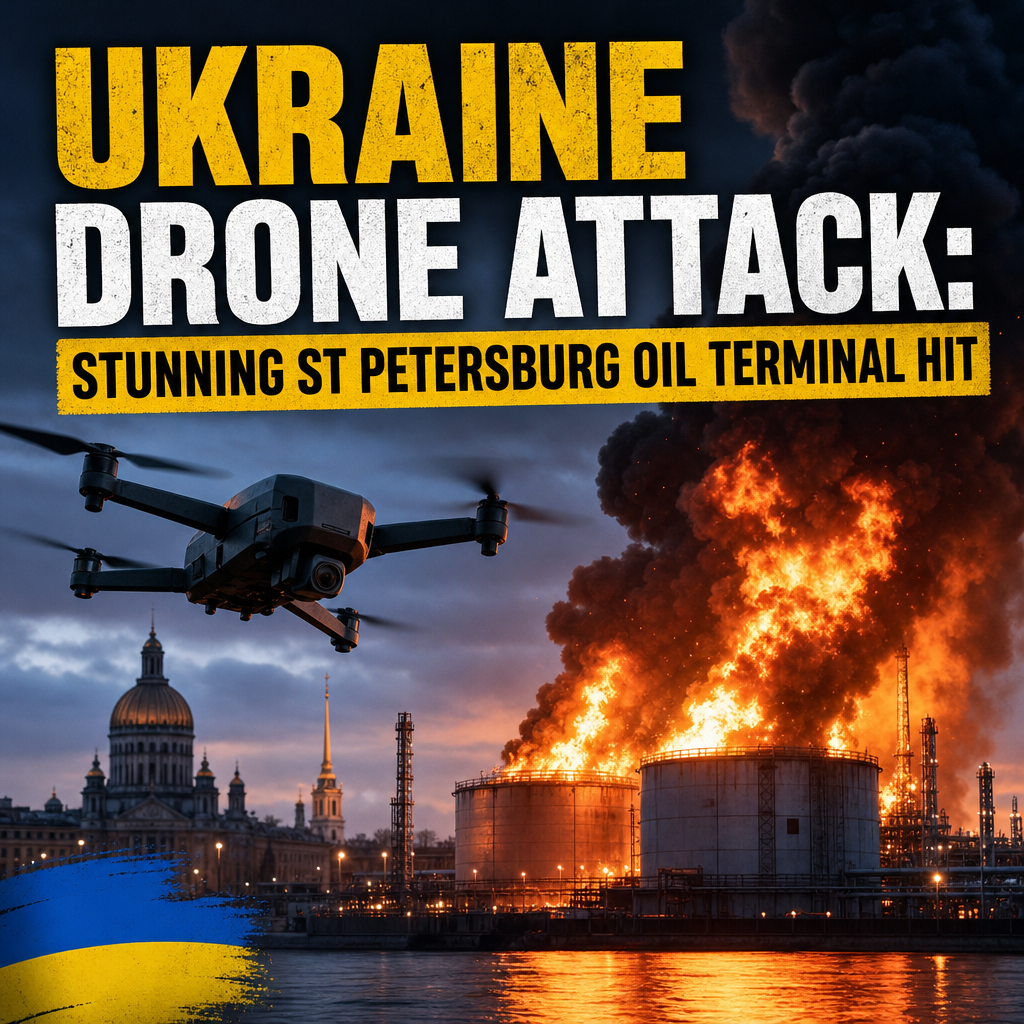
Ukraine Drone Attack: Stunning St Petersburg Oil Terminal Hit


Ukraine drone attack on Russia’s energy infrastructure has once again exposed how the war is widening beyond the front line, with reports that a major facility in St Petersburg was struck in one of Kyiv’s largest cross-border drone operations so far. The incident matters not only because of the target itself, but because it shows how Ukraine is increasingly willing to bring the costs of war deeper into Russian territory while Moscow tries to frame such strikes as limited, containable, or mostly symbolic.
A strike with military, economic and political meaning
According to reporting from Sky News and other international coverage, the St Petersburg oil terminal was hit as part of a larger wave of drone attacks aimed at Russian territory. That fits a pattern seen repeatedly over the past year: Ukraine has used long-range drones to pressure Russian logistics, energy facilities, air bases and industrial sites, hoping to complicate Moscow’s war effort and demonstrate that geography no longer provides the same protection it once did.



From Kyiv’s perspective, strikes like this serve several purposes at once:
– they disrupt fuel handling and storage facilities that support Russia’s military and economy;
– they force Moscow to divert air-defense systems away from the front line;
– they signal that Russia’s northern cities and critical assets are vulnerable;
– they help Ukraine show domestic and international audiences that it can still take the initiative.




But the broader significance is not simply tactical. An attack near St Petersburg carries political weight because it reaches into one of Russia’s most symbolically important regions. Even when the physical damage is limited, the message is hard to miss: the war is no longer confined to occupied Ukrainian territory or border regions.
At the same time, it is important to be careful with claims about the scale of damage. Russian officials often say their air defenses intercept most incoming drones, while Ukrainian officials tend to emphasize disruption and strategic effect rather than detailed battle-damage assessments. Independent verification is often difficult in real time, especially when both sides have an incentive to shape the narrative.
Different lenses on the same event
The reaction to the strike is sharply shaped by where the story is being told from. Sky News’ framing focuses on the operational scale of the attack and the symbolic impact of hitting a major oil terminal. Al Jazeera’s broader war coverage tends to place such incidents within the continuing cycle of escalation, reminding readers that each Ukrainian strike is usually answered by Russian missile and drone attacks on Ukrainian cities, energy networks and infrastructure. RT, by contrast, typically presents these incidents through a Russian security lens, emphasizing the danger to civilians, the resilience of Russian defenses and the idea that Western support enables Ukrainian attacks on Russian soil.
That contrast matters because it shows how the same event can be interpreted in radically different ways:
Kyiv’s argument
Ukraine and its supporters generally portray these strikes as legitimate acts of self-defense against a larger aggressor. Since Russia invaded Ukraine and has continued to target civilian infrastructure, Kyiv argues it has the right to hit assets that support the war machine. In that view, oil terminals, depots and refineries are not just economic sites; they are part of the machinery sustaining the invasion.
Moscow’s argument
Russia presents the attacks as evidence that Ukraine is escalating beyond the battlefield and threatening ordinary Russians. Officials regularly describe drone strikes as terrorism or reckless provocations, especially when they occur far from the frontline. The Kremlin also uses them to justify tighter internal security measures and to reinforce a message of national siege.
The international dilemma
For outside observers, the challenge is that both claims can contain elements of truth. A fuel terminal can be a legitimate military target if it supports the war effort. But strikes near populated areas also raise the risk of civilian harm, panic and wider retaliation. That is why international reactions often sound cautious: there is recognition of Ukraine’s need to defend itself, but also concern that longer-range strikes could lead to further escalation.
What this means for the war ahead
The St Petersburg oil terminal strike suggests Ukraine’s drone campaign is becoming more ambitious and more technically capable. That does not mean it will decisively change the war on its own. Russia still has depth, air defenses and the ability to absorb damage. But persistent attacks on energy infrastructure can create friction, force costly repairs and complicate military planning.
There are also limits to what drones can achieve. Even a highly successful strike may not produce lasting strategic damage unless it is part of a sustained campaign with follow-up pressure. Russia has repeatedly shown that it can repair, reroute and adapt, even if slowly and at significant cost. In other words, a dramatic hit is not the same thing as a war-winning blow.
Still, these attacks matter because they shape the psychology of the conflict. They remind Russian authorities that distance offers no guarantee. They reassure Ukrainians that their military can still impose costs. And they tell the rest of the world that the war is entering a more unpredictable phase, where energy assets, logistics hubs and domestic infrastructure are all part of the battlefield.
The biggest uncertainty is how Moscow will respond. It could intensify strikes on Ukrainian energy systems, expand drone production, tighten internal defenses around key cities, or all three. That makes the St Petersburg strike less a standalone event than part of a dangerous cycle of action and retaliation.
For now, the clearest conclusion is this: the Ukraine drone attack on the St Petersburg oil terminal is both a tactical operation and a strategic signal. It shows Ukraine’s growing reach, Russia’s vulnerability, and the grim reality that neither side appears close to reducing the war’s tempo.