
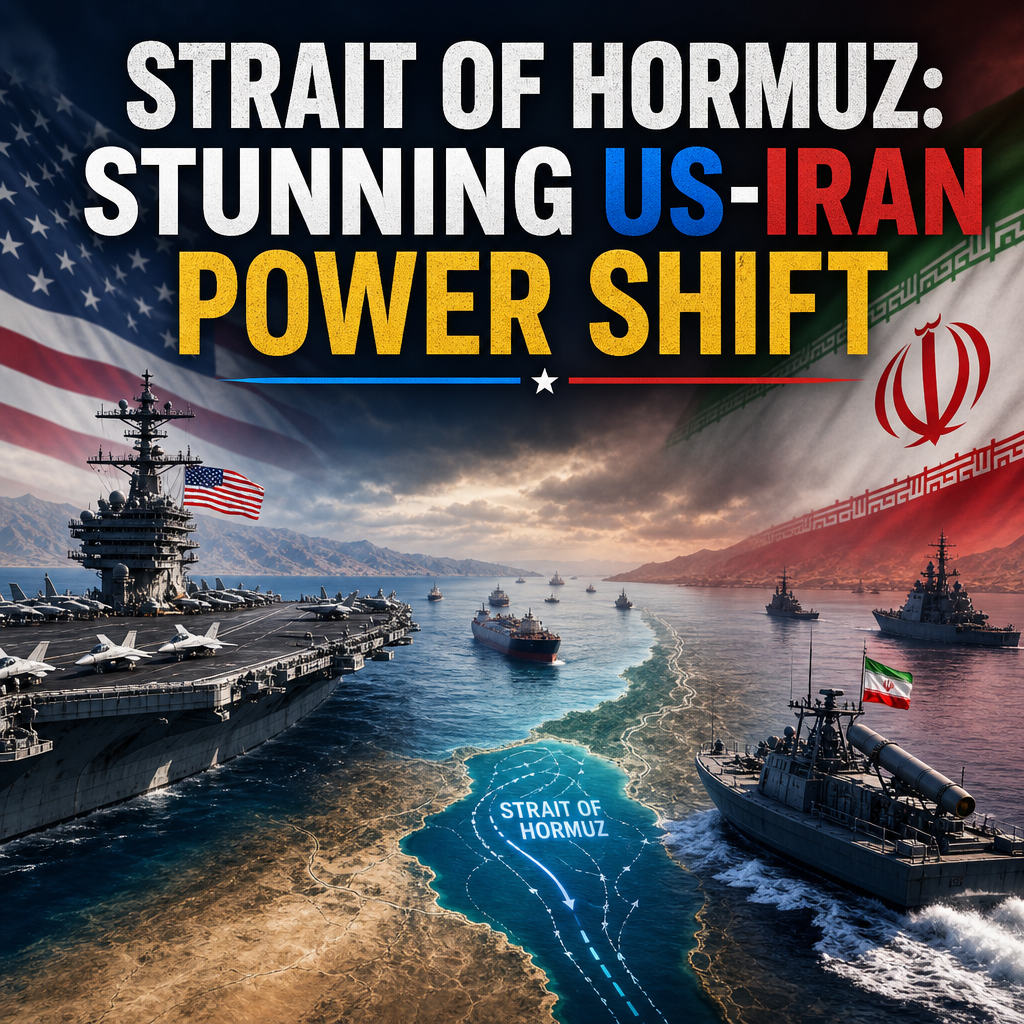
Strait of Hormuz: Stunning US-Iran Power Shift


Strait of Hormuz sits at the center of a fresh and uneasy recalculation between Washington and Tehran, where military signaling, shipping risk, and regional politics are once again colliding.
What makes this moment different is not just the familiar threat of disruption in one of the world’s most important energy chokepoints, but the sense that both the United States and Iran are trying to shape the other’s options without sliding into a war neither appears eager to fight. Recent commentary across international outlets points to the same basic reality: the Strait remains a pressure valve for crisis, but also a place where bluff, deterrence, and miscalculation can all become dangerously expensive.



Why the Strait of Hormuz still matters so much
The Strait of Hormuz is narrow, strategically vulnerable, and economically global. Roughly a fifth of the world’s oil trade still passes through or near this corridor, making it one of the few places where a regional confrontation can have instant worldwide consequences. That is why even limited incidents—ship seizures, drone activity, missile alerts, or naval escorts—can ripple far beyond the Gulf.
For Iran, the Strait is one of its few enduring sources of leverage. It cannot match the United States ship for ship, but it can threaten disruption, raise insurance costs, and keep rivals guessing. For the US and its partners, the goal is to keep the waterway open while avoiding actions that hand Tehran the political victory of claiming resistance to foreign pressure.




The result is a delicate balance: neither side wants to look weak, yet both know that a direct confrontation around the Strait could trigger consequences that quickly outgrow the original dispute.
A power shift, but not a clean one
The phrase “power shift” can be misleading if it suggests a simple winner and loser. The more accurate picture is a shift in the way power is being used.
The US still has overwhelming conventional military superiority, plus alliances, surveillance, and the ability to project force far from home. But Iran has spent years building a strategy designed to exploit asymmetry. That includes fast boats, anti-ship missiles, drones, proxy relationships, and the ability to make maritime trade more costly and uncertain.
In other words, Washington may still have the stronger hand on paper, but Tehran has retained the ability to turn the Strait into a strategic headache. That is a kind of power, even if it is not the same kind of power.
US-Iran tensions are being shaped by restraint as much as force
One of the clearest themes emerging from recent coverage is restraint. Both sides have reasons to avoid crossing the line from pressure into open conflict.
The US has learned, after years of Middle East entanglements, that military escalation rarely stays contained. Even a limited strike meant to restore deterrence can invite retaliation against shipping, bases, or regional partners. Meanwhile, Iran knows that a major closure attempt in the Strait would almost certainly bring a punishing response and could damage its own economy as much as anyone else’s.
That creates a strange kind of stability: a tense, fragile equilibrium built on the understanding that escalation is possible, but costly.
What different media lenses emphasize
Looking across the range of commentary from the cited sources, the emphasis differs in revealing ways:
– Some analysis frames the Strait primarily as a test of American credibility and deterrence.
– Other coverage focuses on Iran’s ability to convert geography into leverage despite sanctions and military pressure.
– International reporting also highlights the commercial angle: shipping firms, insurers, and energy markets often react faster than diplomats do.
Taken together, these viewpoints suggest that the conflict is not just about guns and ships. It is also about perception—who looks in control, who seems cautious, and who can make the other side absorb uncertainty without paying too high a price.
The real risk is miscalculation, not just confrontation
The most worrying scenario is not necessarily a deliberate attempt to close the Strait, but a chain of events that spirals faster than leaders expect. A misread naval maneuver, an intercepted vessel, a drone incident, or a retaliatory strike could all generate pressure for a stronger response.
That danger is heightened because both Washington and Tehran have domestic audiences to consider. Leaders in each capital may feel compelled to project confidence even when their broader interest is to de-escalate. In such environments, public posturing can narrow diplomatic room precisely when it is most needed.
There is also a broader regional factor. Gulf states want stability for trade and investment, but they are also wary of being caught in a US-Iran clash. Their preference is usually for deterrence without war, which helps explain why regional diplomacy often runs in parallel with military posturing.
What a balanced reading suggests
A fair assessment is that neither side currently has a clean strategic breakthrough.
The US retains the stronger overall military and diplomatic position, but Iran has not become irrelevant; it has adapted in ways that make coercion more complicated. At the same time, Iran’s leverage is real but limited. It can raise the cost of confrontation, but not eliminate the risks to itself if it pushes too far.
That is why the Strait of Hormuz remains less a symbol of total control than a barometer of pressure. It reveals how much each side is willing to risk, how much restraint it can sell at home, and how much uncertainty the global economy can tolerate.
For now, the “stunning” shift is not that one side has decisively won. It is that the balance of power has become more conditional, more fragile, and more dependent on signaling than ever. The Strait remains open, but only just: a reminder that in today’s Gulf geopolitics, deterrence is often the difference between a tense standoff and a much larger crisis.

























