Trump Iran Strike Comments: Stunning Brent Crude High


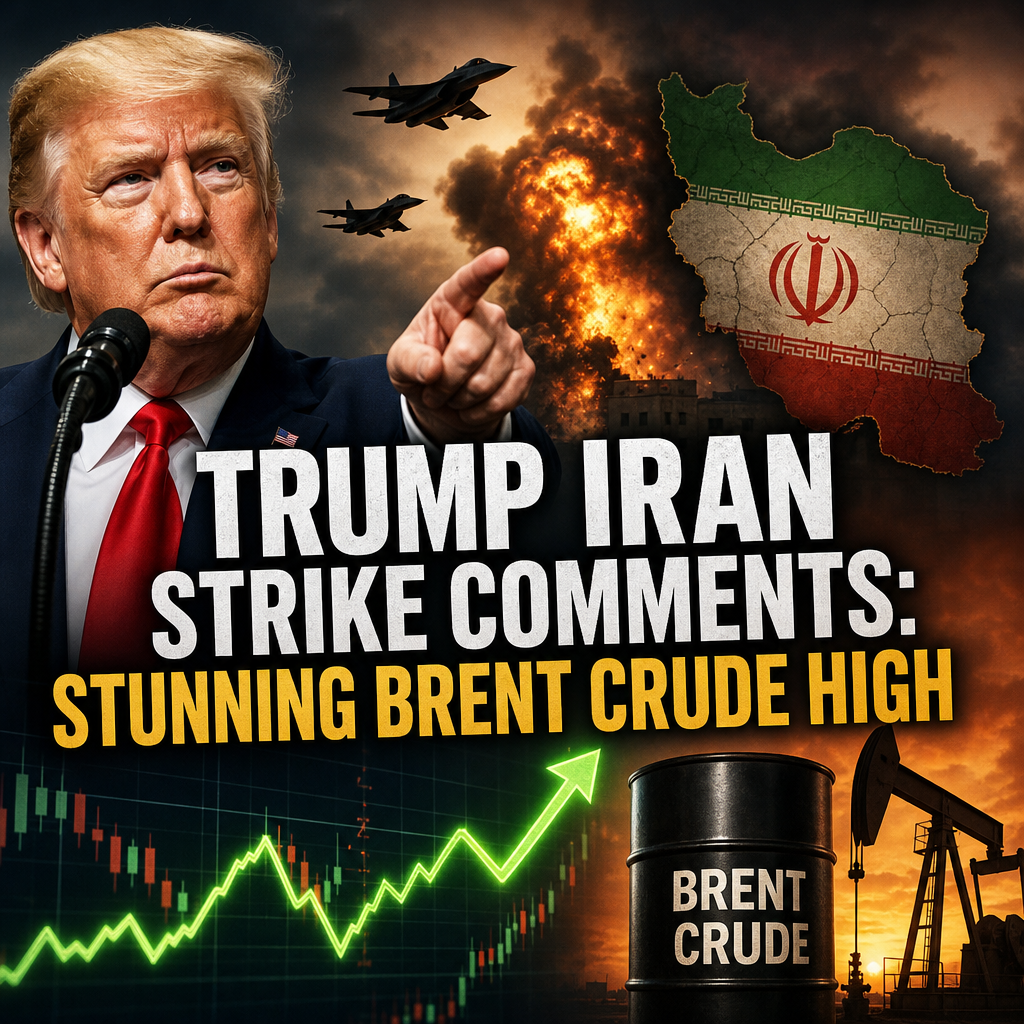
Trump Iran Strike Comments have quickly become more than a political soundbite, because markets treat even the hint of a wider Middle East conflict as a real economic risk. Brent crude’s jump to a two-week high shows how sensitive energy traders remain to any sign that tensions between the United States and Iran could spill beyond rhetoric and into supply disruptions. For investors, policymakers, and consumers, the bigger issue is not just whether a strike happens, but whether the language around one makes the region feel more unstable.
Why oil markets reacted so fast
Oil prices often move on expectations before they move on facts. That is what appears to be happening here. Brent crude climbed after Trump’s comments about Iran raised fears that a military confrontation could threaten shipping routes, production facilities, or regional stability more broadly.



From a market perspective, this response makes sense. Iran sits in a critical geopolitical zone, and any escalation can affect the Strait of Hormuz, one of the world’s most important energy corridors. Even without immediate disruption, traders tend to add a risk premium when the chance of conflict rises. That premium can disappear just as quickly if tensions cool, but in the short term it can lift prices sharply.
Al Jazeera’s economic framing of the story emphasizes that energy markets are now reacting to political language as much as to actual supply data. That matters because price movements triggered by fear can feed into inflation expectations, transport costs, and broader market volatility, even if no barrels of oil are lost.




The market is pricing uncertainty, not certainty
It is important to separate what was said from what has actually happened. A comment about Iran is not the same thing as an operation, a sanctions change, or a supply shock. Still, markets rarely wait for certainty. They trade probabilities, and in a geopolitically tense environment, probabilities can move fast.
That is why the rise in Brent should be read as a warning signal rather than a forecast. Traders are saying, in effect, that the risk of escalation has gone up. They are not necessarily saying war is imminent.
Different outlets, different lenses
One useful way to understand the reaction is to compare how different news organizations frame it.
Al Jazeera: economics through the lens of conflict risk
Al Jazeera’s coverage tends to place the oil spike within a broader story of geopolitical instability and market nerves. That lens is valuable because it connects the price move to the reality that global energy markets remain vulnerable to Middle East tensions. It also highlights the knock-on effects for consumers, especially if higher crude prices persist and begin to flow through to fuel and transport costs.
RT: skepticism about Western escalation narratives
RT typically approaches U.S.-Iran tensions with greater skepticism about Washington’s motives and a stronger focus on the dangers of escalation itself. That perspective matters because it reminds readers that military language can be used as leverage, signaling, or political messaging rather than as a literal roadmap to action. From this angle, market panic may reflect not only fear of conflict, but also fear of political theatrics from major powers.
Sky News: the practical impact on global stability
Sky News often frames these events in a more conventional international news style, stressing what they mean for diplomacy, security, and household costs. That approach is useful because it translates geopolitical tension into concrete consequences: higher fuel bills, pressure on inflation, and concerns about the reliability of global trade routes. In other words, it connects the headlines to everyday life.
Taken together, the three viewpoints suggest a shared conclusion even if they differ in tone: Trump’s comments mattered because markets still see Iran as a flashpoint with real economic consequences.
What this means beyond the trading floor
There is a temptation to treat a Brent crude spike as just another headline for investors. But oil prices do not stay on Wall Street or in London. They travel.
Higher crude prices can eventually affect:
– gasoline and diesel costs
– shipping and freight rates
– airline expenses
– manufacturing input costs
– inflation expectations in major economies
That does not mean a short-lived crude rally automatically becomes a long-term consumer problem. If the geopolitical tension fades, prices may ease. But if comments from political leaders keep signaling possible conflict, volatility itself becomes the story. Businesses hate uncertainty because it makes planning harder, and energy markets are especially vulnerable to it.
The bigger question: signal or escalation?
The hardest part of this story is that no single reading is fully satisfying. One interpretation is that the comments were meant to project strength and deter Iran, with the market reacting more to tone than to substance. Another is that traders are correctly sensing that the risk of confrontation has genuinely risen. A third possibility is that both are true: political rhetoric raises the odds of miscalculation, and markets are responding rationally to that danger.
What seems clear is that the reaction in Brent crude is less about a single quote and more about a familiar pattern. When the U.S. and Iran enter the same sentence in a tense context, oil traders assume the worst first and ask questions later. That may sound alarmist, but in a world still highly dependent on oil flows through politically sensitive regions, it is not irrational.
The more balanced takeaway is this: the Brent move is a warning, not a verdict. It shows that markets remain deeply uneasy about Middle East risk, and that political comments can still move prices materially. But it does not prove that an actual strike is imminent or that supply is about to be disrupted. For now, the price jump reflects fear, fragility, and the market’s memory of how quickly conflict can reshape energy costs.