
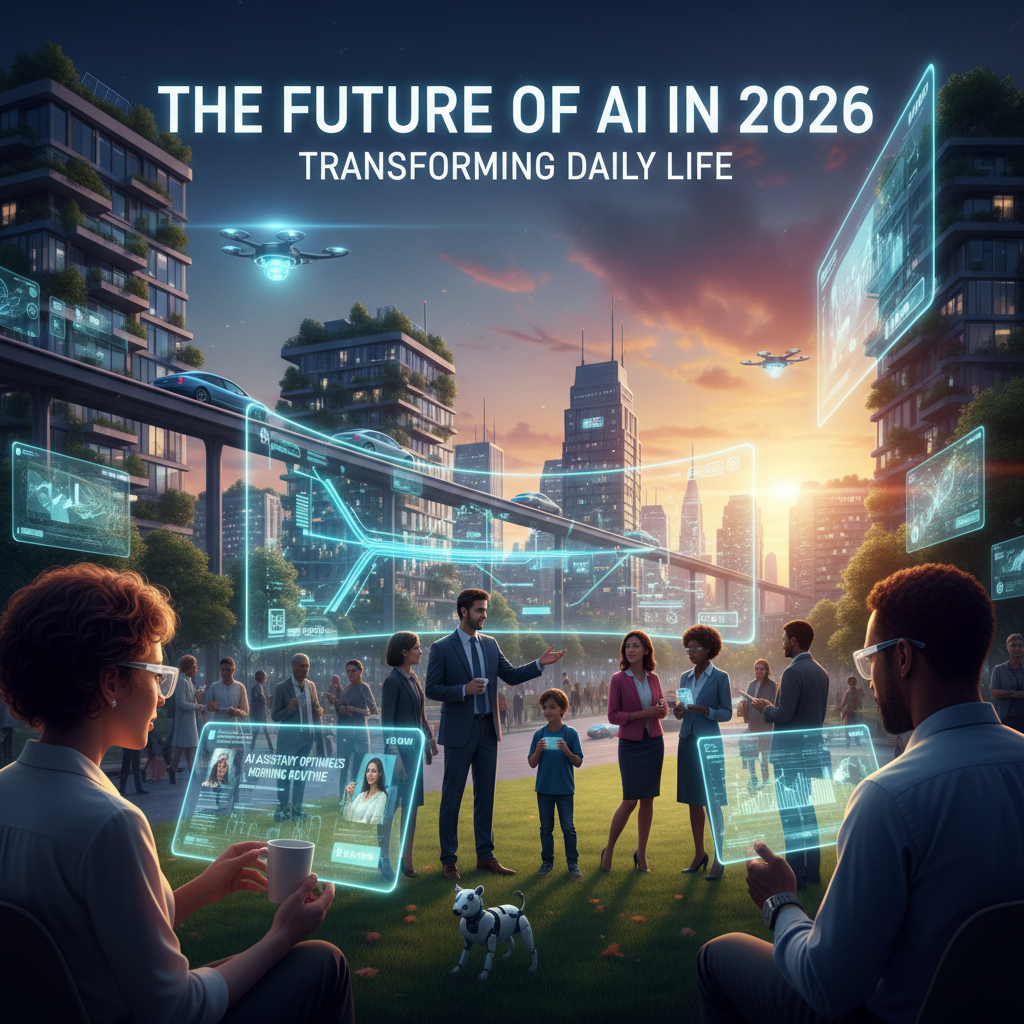
The Future of AI in 2026: Transforming Daily Life
As we navigate through 2026, artificial intelligence has officially transitioned from a futuristic concept into an invisible, indispensable backbone of our daily routines. No longer confined to research labs or tech giants, smart systems now seamlessly integrate into how we work, commute, and manage our households. What once felt like science fiction is now our standard reality, reshaping human experiences in profound and unexpected ways.

[IMAGE: A futuristic living room where a glowing digital assistant interface floats gently in the air, managed naturally by a resident.]
Revolutionizing the Modern Workplace


The professional landscape has undergone a massive shift over the last few years. Autonomous collaboration tools have moved past simple task automation to become true creative partners. Workers across diverse industries rely on advanced machine learning models to synthesize vast amounts of data, draft complex proposals, and manage logistical hurdles in real time.

Enhanced Personal Productivity
Individual workflow optimization has never been more accessible. Intelligent agents anticipate scheduling conflicts, prioritize communications based on urgency and context, and even suggest optimal times for deep work versus collaborative meetings. This has dramatically reduced burnout and elevated overall job satisfaction.
Seamless Living Spaces and Smart Homes
Our homes have also received a major cognitive upgrade. In 2026, smart home ecosystems do not just respond to voice commands; they predict our preferences. Heating, lighting, and entertainment systems adapt dynamically to our moods and daily rhythms, maximizing energy efficiency while prioritizing absolute comfort.
[IMAGE: A sleek, modern kitchen featuring smart appliances communicating with an ambient home AI hub.]
Health and Wellness Monitoring
Personalized healthcare is another area experiencing a monumental leap forward. Wearable technology combined with predictive neural networks can monitor vital signs continuously, flagging potential health anomalies long before symptoms manifest physically. Nutritional planning and fitness regimens are dynamically adjusted daily based on biometric feedback.
Navigating the Ethical Horizon
Of course, this rapid integration brings valid concerns regarding data privacy, algorithmic bias, and the boundaries of automation. Society in 2026 is actively engaging in crucial conversations to establish robust ethical frameworks. Ensuring transparency and human oversight remains paramount as we continue to harness these powerful capabilities.
Looking Ahead
Ultimately, artificial intelligence in 2026 acts as an amplifier of human potential rather than a replacement. By taking over repetitive burdens, it frees us to focus on empathy, creativity, and meaningful connection. The journey of technological evolution is far from over, but today’s landscape proves that a harmonious coexistence between humans and smart systems is entirely possible.