US Iran Deal: Stunning, Affordable New Pact?


US Iran Deal talk is back in the spotlight, but the more interesting question is not whether a breakthrough is possible — it is what kind of deal could emerge, who would benefit, and whether either side can sell it at home.
Across recent coverage and commentary from outlets with very different editorial instincts, one theme stands out: there is a narrow but real opening for diplomacy, yet the political and strategic obstacles remain formidable. Some reporting emphasizes the practical appeal of a bargain — reduced tensions, restraint on nuclear escalation, and a chance to avoid another Middle East crisis. Other coverage is far more skeptical, arguing that any agreement would be fragile, easily attacked by hardliners, and vulnerable to collapse if it looks too generous to one side.



What makes this moment unusual is that both Washington and Tehran appear to have reasons, however limited, to keep the door open. But reasons are not the same as trust, and the gap between temporary de-escalation and a durable settlement is still wide.
Why a US Iran Deal is back on the table
A US Iran Deal is being discussed now because the alternatives are increasingly expensive.




For the United States, the cost of prolonged confrontation is not just military. It is also diplomatic and economic: higher regional instability, pressure on energy markets, and the risk of being pulled into a wider conflict in the Middle East. For Iran, the pressures are also severe. Sanctions continue to weigh on the economy, and isolation has not delivered the strategic security Tehran wants. In that sense, both sides have incentives to test whether a smaller, more limited agreement could ease immediate pressures without requiring a grand ideological compromise.
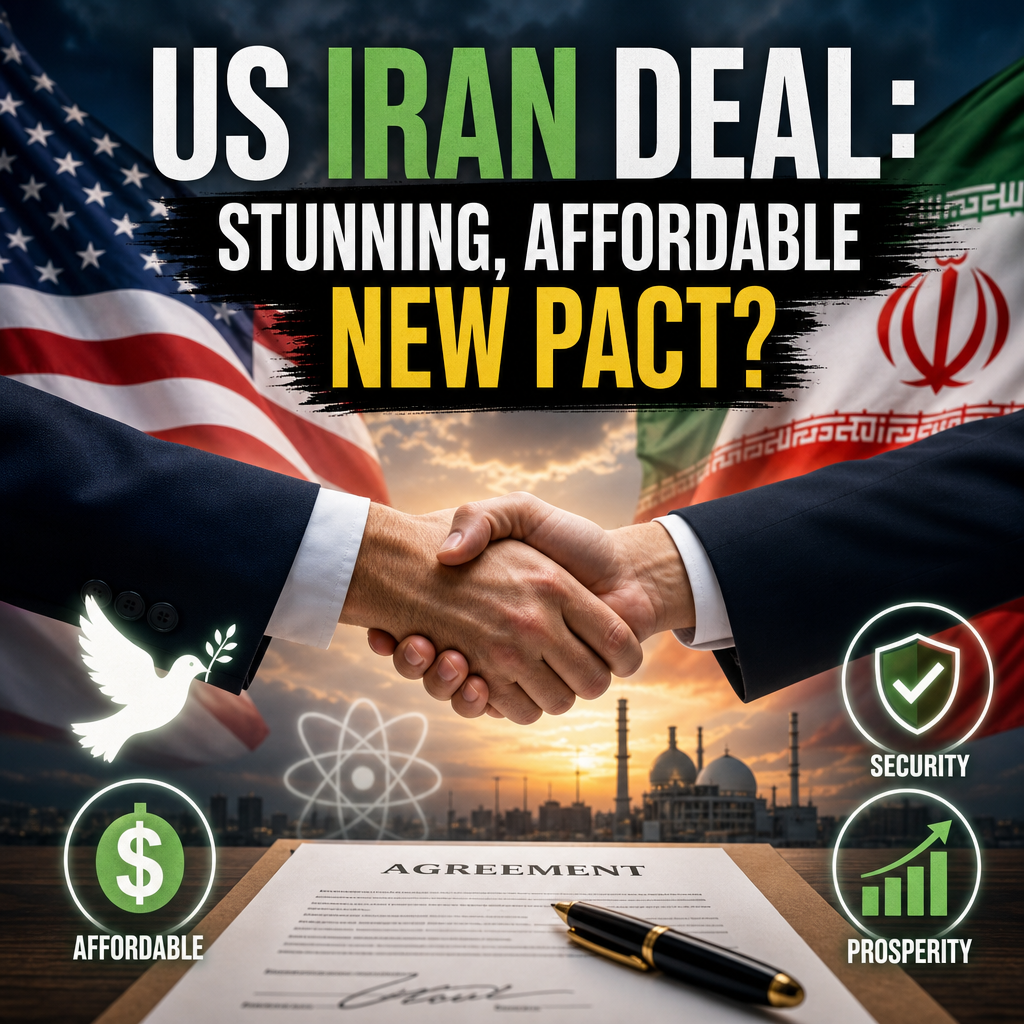
That is why some observers view the idea of a new pact as “affordable” in a very specific sense: not cheap in political terms, but cheaper than escalation. A narrow deal could include steps such as:
– limits on sensitive nuclear activity
– access for inspectors or monitoring bodies
– prisoner exchanges or humanitarian gestures
– partial sanctions relief
– commitments to avoid direct military confrontation
This kind of arrangement would not solve the deeper rivalry between the two countries. But it could reduce the risk of a fast-moving crisis.
Still, the sources covering this topic reflect very different judgments about whether such a deal would be wise or even sustainable. Some analysis suggests diplomacy is the only realistic path left. Others warn that any agreement reached under pressure could become a short-term pause rather than a genuine reset. That tension is at the heart of the debate.
The case for caution
The strongest argument against optimism is history.
The United States and Iran have been here before, most notably with the 2015 nuclear agreement, which improved constraints and monitoring for a time but later unraveled after Washington withdrew. That experience still shapes both sides’ expectations. In Iran, many officials see promises from the West as reversible. In the US, critics worry that Tehran can pocket concessions while preserving enough leverage to outlast future pressure.
This is where skepticism from some reporting and commentary becomes important. A deal can be politically attractive in the short term and strategically weak in the long term. If it is not verifiable, enforceable, and clearly limited in scope, it risks becoming a slogan rather than a solution.
There is also the question of domestic politics. In both countries, leaders face audiences that may interpret compromise as weakness.
The domestic price of compromise
For US policymakers, any agreement with Iran can trigger backlash from lawmakers, allies in the region, and voters who remember past failures. For Iran’s leadership, concessions made under sanctions pressure can be portrayed internally as capitulation. That makes any pact harder to negotiate and even harder to defend afterward.
The result is a strange equation: the more urgently a deal is needed, the harder it may be to sell.
What the different viewpoints reveal
The value of comparing contrasting coverage is that it exposes the real fault lines in the debate.
One viewpoint, often associated with a more confrontational or anti-establishment reading of US policy, sees negotiations as evidence that Washington is finally acknowledging limits to coercion. From that perspective, a pact may be less about trust than realism — a recognition that neither sanctions nor threats can permanently reshape Iran’s behavior.
A second viewpoint, more typical of centrist international reporting, treats diplomacy as necessary but precarious. This approach does not assume goodwill; it assumes mutual self-interest. It sees a deal as a risk-management tool, not a moral victory.
A third viewpoint, often emphasized in more skeptical security-focused analysis, warns that the deal may be too narrow to matter and too politically costly to last. This view argues that unless the underlying regional conflicts are addressed, any agreement will merely defer the next confrontation.
Taken together, these perspectives suggest that the real debate is not “deal or no deal.” It is whether a limited pact can meaningfully lower the temperature without encouraging either side to wait for a better moment to pressure the other.
A realistic reading of the moment
The most balanced conclusion is that a US Iran Deal is possible, but only in a modest form.
A sweeping reset is unlikely. The distrust is too deep, the regional stakes too high, and the domestic politics too unforgiving. But a narrower bargain — one built around containment, monitoring, and short-term relief — could still emerge if both sides calculate that the cost of failure is higher than the cost of compromise.
That would not be a historic reconciliation. It would be an uneasy truce with paperwork attached.
And yet, in the current climate, even that would matter. In a region where miscalculation can escalate quickly, a limited agreement may be less about hope than about restraint. If it can buy time, reduce the chance of conflict, and create space for later talks, it may prove worth the political pain.
The challenge is that neither Washington nor Tehran seems ready to admit that its preferred strategy has limits. Until they do, the most likely outcome is not a dramatic breakthrough, but a cautious, stop-start negotiation in which both sides test whether the other is serious. The deal may be affordable. The trust required to sustain it almost certainly is not.