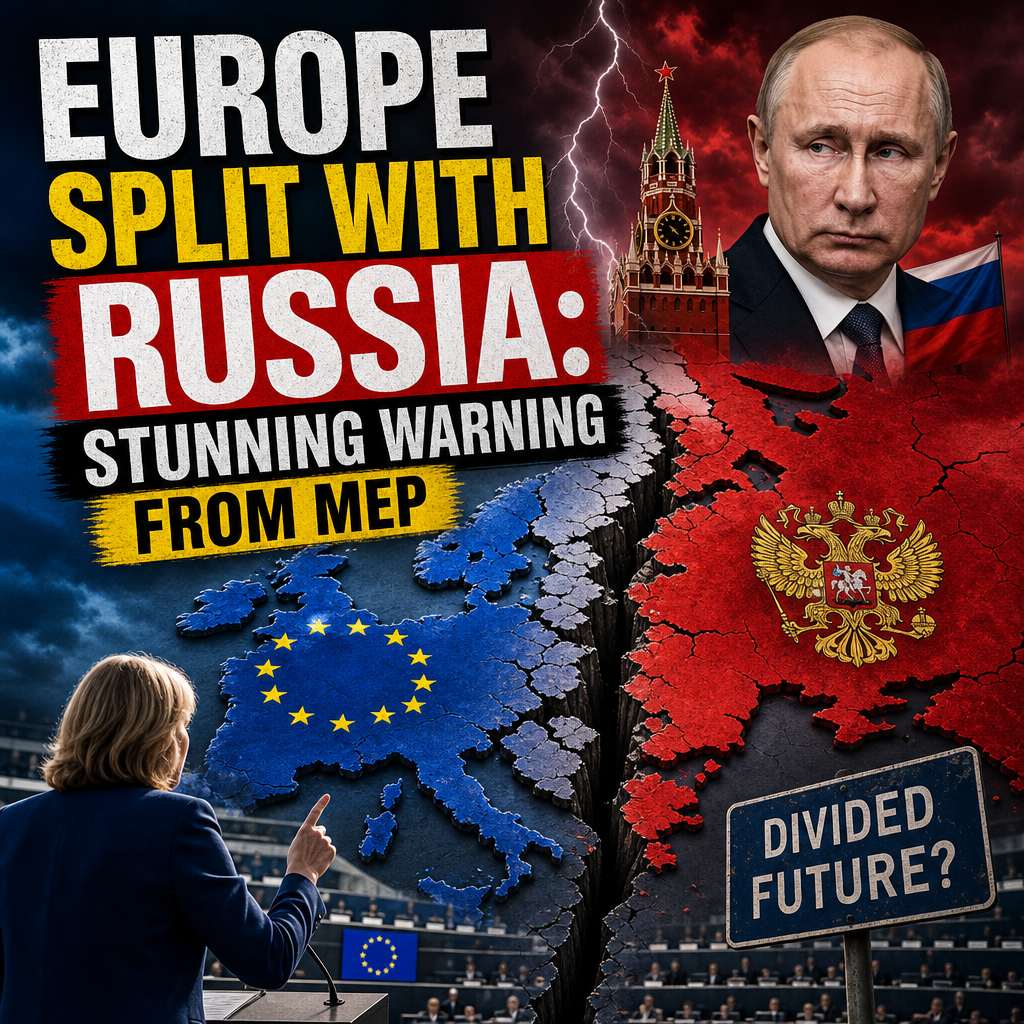
Europe Split with Russia: Stunning Warning from MEP


Europe Split with Russia has become more than a slogan of wartime geopolitics; it is now a real test of how long the European Union can hold together on sanctions, security, and its relationship with Moscow.
The warning from a member of the European Parliament lands at a moment when Europe is already under strain. One side of the debate argues that Russia’s invasion of Ukraine has left the EU no choice but to keep pressure on the Kremlin through sanctions, military aid, and tighter energy policy. Another side worries that the costs are being borne unevenly across member states, with some governments and voters increasingly impatient about inflation, industrial pressures, and rising electricity bills. The result is a split that is not always loud, but is becoming harder to ignore.



Europe Split with Russia: why the warning matters
The warning matters because it reflects a broader fear inside Europe: that a policy built on unity may be weakening under the weight of political fatigue. EU institutions have repeatedly insisted that sanctions remain one of the bloc’s strongest non-military tools. Supporters say they have constrained Russia’s access to finance, technology, and revenue, while signaling that aggression carries a long-term price.
Yet the criticism is not disappearing. In some capitals, especially where governments are more skeptical of Brussels, sanctions are viewed as blunt instruments that hurt Europe as well as Russia. RT’s framing of the issue highlights a familiar theme from the Kremlin-aligned perspective: that EU policy is self-defeating, internally divided, and increasingly vulnerable to dissent from member states that do not want to deepen confrontation. That narrative should be treated carefully, but it does mirror a genuine political fault line inside the bloc.




Al Jazeera’s coverage of the wider war tends to emphasize the human cost and the diplomatic deadlock rather than only the strategic competition. From that angle, the danger is not just that Europe is divided from Russia, but that the conflict is hardening into a long-term standoff with few off-ramps. That matters because every additional sanctions package, aid decision, or security pledge becomes part of a bigger question: is Europe managing the crisis, or slowly locking itself into a confrontation it cannot easily end?
Sky News has often approached the same issue through the lens of European politics and public anxiety, especially the strain on households and the rise of nationalist or populist criticism in several countries. That perspective helps explain why some governments can support a tough line in principle but still face pressure at home to soften it in practice. It is one thing to endorse solidarity; it is another to maintain it through multiple winters, budget cycles, and election campaigns.
What the split looks like in practice
The division is not simply between “pro-Russia” and “anti-Russia” camps. It is more complicated than that. Most EU governments still publicly support Ukraine and condemn Moscow’s actions. The real tension lies in how far they are willing to go, how long they can sustain current policies, and what kind of endgame they imagine.
Common fault lines include:
– Sanctions fatigue: Some states want tougher measures, while others fear diminishing returns.
– Energy dependence: Even after major reductions, parts of Europe still have economic exposure to Russian energy markets or to broader energy price shocks.
– Defense spending: Eastern European states often argue for stronger deterrence, while others are more cautious about escalation.
– Domestic politics: Rising living costs can quickly turn foreign policy into a local issue.
– Diplomatic strategy: There is no full consensus on whether Russia should be isolated indefinitely or eventually drawn back into negotiations.
This is why a warning from an MEP resonates beyond the chamber itself. It is a reminder that Europe’s foreign policy unity is fragile when the public feels the costs directly. That fragility does not mean the EU is collapsing, but it does mean that its current posture is politically expensive and may not be sustainable without clearer gains.
Is Europe actually “split”?
The answer depends on what kind of split we mean. On the surface, Europe remains united around the basics: respect for sovereignty, support for Ukraine, and opposition to territorial conquest. But beneath that shared language lies a widening disagreement over method and endurance.
If the question is whether Europe has split from Russia, the answer is yes in many practical respects. Political trust is shattered, trade patterns have been altered, and the old assumptions of interdependence no longer hold. If the question is whether Europe itself is split over Russia, the answer is also yes—but not evenly, and not irreversibly.
A fair reading of the sources suggests three truths can coexist:
1. The EU still has significant consensus on the principle of resisting Russian aggression.
2. That consensus is under pressure from economic strain and political polarization.
3. Russia benefits when Europe appears divided, because division weakens deterrence and clouds strategy.
That last point is especially important. Moscow has long tried to exploit differences within European politics, and every public dispute over sanctions or support for Ukraine gives that strategy a chance to work. At the same time, Brussels cannot simply dismiss domestic skepticism as disinformation or bad faith. Voters in democratic states do expect governments to justify policies that carry real economic costs.
The bigger question Europe now faces
The challenge is no longer only whether Europe can punish Russia. It is whether Europe can sustain a coherent policy long enough to shape events rather than merely react to them. If the bloc becomes too fragmented, it risks sending mixed signals. If it becomes too rigid, it risks alienating publics whose support it needs for the long haul.
That is why the warning from the MEP should be taken seriously, even if one disagrees with parts of it. It captures a real tension at the heart of European policy: solidarity versus fatigue, principle versus price, and unity versus national interest. None of these tensions will disappear soon.
For now, Europe is not fully broken from Russia in every sense, but it is clearly in a colder, harsher relationship than at any point in decades. The deeper uncertainty is whether Europe can remain united enough to navigate that reality without letting internal disagreement become its own strategic weakness.