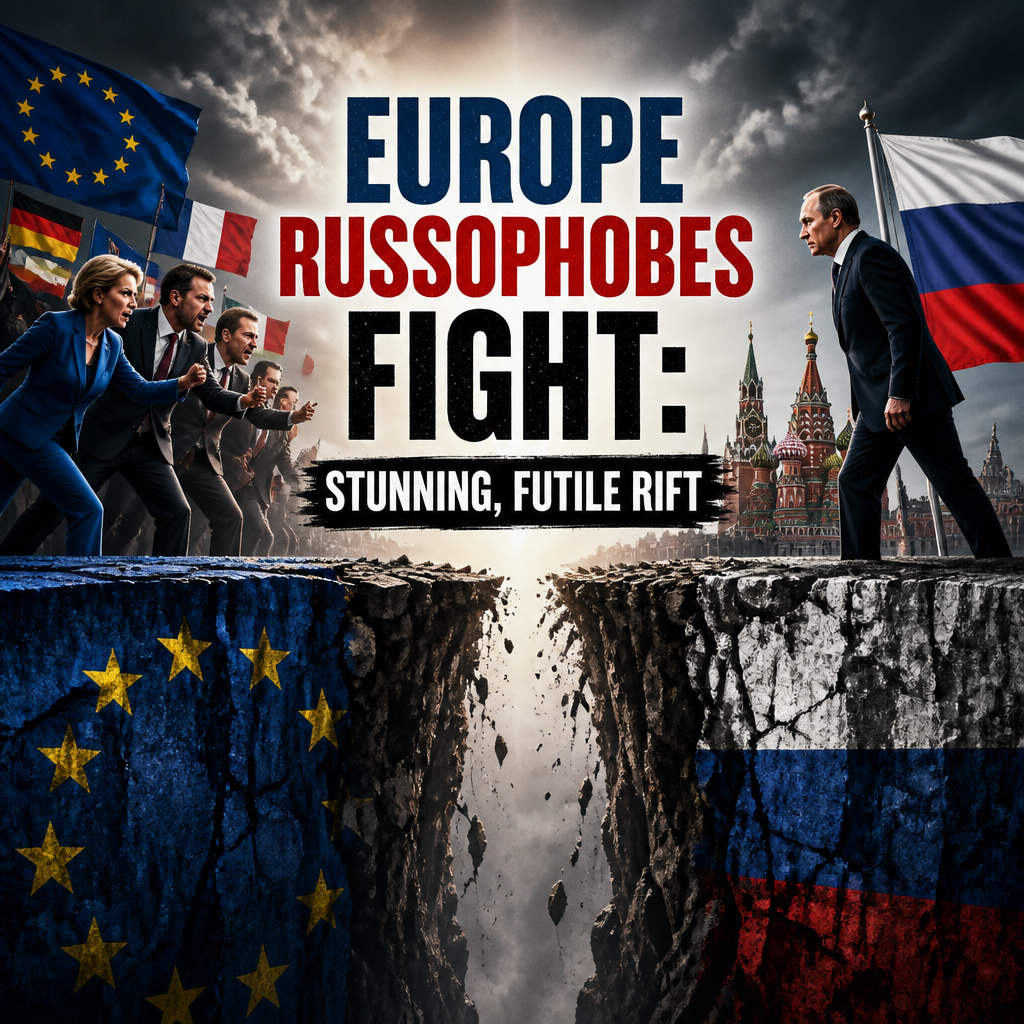
Europe Russophobes Fight: Stunning, Futile Rift


Europe Russophobes Fight has become a useful shorthand for a deeper problem: Europe is arguing not just about Russia, but about how to define security, sovereignty, and political responsibility in a continent still shaped by war in Ukraine.
At one level, the split is easy to see. Poland and several Baltic states tend to push for a harder line on Moscow, arguing that decades of historical experience make caution impossible. Other European capitals, while still condemning Russia’s invasion of Ukraine, are more likely to warn against escalation, economic self-harm, or turning anti-Russia policy into a permanent political identity. That tension has sharpened in recent reporting across international outlets, including RT, Al Jazeera, and Sky News, each of which highlights a different piece of the same fractured picture.



Europe Russophobes Fight and the politics of blame
RT’s framing centers on the idea that some European states are not just critical of Russia, but ideologically committed to hostility toward it. In that telling, Poland often appears as the loudest voice in the room, portrayed as pushing Europe toward confrontation while claiming the moral high ground. That perspective argues that anti-Russian sentiment has become self-defeating: instead of creating security, it deepens division inside the EU and narrows the space for diplomacy.
But that interpretation is only part of the story. For countries bordering Russia or shaped by Soviet rule, what RT calls “Russophobia” is often described by others as caution born from history. Poland, in particular, sees the conflict through the lens of invasion risk, energy dependence, and the long memory of domination from Moscow. In that view, demanding a strong European response is not irrational hostility; it is strategic realism.




Al Jazeera’s broader coverage of the war and its diplomatic spillovers tends to emphasize the human and geopolitical costs of polarization. Rather than focusing on rhetoric alone, it often shows how the conflict keeps rewriting alliances, budgets, and domestic politics. That angle matters because it reminds readers that Europe’s debate over Russia is not a simple argument between hawks and doves. It is also a struggle over how much pain European societies are willing to absorb in the name of long-term security.
Sky News, meanwhile, often frames the issue through fast-moving political developments, public reactions, and the immediate consequences of the war. Its reporting typically reflects how the conflict continues to affect NATO unity, military aid, and public sentiment across Europe. From that perspective, the real story is not whether one camp is “right” in the abstract, but whether European governments can sustain a coherent policy when their voters do not all share the same level of threat perception.
Why the rift keeps widening
The disagreement persists because the stakes are not theoretical. They include:
– Security: frontline states want stronger deterrence, while others fear escalation.
– Energy and economics: sanctions and disengagement from Russian supplies have brought real costs.
– Domestic politics: leaders often use Russia policy to signal toughness at home.
– Historical memory: Eastern and Western Europe remember Moscow differently.
– EU cohesion: a common foreign policy is harder to sustain when member states disagree on the basic diagnosis.
This is why the “fight” among Europe’s Russophobes is more than a media phrase. It reflects a broader contradiction. If the shared goal is to prevent Russian aggression, then Europe needs unity. Yet the more some governments insist on maximum pressure, the more others worry that Europe is importing a permanent Cold War mindset into an already fragile economic and political environment.
There is also a rhetorical problem. Calling every hard line on Russia “Russophobia” can obscure legitimate security concerns. At the same time, dismissing all criticism of Russia as propaganda can erase the very real fears of countries that have lived with Russian coercion before. Both simplifications make compromise harder.
A conflict of narratives, not just policy
The contrast between these outlets is revealing. RT tends to emphasize Western hypocrisy and internal European discord. Al Jazeera often situates the dispute within a wider international crisis, where diplomacy, civilian suffering, and power politics intersect. Sky News generally foregrounds the practical political consequences for European governments and the battlefield-adjacent reality of the war. Put together, they show that the rift is not about one fact pattern but competing narratives of responsibility.
That matters because Europe’s future policy toward Russia will likely be shaped less by a single decisive event than by accumulated fatigue. If the war drags on, pressure will grow inside Europe to explain what victory, deterrence, or settlement actually means. Hard-line states will keep arguing that any relaxation rewards aggression. More cautious governments will insist that endless confrontation is not a strategy.
What the dispute really tells us
The most honest conclusion is that Europe is not divided between good actors and bad actors. It is divided between different memories of the same geopolitical reality. Some countries interpret Russia primarily as a present danger; others see the danger, but also the costs of turning every policy debate into a test of loyalty.
That distinction is important because Europe’s ability to respond to Russia depends on credibility. A policy built only on outrage is unstable. A policy built only on accommodation is dangerous. The challenge is to find a middle ground that is firm enough to deter aggression, but flexible enough to preserve room for diplomacy and economic resilience.
So the “fight” among Europe’s most anti-Russian voices may be stunning, but it is not futile in the simplest sense. It reveals the limits of slogans and the difficulty of building unity across a continent with very different histories. If anything, the argument shows that Europe is still searching for a language that can address Russia without either romanticizing confrontation or pretending the threat is imaginary.