
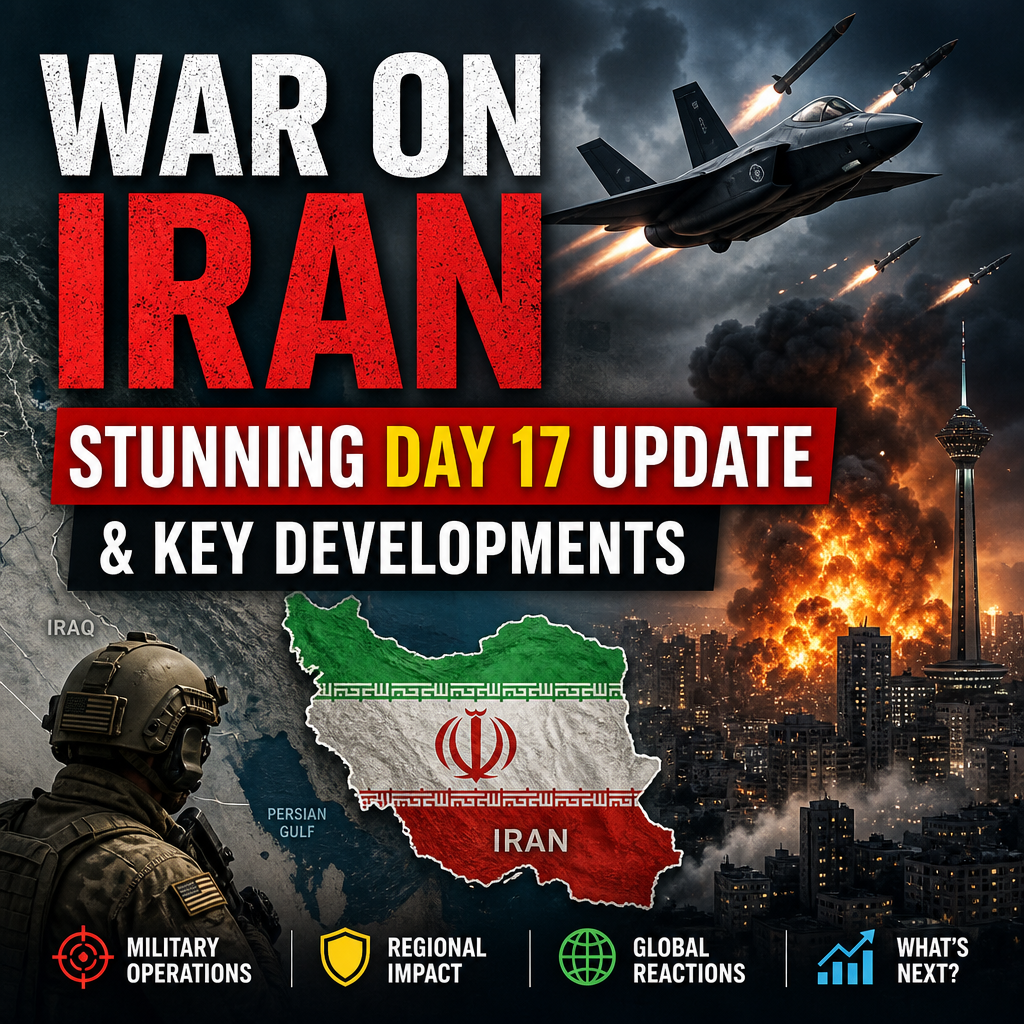
War on Iran: Stunning Day 17 Update & Key Developments


War on Iran has entered a more dangerous, uncertain phase, and day 17 appears to be defined less by a single decisive event than by a widening pattern of escalation, retaliation, and high-stakes signaling. Across the available reporting stream, one theme is consistent: the conflict is no longer being judged only by battlefield gains or losses, but by its wider effect on civilians, regional security, energy markets, and the chance of drawing in outside powers.
War on Iran: what day 17 suggests about the conflict
The most important takeaway from the latest coverage is that the war is being shaped by momentum rather than clarity. Al Jazeera’s reporting continues to frame the conflict through its humanitarian and geopolitical consequences, emphasizing the toll on civilians and the pressure on diplomacy. Sky News, by contrast, tends to focus more on the strategic and military dimensions, especially how each round of strikes or counterstrikes alters the balance of deterrence. RT’s coverage often highlights the anti-Western framing of the conflict and questions the motives of the governments backing military escalation.



Taken together, these perspectives point to a conflict that is being fought on at least three levels at once:
– a military campaign involving direct strikes and counterstrikes
– a political contest over legitimacy, blame, and deterrence
– a broader regional struggle that could spill beyond Iran’s borders




That layered reality matters because it makes “day 17” less about a single headline and more about whether either side is gaining enough leverage to force a pause. So far, the answer appears to be no.
Civilian risk remains the clearest through line
Even when outlets disagree sharply on responsibility, they converge on one uncomfortable fact: civilians are paying the biggest price. Al Jazeera’s coverage consistently keeps that human cost at the center, while Sky News also notes the danger posed by strikes on populated areas, infrastructure, and transport links. The result is a conflict in which military messaging often outruns the reality on the ground.
This is especially important because the longer a war continues, the more difficult it becomes to separate tactical objectives from strategic drift. Early claims of precision and control can quickly give way to damaged hospitals, disrupted power supplies, strained emergency services, and population displacement. When that happens, the public narrative shifts too—from “limited response” to “prolonged crisis.”
Competing narratives, same dangerous trajectory
A fair reading of the sources is that each outlet frames the conflict through its own political lens, but none suggest a clean exit is close.
Al Jazeera generally stresses diplomacy, civilian protection, and skepticism toward military solutions. That approach can sometimes underplay hard-security realities, but it is useful in reminding readers that wars are not only won or lost on paper. Sky News provides a more conventional security analysis, which is valuable for understanding how military planners and allied governments may be thinking about escalation thresholds. RT, meanwhile, is useful less as a neutral guide than as a signal of how the conflict is being interpreted by voices hostile to Western intervention.
The contrast is not just editorial—it reflects the reality that this war is being narrated by actors with conflicting interests. That makes certainty hard to come by. Even when the facts of a strike are agreed upon, the meaning of the strike is not.
What appears most likely now
Based on the pattern in the reporting, several conclusions seem reasonable, though none are guaranteed:
1. Escalation is still the default setting.
Neither side appears ready to absorb blows indefinitely without responding.
2. Diplomacy is possible but fragile.
Any negotiation effort would likely depend on back-channel pressure, ceasefire language, and some face-saving arrangement for all sides.
3. The risk of spillover remains high.
Regional allies, proxy groups, and shipping routes all remain vulnerable to the conflict’s wider effects.
4. Information warfare is now part of the battlefield.
Each side and its media allies are competing to define what “day 17” means before the facts are even fully settled.
What to watch next in the War on Iran
If the conflict is moving toward any kind of turning point, it will likely show up in a few measurable ways rather than in a dramatic announcement. Watch for:
– whether strikes become more concentrated or more geographically dispersed
– whether civilian infrastructure becomes a bigger target
– whether regional powers push harder for a ceasefire
– whether energy and shipping markets react to a new security threat
– whether official rhetoric starts shifting from retaliation to negotiation
The most responsible conclusion is that the war remains deeply unstable, and day 17 does not look like a moment of resolution. Instead, it looks like a warning sign: when multiple media ecosystems describe the same conflict in sharply different ways, it often means the situation on the ground is chaotic enough that no single narrative can contain it.
That is why the best reading of the latest developments is one of cautious skepticism. Military claims may be dramatic, but they do not yet add up to a decisive outcome. Humanitarian concerns remain acute. Regional tensions are still elevated. And the longer the fighting continues, the harder it becomes to imagine a return to anything resembling normal diplomacy.

























