
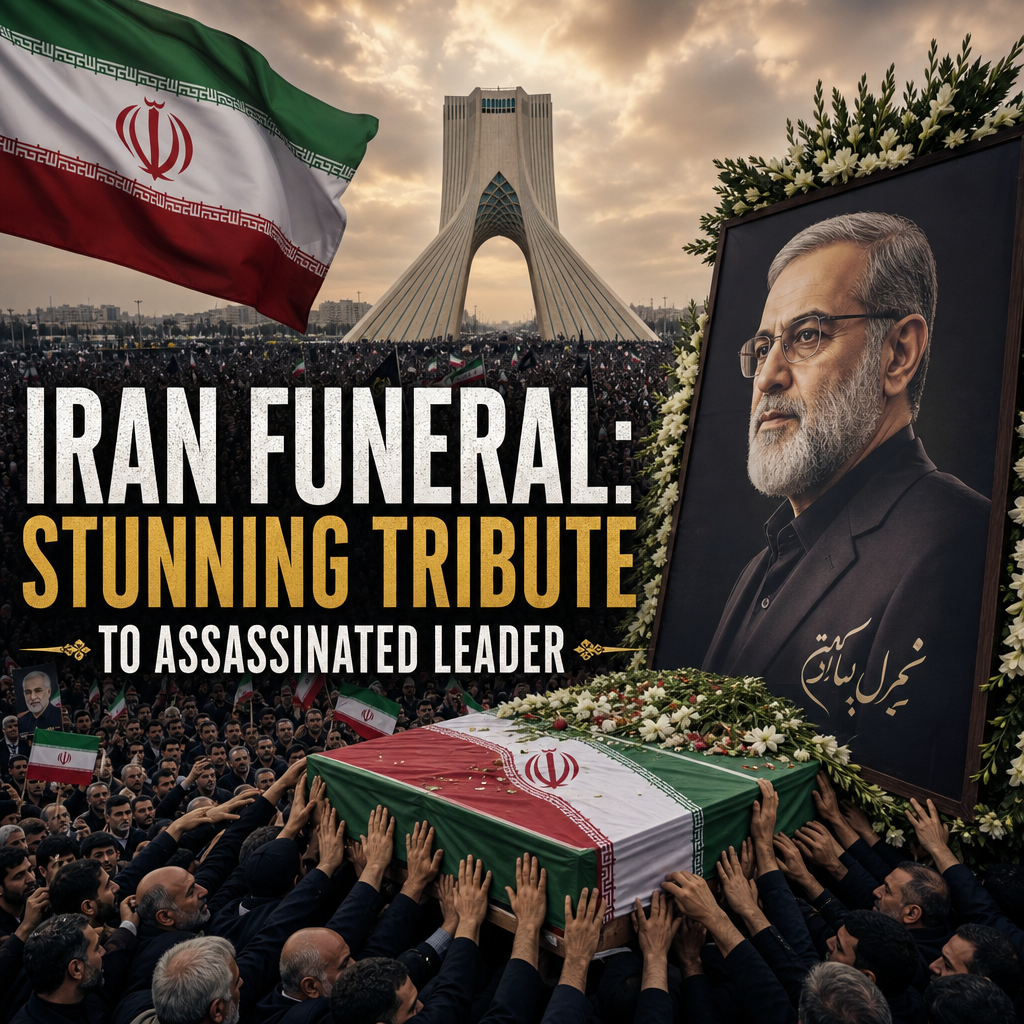
Iran Funeral: Stunning Tribute to Assassinated Leader


Iran funeral scenes this week showed both genuine grief and political theatre, as massive crowds gathered in Tehran to mourn a senior Iranian leader whose killing has jolted the region and sharpened fears of wider conflict.
The scale of the procession was striking. State media and international outlets described streets filled with mourners, flags, posters and chants of loyalty to the Islamic Republic. For supporters, the funeral became more than a farewell: it was a public display of defiance, designed to show that the assassination had not weakened the state’s hold over its base. For critics, it was also a reminder of how closely mourning in Iran can be woven into political messaging.



The event has been covered from sharply different angles. Sky News emphasized the size of the crowd and the symbolism of the state-organized tribute. Al Jazeera, meanwhile, placed the funeral within a broader regional crisis, linking the killing to long-running tensions between Iran, Israel and the United States. RT’s coverage has tended to frame the episode through the lens of confrontation with the West and the consequences of foreign-backed pressure on Iran. Taken together, these perspectives highlight one essential point: the funeral was not only about one man’s death, but about the struggle over Iran’s political narrative.
Iran funeral becomes a test of public loyalty
Large funerals in Iran are rarely just private ceremonies. They are often moments when the state measures loyalty, broadcasts resolve and signals continuity. In this case, the crowds appeared intended to answer a question that has become more urgent after the assassination: does the killing of a senior figure fracture Iran’s authority, or does it harden it?




The immediate answer, at least visually, was the latter. The funeral drew thousands, and perhaps many more if one counts those who lined the procession route rather than joining the central gathering. The messaging was clear: the assassination may have created shock and anger, but it had not produced visible collapse.
Yet crowd size does not automatically equal unanimous support. In Iran, as elsewhere, public mourning can reflect a mix of genuine respect, nationalism, religious duty and political pressure. Some attendees likely came out of personal conviction; others may have felt social or state expectations. That ambiguity matters. It is easy to mistake a mass funeral for total consensus, when in reality it often reveals only that the state can still mobilize large numbers for a high-stakes moment.
What the scene suggests — and what it does not
There are three important takeaways from the funeral coverage:
– The state remains capable of mobilization. Whatever the internal strains Iran faces, it can still bring out impressive crowds for moments of national importance.
– The assassination has raised the emotional temperature. The public display of anger suggests the killing may have intensified pressure on Iranian leaders to respond decisively.
– The event does not reveal the full picture of public opinion. Mourning crowds tell us about mobilization, not necessarily about the depth or breadth of political support.
That nuance is easy to lose in highly charged coverage. Images of thousands of mourners can be read as proof of unity, but they can also be evidence of a state using ritual to project strength in a moment of vulnerability.
Regional tensions hover over the mourning
The wider context is impossible to ignore. Reports across the outlets pointed to the assassination as part of a broader cycle of escalation involving Iran and its adversaries. That matters because funerals for senior Iranian figures often become pressure valves for national anger and strategic signaling.
Al Jazeera’s framing is especially useful here because it situates the event within the region’s tangled security dynamics. From that angle, the funeral is not just a domestic ceremony but a potential pivot point. If Iran chooses to retaliate directly or through allied groups, the consequences could spread beyond its borders. If it holds back, critics at home may accuse it of weakness. The leadership is trapped between deterrence and restraint.
Sky News focused more on the optics and scale of the mourning, but those optics themselves are politically meaningful. A funeral of this size sends a message to foreign governments that killing a senior figure has not silenced Iran’s public institutions. At the same time, it also signals to domestic audiences that the state wants unity, discipline and continuity rather than panic.
RT’s commentary, by contrast, leaned into the idea that the killing reflects the dangers of external interference and escalating pressure from Western-aligned actors. Even where readers may not agree with that framing, it underscores a key reality: the story is being interpreted through deeply conflicting geopolitical narratives. Iran and its opponents are not just battling on the ground; they are battling over meaning.
A moment of grief with uncertain consequences
The most honest reading of the Iran funeral is that it is both a real public grief event and a carefully staged political moment. Those two things are not mutually exclusive. In fact, in Iran they are often inseparable.
The assassination has almost certainly strengthened hard-line rhetoric and may give Tehran more incentive to portray itself as a besieged but resilient power. Yet that does not guarantee a simple retaliatory path. Iranian leaders will weigh military risk, domestic expectations, diplomatic consequences and the possibility of provoking a larger war.
What the funeral makes clear is that the killing has not passed quietly into history. It has become a symbolic event with aftershocks that are still unfolding. The crowds in Tehran show that the emotional and political stakes are high. The competing coverage shows that the world is still struggling to interpret what comes next.
For now, the most balanced conclusion is also the most cautious one: the funeral demonstrated the state’s ability to command attention and grief, but it did not settle the deeper question of whether Iran is entering a phase of greater unity, greater repression or greater confrontation. It may be all three at once.

























