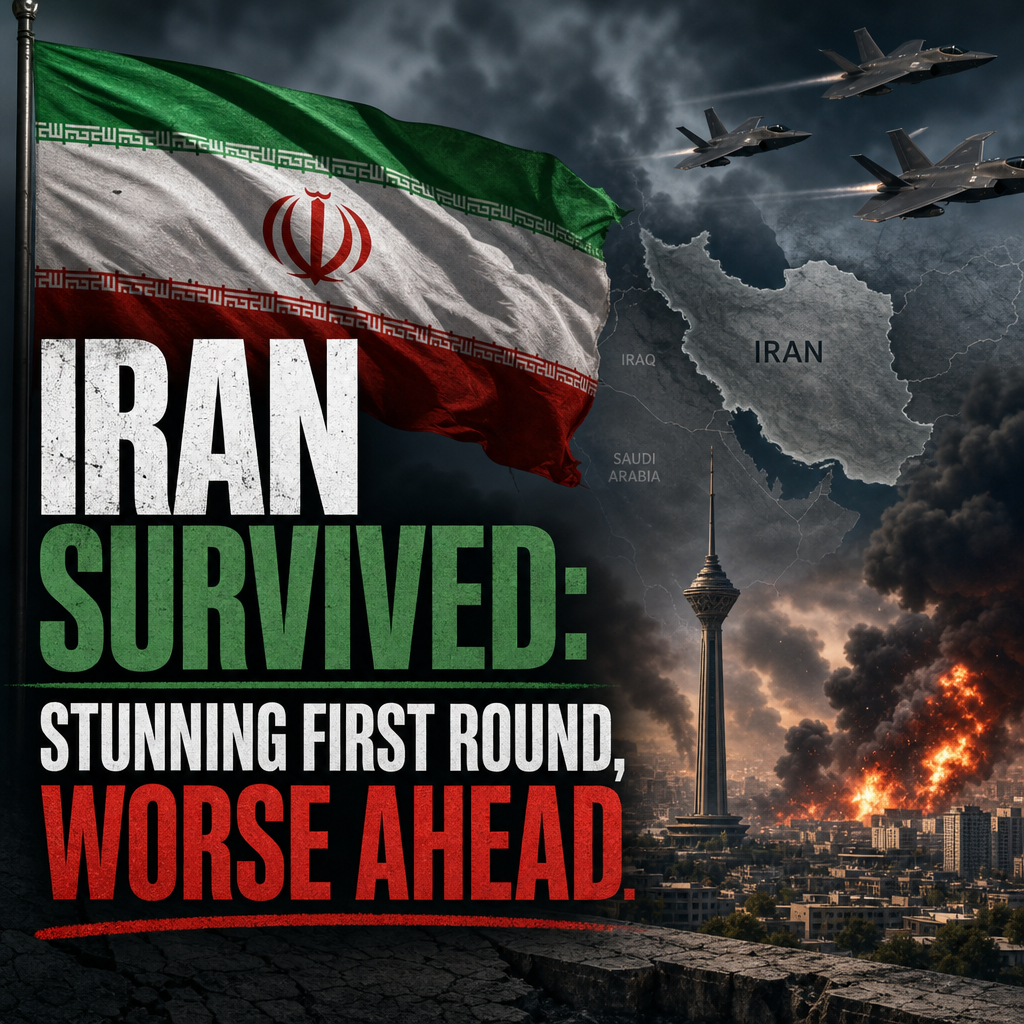
Iran Survived: Stunning First Round, Worse Ahead


Iran survived the first round of the crisis, but that does not mean the danger has passed; in many ways, it may only be entering a more difficult phase.
What stands out across the most recent international reporting is not a single clean verdict, but a shared sense that Iran has absorbed the initial shock of confrontation without collapsing, while the wider region has become more volatile and less predictable. Some coverage frames that as a political victory for Tehran, others as a temporary reprieve bought at a high cost, and still others as evidence that the real consequences will unfold over months rather than days.



Iran Survived the First Round, but the Costs Are Not Finished
In strategic terms, survival matters. Iran has shown that it can endure pressure from multiple directions — military, diplomatic, and economic — while still keeping its basic state machinery intact. That is no small thing in a region where external pressure is often expected to produce rapid internal fracture. But “survival” is not the same as security.
One line of interpretation, reflected in more skeptical Western coverage, is that Iran’s leadership may be mistaking resilience for victory. A state can withstand an initial blow and still emerge weaker if its deterrence erodes, its economy tightens further, or its allies become less reliable. Even when direct damage is limited, the psychological effect of being tested can shape how opponents behave next. If adversaries conclude that Iran is vulnerable, they may be tempted to increase pressure rather than reduce it.




At the same time, other reporting stresses that Iran is not acting from a position of helplessness. It still has leverage through regional networks, missile capabilities, and its ability to influence shipping lanes, energy markets, and political calculations across the Middle East. That means any escalation involving Iran is never just about Iran. It quickly becomes a broader question of regional stability, maritime security, and the risk of miscalculation.
Why “survived” is not the same as “safe”
The distinction matters because Iran’s immediate challenges are layered:
– Military pressure may continue in indirect or direct forms.
– Economic strain remains severe, especially if sanctions tighten or regional trade is disrupted.
– Diplomatic isolation could deepen if neighboring states move to insulate themselves from fallout.
– Internal expectations rise when leadership presents endurance as strength, even if the public feels the opposite.
This is where the outside commentary begins to diverge. Some analysts see a regime that has once again outlasted a challenge. Others see a system becoming more brittle, more dependent on coercion, and more exposed to long-term decay than short-term headlines suggest.
Regional Fallout: The Real Story May Be Beyond Tehran
Al Jazeera’s broader regional framing is useful here because it tends to place Iran in a web of consequences rather than treating it as the only actor that matters. From that angle, the biggest issue is not whether Iran can claim to have survived a first round, but whether the region can absorb another one without sliding into wider instability.
That concern is especially acute because every confrontation involving Iran tends to spill over into neighboring states. Gulf countries worry about shipping disruption and energy security. Lebanon, Syria, Iraq, and Yemen are vulnerable to being pulled into a wider cycle of retaliation. And civilian populations across the region are often the least protected and most exposed participants in a conflict they did not choose.
Sky News’ coverage, by contrast, typically emphasizes the security implications for European allies, the United States, and the Gulf. That perspective focuses less on symbolism and more on practical risk: how to prevent escalation, how to deter further attacks, and how to avoid a scenario in which one misjudged move creates a much broader war. That approach may sound colder, but it reflects a serious reality. In the Middle East, even “contained” clashes often prove difficult to contain for long.
The uncomfortable truth is that there is no clean off-ramp if the parties remain convinced they can still improve their position through pressure. Iran may believe that endurance itself strengthens its hand. Its opponents may believe that continued pressure is the only language Tehran understands. When both sides think this way, the next phase becomes more dangerous than the first.
What Comes Next for Iran?
The next phase is likely to be shaped less by dramatic headlines and more by cumulative strain. That includes pressure on Iran’s economy, its foreign relationships, and its domestic political narrative. A government can celebrate survival, but it also has to explain why survival keeps coming at such a cost.
The likely pressure points ahead
– Economic fatigue: sanctions, reduced investment, and trade disruption can compound quietly.
– Strategic overreach: regional commitments may become harder to sustain if resources are stretched.
– Alliance management: partners and proxies may act according to their own interests, not Tehran’s.
– Domestic credibility: public patience can weaken if external confrontation brings little visible benefit.
There is also a more subtle issue: every round of confrontation changes expectations. If Iran is seen as having escaped the worst, its adversaries may look for more creative ways to weaken it. If Iran believes that restraint simply invites more pressure, it may be tempted to respond more aggressively next time. That is the classic escalation trap, and it is one reason analysts are warning that the “worse ahead” part of the story may be less about a single event and more about a slowly closing window for diplomacy.
A Cautious Conclusion
The fairest conclusion is that Iran has not been knocked out of the game, but it has not won a stable one either. It survived the first round, yes — yet the broader contest now looks more complicated, more dangerous, and less forgiving of mistakes. The mixed tone across RT, Al Jazeera, and Sky News reflects that ambiguity: resilience is real, but so are the costs; deterrence still exists, but so does fragility; and regional escalation remains a threat even when one side appears to have absorbed the initial blow.
That is what makes the current moment so precarious. Iran may have survived, but survival alone does not end the crisis. In a region already defined by distrust, the more important question is whether anyone can now step back before the next round becomes far worse than the first.