
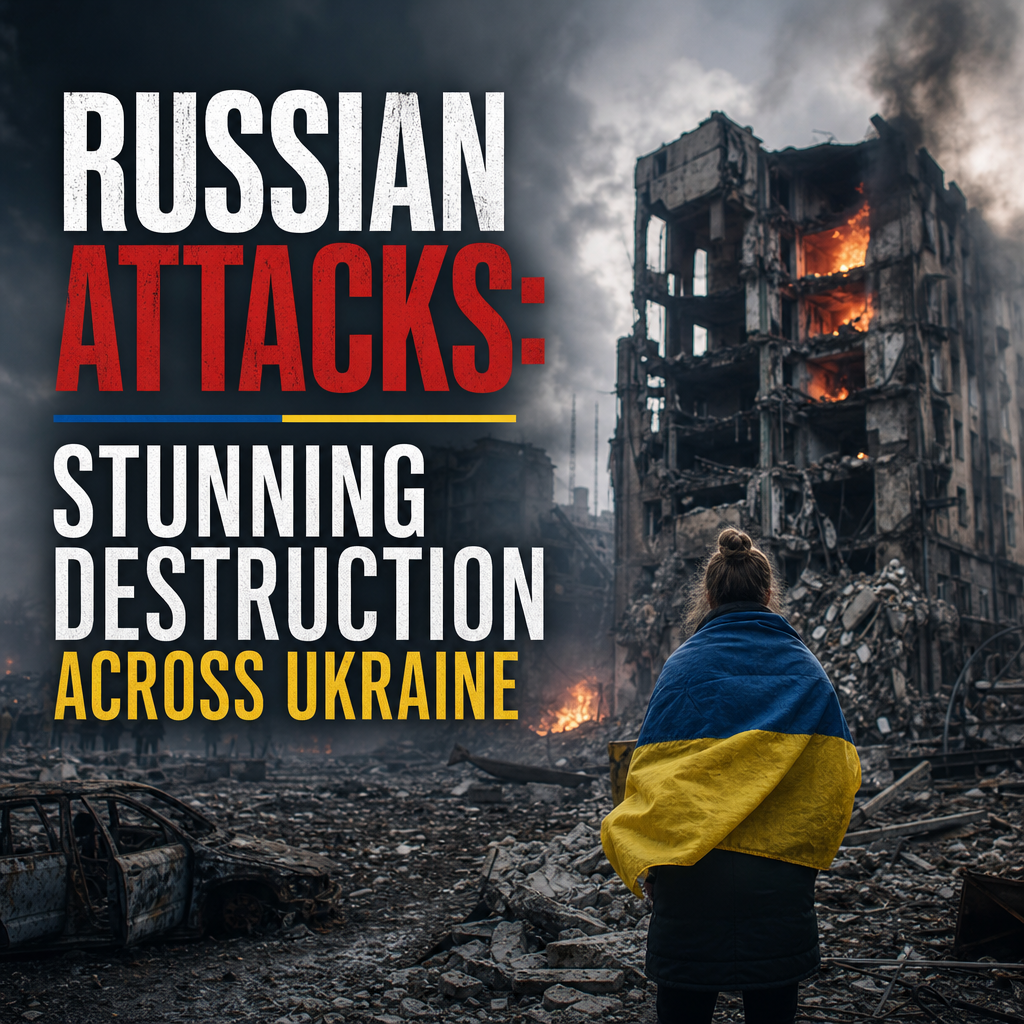
Russian attacks: Stunning destruction across Ukraine


Russian attacks have once again left cities, homes, and infrastructure across Ukraine visibly scarred, underscoring how the war continues to cycle between battlefield claims and civilian suffering. Reports from multiple news outlets paint a picture of widespread damage, interrupted daily life, and a conflict that shows no sign of easing even as each side insists it has the upper hand.
What stands out most is not just the scale of the destruction, but the different ways it is being framed. Coverage from international broadcasters such as Al Jazeera and Sky News emphasizes the human cost: shattered apartment blocks, emergency crews searching through rubble, power and water disruptions, and residents trying to carry on amid repeated air-raid warnings. By contrast, Russian state media outlets like RT typically stress military justification, portraying attacks as strikes on legitimate targets or as part of a broader campaign against Ukrainian military infrastructure. That gap in framing is important, because it shapes how audiences understand both the immediate events and the wider war.



A War Measured in Damage and Exhaustion
For Ukrainians on the ground, the debate over narrative matters far less than the immediate consequences. When missiles, drones, or artillery hit residential neighborhoods, the result is often the same: destroyed homes, frightened families, and public services stretched even thinner. Even when a strike is described by one side as “successful” in military terms, the aftermath reported by independent and international outlets usually reveals a broader toll that includes civilians, businesses, schools, and hospitals.
The latest round of attacks, according to the overall news picture, appears to fit a familiar pattern. Ukrainian authorities frequently report that Russian strikes target multiple regions at once, forcing emergency workers to respond across wide areas. The damage is rarely confined to a single building. Power systems, transport links, and communication networks are often affected too, which means the impact can ripple far beyond the blast site.




That is what makes the story so grim: destruction in Ukraine is not only physical. It is psychological and economic as well.
– Families lose not just their homes but also their sense of safety.
– Local governments must divert limited resources to emergency repairs.
– Businesses struggle to reopen when infrastructure is unreliable.
– Schools and hospitals face repeated disruptions, even when they are not directly hit.
In this sense, the attacks are not isolated events. They are part of a long war of attrition that wears down everyday life.
Russian Attacks and the Battle Over Narrative
The contrast between sources becomes especially clear when looking at how the same event can be described in radically different language. International reports generally focus on destruction, civilian trauma, and Ukraine’s calls for more air defenses. Russian outlets, meanwhile, often present attacks as necessary responses to Ukrainian military activity or as evidence that Russia is still shaping the battlefield.
That difference does not automatically mean every Russian claim is false or every Ukrainian statement is complete. War reporting is notoriously difficult, and both sides have strong incentives to emphasize favorable details and omit unfavorable ones. But it does mean readers should be cautious when treating any single account as definitive.
A fair reading of the available reporting suggests three things are true at once:
1. Ukraine continues to experience severe damage from Russian strikes.
2. Russia seeks to portray those strikes as strategically justified.
3. Independent verification is often limited in real time, especially in active combat zones.
This is where broader international coverage becomes valuable. It helps separate verified damage from battlefield messaging. It also reminds readers that the civilian dimension of the war should not be lost in the noise of military claims.
Why the destruction matters beyond the battlefield
The physical damage caused by Russian attacks has implications well beyond the frontline. Infrastructure losses can slow economic activity, deepen displacement, and strain already overburdened public services. The longer such attacks continue, the harder it becomes for communities to recover, even in areas not directly involved in fighting.
There is also a strategic layer. Repeated strikes on civilian infrastructure can be seen as an attempt to pressure Ukraine by making normal life increasingly difficult. Whether that is the intended effect or not, the consequence is clear: the burden of the war is felt most heavily by ordinary people.
What Can Be Said Responsibly
The most responsible conclusion, based on the mix of reporting, is that the destruction across Ukraine remains severe and deeply destabilizing, even as the exact military significance of each attack remains contested. International outlets are consistent in describing the visible aftermath and the civilian toll. Russian media offers a competing interpretation that frames the strikes as part of military necessity. Neither angle fully captures the whole picture on its own.
What does seem beyond dispute is that the war’s destructive capacity remains very high. Each new wave of attacks reinforces the same bleak reality: Ukraine’s resilience is being tested not only on the battlefield, but in homes, neighborhoods, and public systems that must somehow keep functioning under relentless pressure.
Until there is either a major shift in battlefield dynamics or a credible diplomatic breakthrough, the most likely pattern is continued destruction, continued dispute over responsibility and purpose, and continued suffering for civilians caught between competing narratives and expanding ruins.