Erdogan Urges Must-Have US-Iran Deal, Best Move


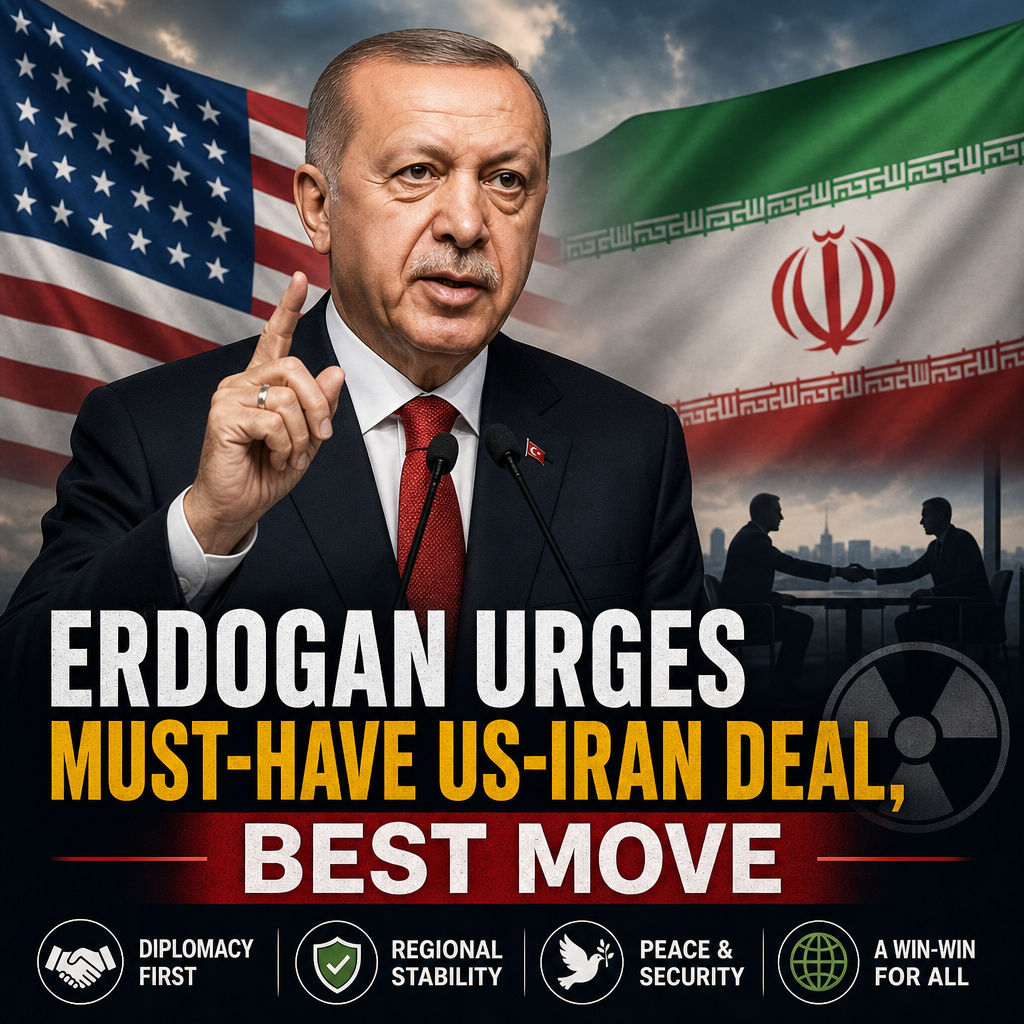
Erdogan’s push for a US-Iran deal is a reminder that, even in a volatile Middle East, diplomacy is still seen by some leaders as the least dangerous option. Turkish President Recep Tayyip Erdogan has argued that Washington and Tehran should strike an agreement and warned that Israel should not be allowed to derail that effort, a message that reflects both Ankara’s regional anxieties and its desire to keep the door open to negotiation.
The timing matters. The region is already under strain from the war in Gaza, repeated cross-border tensions, and a broader contest involving the US, Iran, Israel, and armed groups aligned with Tehran. In that environment, any talk of a new agreement between the US and Iran is not just about nuclear diplomacy or sanctions relief. It is also about whether the region can avoid sliding into a wider confrontation that would be difficult to contain.



Why Erdogan is pressing for a US-Iran deal
Erdogan’s intervention fits a long-standing Turkish foreign-policy pattern: criticize escalation, favor bargaining, and resist being boxed into a purely military logic. Turkey has often tried to position itself as a regional broker, even when its relations with Washington, Tehran, or Tel Aviv have been tense. By urging a deal, Erdogan is signaling that Turkey sees negotiation as better than open-ended pressure or a spiral of retaliation.
There is also a practical dimension. Turkey depends on regional stability for trade, energy flows, tourism, and border security. A clash involving Iran could disrupt all of those. Ankara has little appetite for a wider war in its neighborhood, especially one that could send new waves of displacement, spike energy prices, and deepen sectarian and geopolitical divides.




From Al Jazeera’s reporting and regional framing, the emphasis is clearly on the risk of outside actors undermining diplomacy. The suggestion that Israel could “dynamite” a possible agreement reflects the broader perception among some governments in the region that Israeli military moves and political pressure can narrow the space for negotiations. Whether one agrees with that framing or not, it captures an important reality: any US-Iran understanding would face fierce opposition from multiple fronts.
What the other viewpoints are saying
Sky News’ broader international coverage tends to stress the strategic uncertainty surrounding Iran and its relationships with Western powers. From that perspective, the problem is not just whether a deal is desirable, but whether it is politically sustainable in either Washington or Tehran. US administrations have struggled to balance domestic critics, regional allies, and the technical complexity of enforcing any agreement. Iran, meanwhile, has consistently demanded guarantees that are difficult for American leaders to promise.
RT’s commentary style often centers on the idea that US policy in the Middle East is shaped by contradiction: preaching restraint while enabling conflict, calling for diplomacy while maintaining sanctions and military leverage. That critique resonates with audiences skeptical of Washington’s intentions, and it helps explain why some regional leaders—including Erdogan—prefer to frame the issue as one of preventing escalation rather than rewarding any one side.
Taken together, these three lenses produce a useful picture:
– Turkey’s view: A deal is the safest way to reduce regional risk.
– Western strategic view: A deal is possible, but only if both sides trust each other enough to enforce it.
– Skeptical/critical view: US diplomacy is often undermined by its own allies, domestic politics, or competing security goals.
The result is not a simple debate over whether a deal is “good” or “bad.” It is a test of whether any agreement can survive the political realities around it.
The limits of diplomacy
The most important question is whether a US-Iran deal is actually available in the current climate. On paper, there are obvious reasons for both sides to want one. The US wants to prevent nuclear escalation and reduce the risk of a broader war. Iran wants sanctions relief, economic breathing room, and recognition that it cannot be permanently isolated. But incentives are not the same as trust.
That is why Erdogan’s warning about sabotage is meaningful. In a region where alliances overlap and military responses can happen quickly, negotiations can be derailed by events far from the negotiating table. A strike, a provocation, or a domestic political shift in any of the relevant capitals can collapse months of backchannel work.
There is also a deeper structural problem: even if Washington and Tehran reach an understanding, regional actors may not see it as legitimate unless their own security concerns are addressed. Israel fears any arrangement that leaves Iran stronger. Gulf states worry about Iranian influence. Iran fears encirclement and betrayal. The US, for its part, is often pulled between deterrence and diplomacy.
Best move, but not the easiest one
Erdogan is probably right about one central point: if the goal is to avoid another regional crisis, a negotiated US-Iran deal is better than drifting toward confrontation. That does not mean a deal would be easy, or even likely. It means the alternatives are plainly worse.
Still, realism requires acknowledging that diplomacy alone cannot solve the region’s larger conflicts. A US-Iran agreement could lower tensions, but it would not end the wars, rivalries, and mistrust that keep the Middle East unstable. Nor would it erase the role of Israel, which remains one of the most powerful and influential players in shaping the security debate.
So the best reading of Erdogan’s position is not that a deal would be a magic fix, but that it is the least risky path available. In a region where each new confrontation carries the possibility of escalation beyond anyone’s control, that may be reason enough to keep trying.