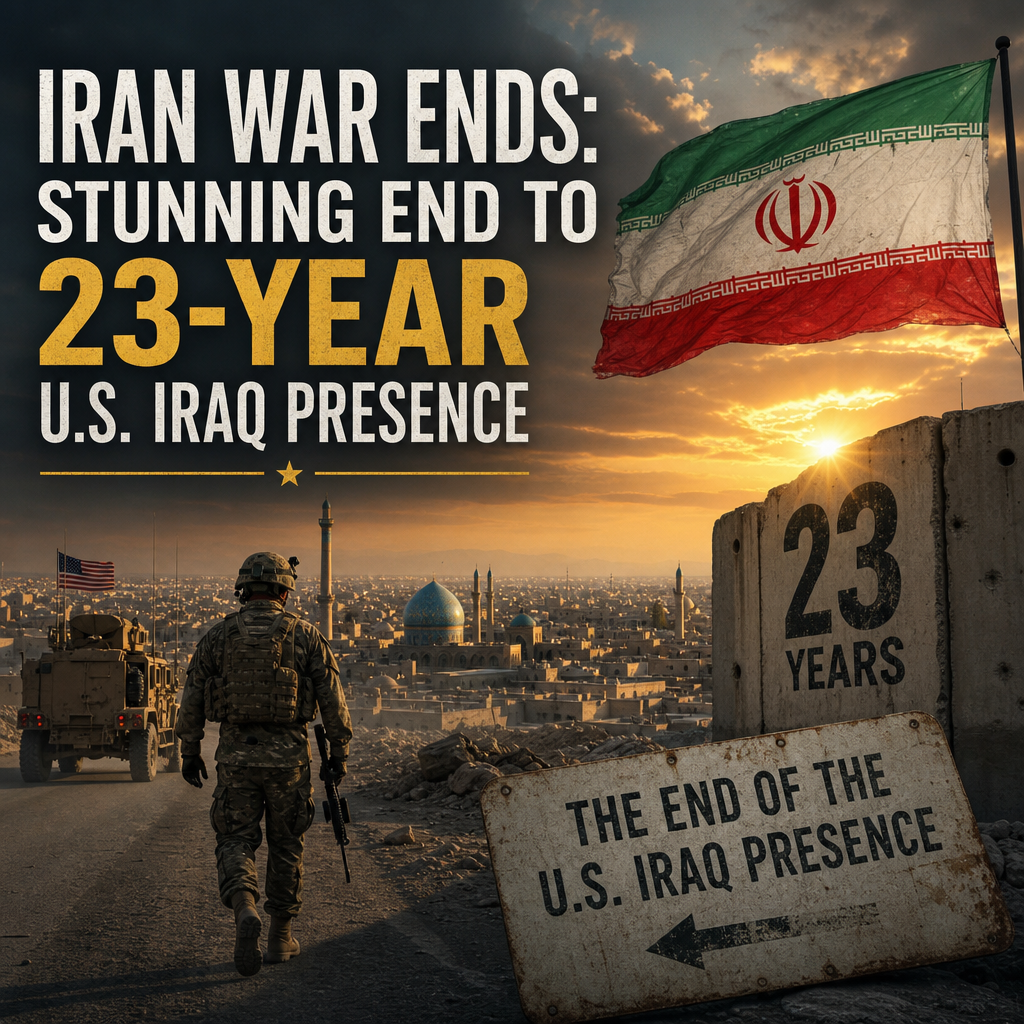
Iran War Ends: Stunning End to 23-Year US Iraq Presence


Iran War Ends is the kind of headline that captures attention immediately, but the reality behind the end of the U.S. military presence in Iraq is more complicated than a single dramatic phrase suggests.
After more than two decades of U.S. involvement, Iraq is now moving into a new phase in which the American-led coalition’s mission is being wound down and redefined. That shift matters far beyond ceremonial flag changes. It reflects changing security conditions, political pressure in Baghdad, regional tensions linked to Iran, and a broader fatigue among Iraqis who have lived with foreign troops for most of their adult lives. But whether this is a true ending, a strategic pause, or simply a rebranding of continued influence depends on whom you ask.



What the drawdown really means
The core fact across the reporting is that the U.S. military footprint in Iraq is shrinking and, in some areas, ending in its current form. RT framed the move as a major turning point, emphasizing the symbolic significance of Washington stepping away after a long and costly presence. That angle resonates with a view common among critics of U.S. intervention: the mission lasted far longer than promised and became tied to a wider regional strategy that many Iraqis never fully endorsed.
Al Jazeera’s broader coverage of Iraq and the region tends to place these developments inside the country’s political reality. Iraq has spent years balancing relations with Washington, Tehran, and domestic factions that disagree on nearly every major security issue. From that perspective, the U.S. drawdown is not just about military logistics. It is also about sovereignty, the legitimacy of the Iraqi state, and whether Baghdad can finally claim more control over its own security architecture.




Sky News, by contrast, typically centers the practical and strategic questions: what happens to counter-ISIS operations, how regional allies react, and whether the U.S. retreat creates a vacuum. That angle matters because even if the headline is “departure,” the consequences can ripple through air defense coordination, intelligence sharing, and the ability to respond to extremist regrouping.
Taken together, the reporting suggests three overlapping truths:
– The U.S. presence in Iraq is undeniably changing.
– Iraq’s leaders want greater autonomy, even if they disagree on how to get there.
– The security risks that justified some level of foreign involvement have not disappeared entirely.
Iran War Ends and the regional context
The phrase “Iran War Ends” may sound oversized, but it points to the larger regional context that has shaped the U.S. role in Iraq since 2003. Iraq was never only about Iraq. It became a battleground for influence between Washington and Tehran, especially after the fall of Saddam Hussein.
That rivalry has played out in elections, militia politics, border security, and the status of armed groups aligned with Iran. For many observers, the reduction of the U.S. presence is therefore less about a clean ending and more about a recalibration in a long struggle for influence. Tehran is likely to view a weaker American footprint as a strategic gain, while Washington may present the transition as a responsible handoff rather than a defeat.
Still, it would be too simple to say that one side has “won.” Iraq itself has been the main arena of cost and consequence. The country has repeatedly had to absorb the fallout from a contest it did not choose: political fragmentation, militia violence, pressure from external powers, and the challenge of rebuilding institutions after years of war and instability.
That is why the most important question is not whether the U.S. has “left,” but what kind of Iraq is left behind. If Baghdad can strengthen its military command structures, improve border security, and reduce reliance on foreign assistance, the drawdown may help stabilize the country. If not, the absence of U.S. forces could expose weaknesses that armed groups or regional actors will quickly exploit.
Why reactions are so divided
Reactions to the end of the U.S. presence are sharply split, and that divide is itself revealing.
Supporters of the exit argue that Iraq has had enough foreign military interference. They point to civilian casualties, sovereignty concerns, and the belief that the U.S. mission often drifted from counterterrorism into open-ended strategic management. For them, the drawdown is overdue and morally necessary.
Others are more cautious. They worry that an abrupt or poorly managed departure could weaken the fight against ISIS remnants and embolden militias operating outside state control. They also note that while the U.S. presence has been controversial, it has often served as a stabilizing force in moments of acute crisis.
A fair reading is that both views contain truth. Foreign troops can undermine sovereignty while also providing security benefits that local institutions are not yet able to replace. Iraq’s dilemma is not unusual: many post-conflict states want outside powers gone, but they also inherit security gaps that those same powers helped create or deepen.
The bigger lesson
The end of a 23-year U.S. presence in Iraq should not be mistaken for the end of American influence, Iranian influence, or Iraq’s security problems. It is, instead, the end of one phase of an intervention whose consequences are still unfolding.
That makes this moment less like a final curtain and more like a stress test. Can Iraq stand more independently? Can the U.S. shift from occupying force to distant partner without losing leverage or responsibility? Can regional powers resist turning Iraq into a proxy arena again?
Those questions do not have simple answers yet. The available reporting points to cautious optimism in some quarters, deep skepticism in others, and a shared recognition that the country’s future will be shaped less by slogans than by whether its leaders can deliver security, political balance, and public trust.
So yes, the presence is ending in a stunningly symbolic way. But in Iraq, endings rarely arrive cleanly. They tend to open the door to a new struggle over who fills the space next.