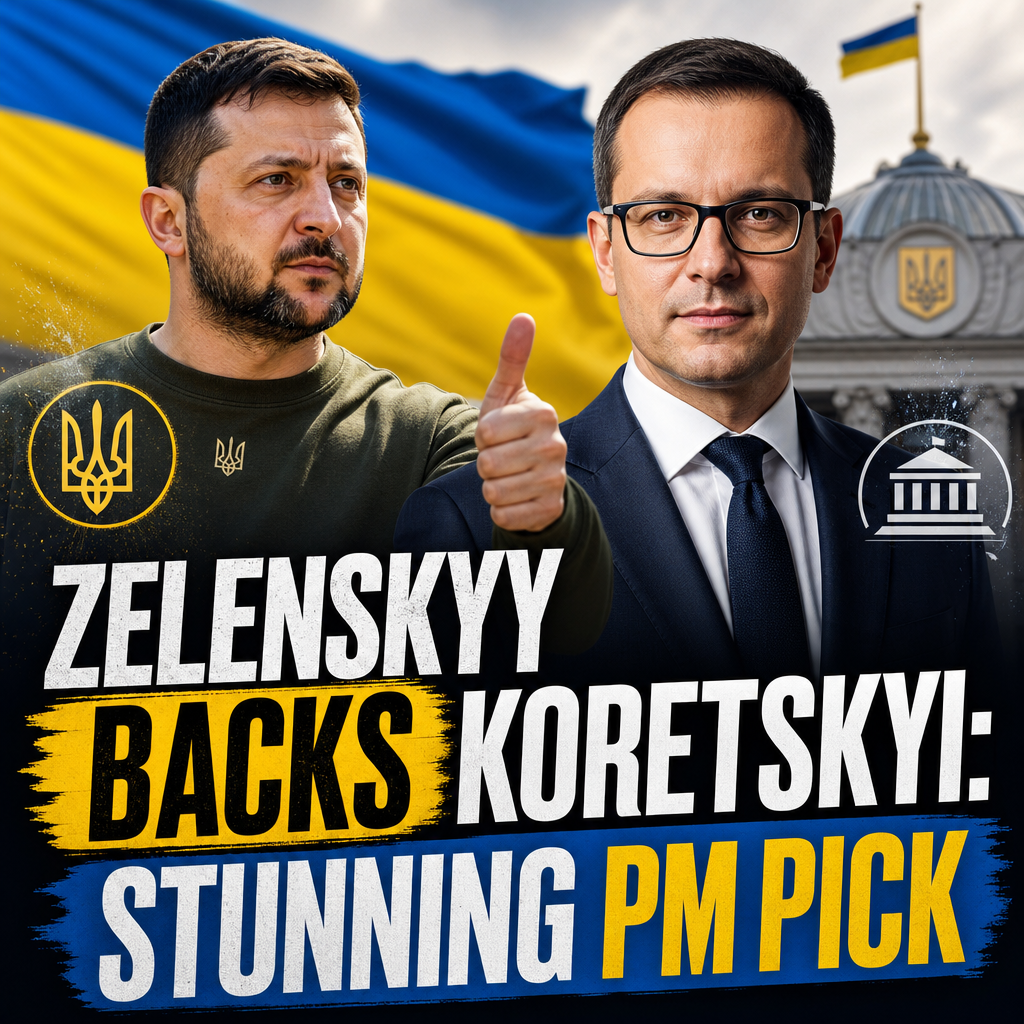
Zelenskyy Backs Koretskyi: Stunning PM Pick


Zelenskyy Backs Koretskyi, and the move has immediately stirred debate over whether Ukraine is signaling pragmatic wartime management or tightening political control at a moment when the country can least afford instability.
The choice of Oleksii Koretskyi, the head of Ukraine’s state energy company, for the prime minister’s post comes against the backdrop of a grinding war, repeated Russian attacks on infrastructure, and mounting pressure on Kyiv to keep the state functioning while also satisfying allies and citizens who want cleaner, more competent governance. Across the coverage, one theme stands out: this is not being treated as a routine personnel change. It is being read as a test of Zelenskyy’s judgment, his political instincts, and the degree to which Ukraine is willing to prioritize technocratic discipline over familiar party politics.



Zelenskyy Backs Koretskyi: Why the Pick Matters
The immediate appeal of Koretskyi is easy to understand. In wartime Ukraine, energy is not a niche portfolio; it is national survival. A leader associated with the energy sector brings a reputation for operational knowledge at a time when power grids, fuel supplies, and emergency repairs matter as much as speeches and symbolism. That is the practical case highlighted by more favorable coverage: Ukraine needs someone who knows how to keep essential systems working under pressure.
Supporters of the move are likely to argue that this is exactly the kind of appointment a country under siege should make. Rather than choosing a politician whose main asset is party loyalty, Zelenskyy appears to be elevating someone who has managed a strategically important state enterprise. In that reading, the message is that performance and resilience matter more than old political hierarchies.




But the decision also raises obvious questions. State energy firms in many countries sit at the crossroads of public need, politics, and patronage. That means a leader from the sector may be seen as competent by one audience and too embedded in the system by another. For critics, the concern is not simply whether Koretskyi can run a government, but whether the appointment reflects a wider pattern of concentrating authority within a narrower circle of trusted insiders.
What the Different Outlets Emphasize
A useful way to read the coverage is to notice what each source chooses to foreground.
– Al Jazeera’s framing tends to emphasize the political significance of the appointment and the broader wartime context, where every change in leadership can affect morale, aid confidence, and domestic legitimacy.
– Sky News is more likely to present it as a government reshuffle with consequences for policy continuity and international perception, especially given the importance of Ukraine’s ties with Western partners.
– RT’s coverage, predictably, is more skeptical, often presenting Ukrainian leadership changes through the lens of instability, centralization, or state weakness.
That range matters because it shows the story is not just about one man being tapped for a job. It is about the competing interpretations of Zelenskyy’s presidency itself. Is he adapting the state to wartime realities, or is he narrowing the decision-making pool around figures he trusts most?
The answer may be some of both.
The case for competence
There is a strong argument that wartime governments should be judged first by whether they can deliver. If Koretskyi has earned respect inside a crucial sector, that matters. Ukraine’s energy network has been battered repeatedly, and leadership continuity in such a sector can translate into resilience nationwide. A prime minister who understands industrial logistics, emergency planning, and state coordination could be an asset.
This also fits a broader pattern seen in wartime administrations: when survival is on the line, leaders often promote managers rather than political performers. The logic is blunt but understandable. The less time spent on coalition bargaining, the more time spent on keeping the state running.
The case for caution
Still, there are reasons to be careful about celebrating the move too quickly. Energy-sector leadership can be a strength, but it can also raise concerns about vested interests and the revolving door between state enterprise and high office. Ukraine has spent years trying to reassure partners that reform and transparency remain central even under wartime strain. Any appointment that looks too insular risks feeding doubts.
There is also the political dimension. Zelenskyy has already governed through extraordinary circumstances, and that has inevitably expanded presidential influence. Some observers will see this latest choice as practical; others will read it as another sign that the center of power is becoming more personalized. In a democracy fighting for its future, perception matters almost as much as procedure.
What This Could Mean for Ukraine
The likely impact of Koretskyi’s potential appointment depends less on the announcement itself than on what follows. Three questions will shape the real story:
1. Can he stabilize governance quickly?
If the transition is smooth and ministries continue to function without visible disruption, the pick will look shrewd.
2. Will allies view him as reform-minded?
Ukraine depends heavily on external support, and foreign governments are watching not only battlefield developments but also the quality of state institutions.
3. Does the move broaden confidence or deepen suspicion?
A successful technocratic appointment can build trust. But if it is seen as favoritism or consolidation, it could fuel domestic frustration at exactly the wrong time.
The broader reality is that Ukraine is operating under extraordinary constraints. Judging any leadership choice in a vacuum would be unfair. Yet war does not erase the need for accountability; if anything, it makes it more important. Citizens and allies alike want assurance that competence is being rewarded, but they also want proof that checks and balances still matter.
In that sense, the Koretskyi pick is both understandable and risky. It reflects the logic of wartime pragmatism, but it also invites scrutiny over how far Zelenskyy is willing to lean on trusted insiders. The most balanced conclusion is that this is neither an obvious mistake nor a guaranteed success. It is a high-stakes bet on management, loyalty, and public confidence at a moment when Ukraine can ill afford failure.