Hungary Sets Stunning Condition for Ukraine’s EU Bid


Ukraine’s EU bid has run into a fresh obstacle, and this time the resistance is coming from inside the bloc itself. Hungary’s latest stance has once again shown that Kyiv’s path to membership is not just about reforms in Ukraine, but also about the political will of all 27 EU states to keep the process moving.
Hungary’s leverage over Ukraine’s EU bid
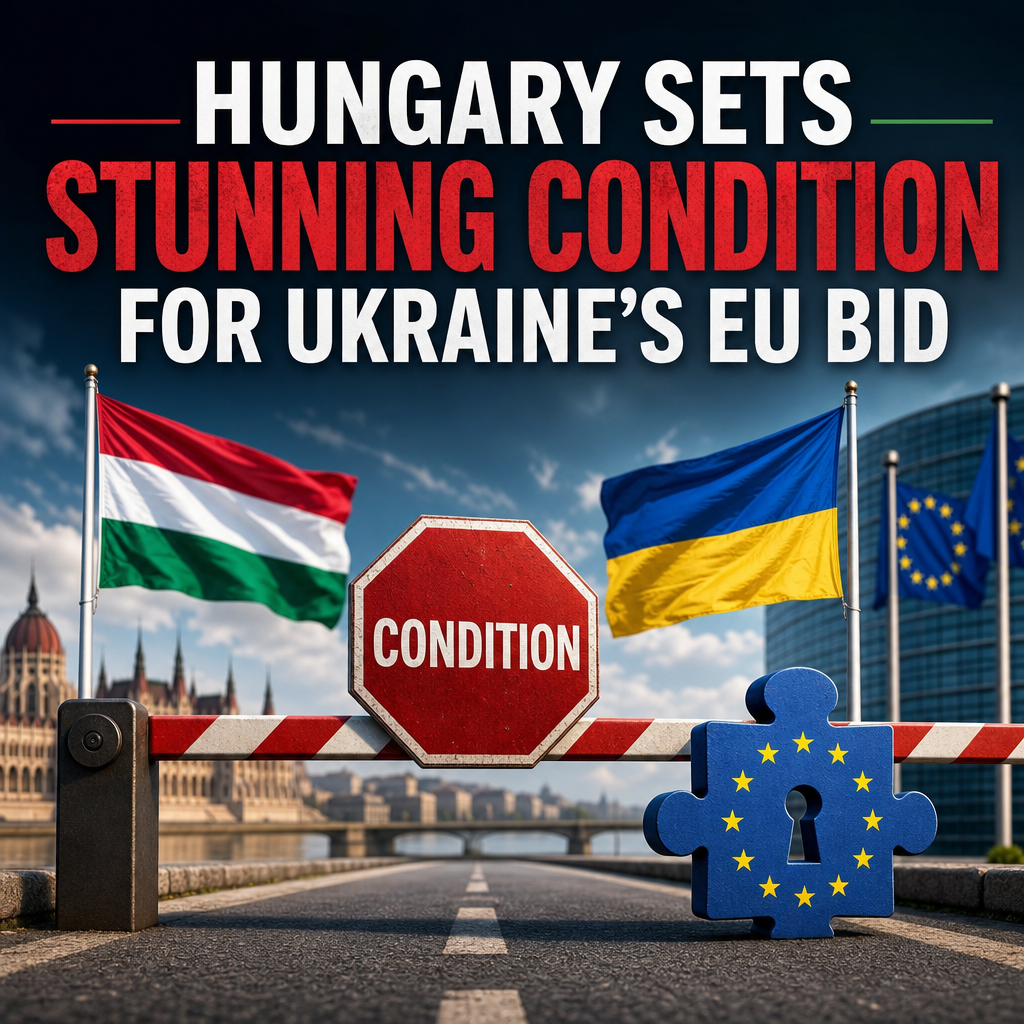
Hungary has become the most consistent holdout in the EU enlargement debate, and its latest condition for Ukraine is being read in Brussels as both a warning and a bargaining tactic. Budapest has long argued that Ukraine must address issues tied to the rights of ethnic Hungarians living in western Ukraine, especially language and education rules that Hungary says were eroded in recent years.



That position matters because EU accession requires unanimity at key stages. In practical terms, that gives Prime Minister Viktor Orbán’s government real leverage: one country can slow or block the process, even if the rest of the bloc is ready to move ahead. For Ukraine, which is fighting a full-scale war while trying to align with EU standards, that creates a frustrating contradiction. Kyiv is being asked to make sweeping institutional changes at the same time that its territory, economy, and security are under daily pressure.
From Hungary’s point of view, this is not simply obstruction for its own sake. Budapest presents its stance as a defense of minority rights and national sovereignty. Hungarian officials say that if a country wants the privileges of EU membership, it must also take seriously the treatment of minorities and the rule of law. That argument may be politically convenient, but it is not entirely without substance. The EU has repeatedly framed enlargement as a values-based project, not just a geopolitical one.




Still, the timing of Hungary’s demands makes many European leaders suspicious. With the war still raging, and with the EU eager to signal support for Ukraine, Budapest’s hard line looks to critics like a deliberate attempt to extract concessions on unrelated issues. It is also part of a broader pattern: Orbán has frequently challenged mainstream EU policy on Ukraine, Russia, sanctions, and aid.
Why Ukraine’s EU bid is about more than one country
The bigger story is that Ukraine’s EU bid has become a test of what enlargement means in a moment of war. Supporters in Brussels, Kyiv, and several EU capitals argue that Ukraine’s candidacy is strategically important. Bringing Ukraine closer to Europe, they say, reinforces the continent’s political unity and sends a signal that Russian pressure will not determine Ukraine’s future.
Al Jazeera’s coverage of the broader conflict has often emphasized the human and geopolitical stakes of that choice: Ukraine is not seeking accession from a position of stability, but from the middle of a devastating war. That makes the membership process uniquely difficult. Reforms are hard enough in peacetime; they become far more complicated when a country is rebuilding institutions, defending its territory, and trying to keep the economy functioning.
At the same time, the EU cannot ignore its own rules. Candidate countries are expected to meet standards on judicial independence, anti-corruption efforts, media freedom, and minority protections. Sky News has reported in previous coverage that European leaders often describe Ukraine’s accession as a long-term project rather than a quick political gesture. That is an important reality check. Even if political support exists, actual membership can take years, sometimes much longer.
In other words, Hungary’s condition is only one piece of a larger puzzle. Ukraine must still prove it can meet the bloc’s criteria, and the EU must prove it can keep enlargement from being derailed by individual member-state politics.
The competing arguments in plain terms
The dispute can be understood through three distinct lenses:
– Hungary’s argument: Ukraine should not be rewarded with closer EU integration unless it protects minority rights and addresses Hungary’s concerns.
– Ukraine’s argument: It is unfair for a country at war to be held hostage by bilateral disputes when it is already working toward EU standards.
– The EU’s dilemma: Enlargement must remain credible and rule-based, but the unanimity requirement gives every member a veto-like power that can be used for national politics.
This is why the issue feels bigger than a single condition. It is really about whether the EU can enlarge while staying united, and whether Ukraine can keep momentum when one member state chooses to slow the process.
What this means for Brussels, Kyiv, and the wider region
For Brussels, the immediate challenge is political management. EU leaders want to avoid a public showdown with Hungary, but they also do not want accession policy to become a hostage to domestic politics in any one country. That tension will only grow if Budapest continues to use the enlargement file as leverage in disputes over funding, sovereignty, or broader EU policy.
For Kyiv, the message is equally stark. Ukraine has strong support in many European capitals, but support does not equal automatic accession. The country still has to complete reforms, manage wartime governance, and navigate a diplomatic process that can be slowed by any member state. Even so, the strategic direction remains clear: Ukraine’s leadership sees EU membership not as a symbolic prize, but as part of the country’s long-term security and recovery.
For the wider region, Hungary’s move is another reminder that the war in Ukraine is reshaping European politics well beyond the battlefield. Enlargement, minority rights, energy policy, and security are now tightly linked. What once looked like a technical accession debate has become a referendum on Europe’s future order.
The most balanced conclusion is this: Hungary’s concerns should not be dismissed outright, because minority rights and treaty obligations matter in the EU framework. But using those concerns to create a near-endless blockage would damage the credibility of enlargement and weaken Europe’s response to the war. Ukraine’s EU bid is likely to remain contested, and that uncertainty is now part of the process itself.