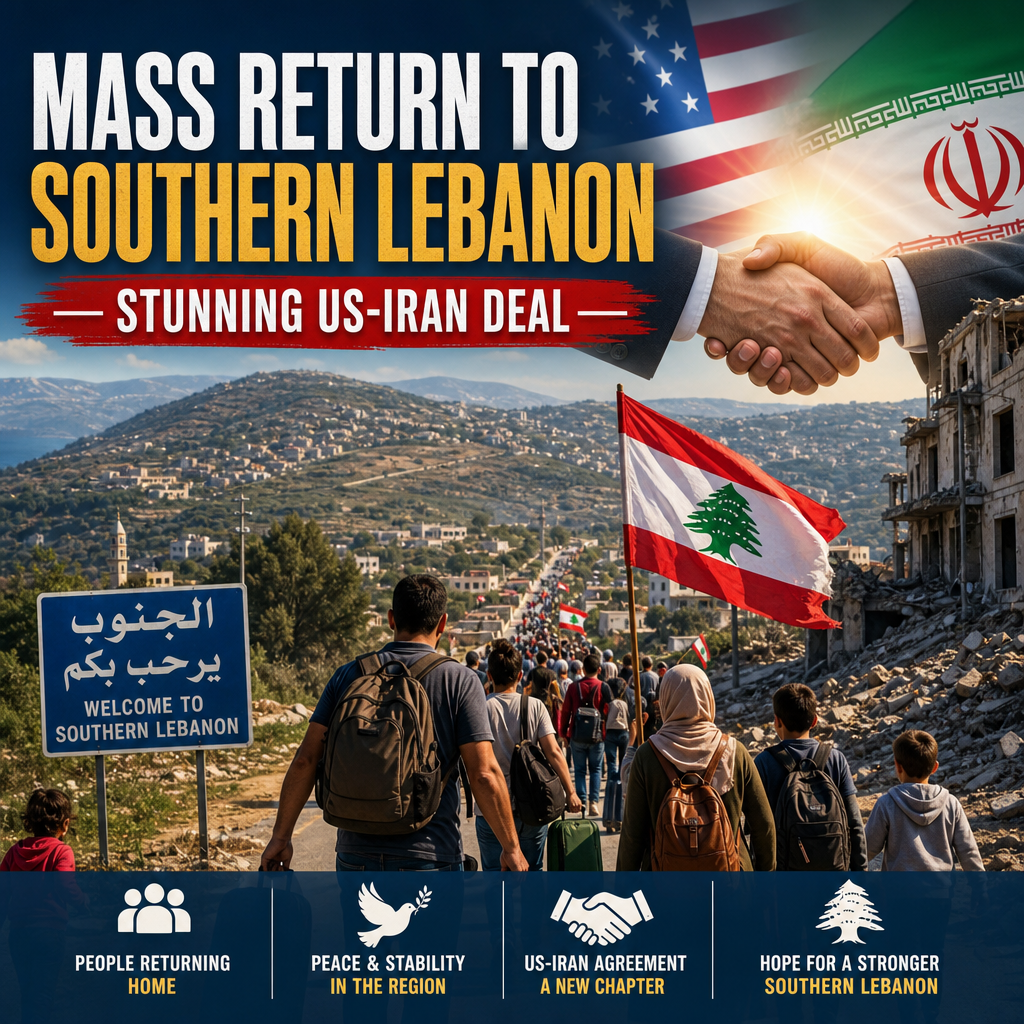
Mass Return to Southern Lebanon: Stunning US-Iran Deal


Mass return to southern Lebanon is being greeted with a mix of relief, caution, and deep political skepticism after reports of a US-Iran agreement helped clear the way for displaced families to head back home.
For many Lebanese households, the immediate story is painfully simple: after weeks or months of uncertainty, people want to sleep in their own beds, check on damaged homes, and reopen their lives. But beyond the human dimension, the reported agreement has also reopened a much bigger debate about whether diplomacy can ease one of the Middle East’s most volatile fault lines—or whether it merely pauses the next crisis.



A humanitarian return with heavy political baggage
The most visible part of the story is the return itself. In southern Lebanon, roads that had emptied during the latest round of tension are now seeing vehicles loaded with families, furniture, and what little they could carry. That movement signals hope, but not necessarily safety. Residents returning to towns near the border are doing so with unanswered questions about unexploded ordnance, damaged infrastructure, and whether the calm will last.
This is why the reaction has been so mixed. On one hand, the return suggests that at least some immediate pressure has eased. Humanitarian groups and local communities tend to view that as an urgent win: people need access to homes, schools, clinics, and livelihoods.




On the other hand, the speed of the return raises concerns. If an agreement between Washington and Tehran is truly shaping events on the ground, then the situation may still be fragile and highly dependent on actors far outside Lebanon. That leaves ordinary families in a familiar position: they are encouraged to move forward, even while the larger conflict remains unresolved.
Why the US-Iran deal matters, and why it may not settle much
A reported US-Iran deal would matter because both countries, directly or indirectly, influence the regional equation. Iran’s ties to armed groups in Lebanon are well known, while the United States remains central to diplomacy, deterrence, and the broader balance of power in the region. If the two sides have reached even a limited understanding, it could create space for de-escalation without a full peace settlement.
Still, any deal of this kind should be viewed carefully.
Three readings of the agreement
Different outlets and perspectives tend to frame the development in distinct ways:
– A diplomatic breakthrough view: Some analysts see the return as evidence that back-channel negotiation can reduce violence, even if only temporarily. In this reading, the agreement is less about friendship and more about mutual restraint.
– A humanitarian relief view: Others focus on the practical outcome—families are going home, and that alone is a meaningful improvement after displacement and fear.
– A strategic skepticism view: Critics argue that deals involving Washington and Tehran often manage symptoms rather than causes. From this angle, a return to southern Lebanon does not mean the underlying military and political tensions have been solved.
That third view is especially important. Southern Lebanon has long been caught between local realities and regional rivalries. A ceasefire, informal understanding, or temporary arrangement can create breathing room, but it does not erase the security concerns of neighboring states, nor does it resolve the question of who controls escalation.
The regional stakes are bigger than Lebanon alone
The return of civilians is happening in a landscape shaped by competing narratives. Lebanese communities are focused on rebuilding normal life. Israeli officials and security-minded observers are likely to watch developments closely, wary of any arrangement that could allow armed groups to retain or expand capabilities near the border. Iranian and pro-Iran voices, meanwhile, may present the agreement as proof that resistance and pressure have forced negotiations on more favorable terms.
That clash of interpretations matters because it influences what comes next. If one side believes the agreement signals restraint, while another sees it as a tactical pause, the risk of miscalculation remains high.
Internationally, Western media commentary often emphasizes the instability of the arrangement and the difficulty of enforcing durable commitments. Regional coverage may place more weight on sovereignty, deterrence, and the everyday needs of civilians. Both angles contain part of the truth. People in southern Lebanon do need immediate relief. But they also need guarantees that they will not be displaced again in a few weeks or months.
What to watch in the days ahead
The real test of this reported deal will not be the first wave of returning cars and trucks. It will be whether the return becomes sustainable.
Key questions remain:
– Will residents be able to restore basic services quickly?
– Are damaged areas safe to re-enter?
– Is the agreement formal and enforceable, or merely an informal understanding?
– Does the return indicate a broader de-escalation, or only a temporary pause?
– How will Israel, Lebanon’s political factions, and outside powers respond?
For now, the most responsible conclusion is a cautious one. The mass return to southern Lebanon is genuinely significant, especially for families who have endured displacement and uncertainty. It could also be an early sign that diplomacy has created a narrow path away from further escalation.
But it would be premature to call it a lasting turning point. In a region where deals are often shadowed by distrust, the difference between relief and renewed crisis can be measured in days. The people returning home deserve more than symbolic calm—they need lasting stability, physical safety, and a political framework that does not force them to flee again.