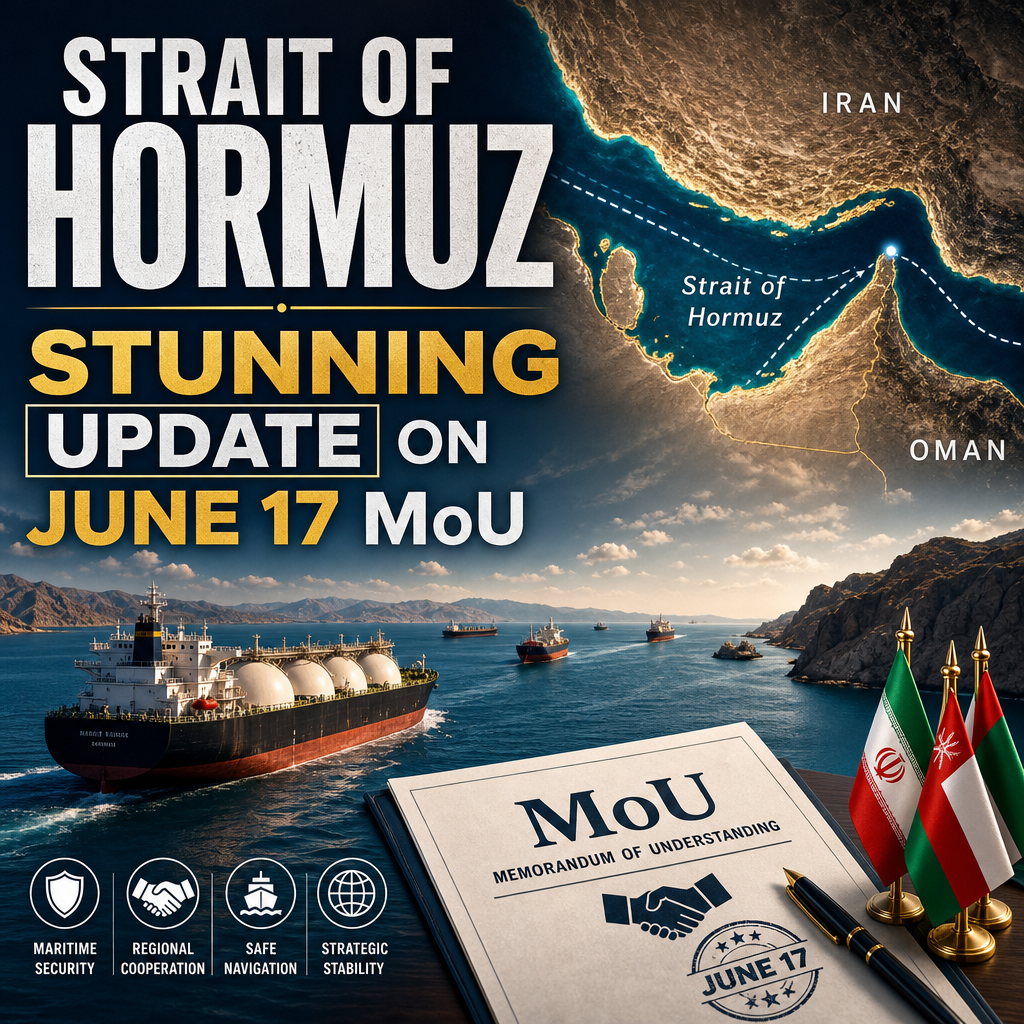
Strait of Hormuz: Stunning Update on June 17 MoU


Strait of Hormuz developments since the June 17 memorandum of understanding have kept markets, diplomats, and security analysts on edge, but the picture remains more complicated than any single headline suggests.
What stands out across reporting from Al Jazeera, Sky News, and RT is not a neat breakthrough or a clean collapse, but a tense pause in a region where small moves can have outsized consequences. The Strait of Hormuz remains one of the world’s most consequential chokepoints, and even modest changes in naval posture, diplomatic language, or shipping behavior can ripple through global energy markets almost immediately.



Strait of Hormuz: what the June 17 MoU appears to have changed
The June 17 memorandum has been framed by different outlets in very different ways. In some coverage, it is portrayed as a practical step meant to reduce immediate friction and keep maritime traffic flowing. In others, it is presented less as a durable agreement and more as a temporary political signal — useful in the short term, but too fragile to remove the underlying risks.
That split matters because the Strait of Hormuz is not just a shipping lane; it is a pressure point where military signaling, sanctions policy, and regional rivalries all intersect. If the memorandum was intended to reduce the chance of confrontation, then its value may lie in what has not happened so far: no major escalation, no prolonged closure, and no dramatic interruption to tanker traffic. But if the goal was to create confidence, the broader mood remains cautious.




The different source perspectives suggest three overlapping realities:
– Diplomatic optimism is limited. Any understanding involving the US and Iran is likely to be tactical first and strategic second.
– Security concerns remain active. Regional actors still treat the strait as vulnerable to disruption, whether through direct confrontation or proxy pressure.
– Markets are watching behavior, not words. Traders and shipping operators respond less to formal statements than to actual patterns of risk.
That makes the June 17 MoU noteworthy, but not decisive. It may have lowered the temperature temporarily, yet it has not removed the underlying causes of instability.
Why the Strait of Hormuz remains such a flashpoint
The Strait of Hormuz matters because it carries a large share of the world’s seaborne oil exports. That makes it an economic lifeline far beyond the Gulf. Any threat to passage can quickly affect freight rates, insurance costs, and energy prices worldwide.
This is why even the hint of progress tends to be welcomed by governments and markets alike. A calmer strait means fewer panic scenarios, less pressure on global supply chains, and more room for diplomacy. But the opposite is also true: when tensions rise, the consequences are not limited to the immediate region.
Sky News reporting in particular reflects the concern that the strait’s stability is always conditional. Shipping can continue normally for a while, yet still remain exposed to a sudden shock. That helps explain the narrow, pragmatic nature of many official reactions: rather than declaring success, governments tend to speak about risk management, deterrence, and “de-escalation” without claiming the problem has been solved.
Al Jazeera’s coverage, meanwhile, tends to emphasize the geopolitical context: the strait is not an isolated issue, but part of a wider cycle involving Iran, the United States, Gulf states, and shifting regional alliances. In that framing, the memorandum is one chapter in a longer dispute rather than a turning point on its own.
Competing readings: relief, skepticism, and strategic messaging
RT’s reporting often highlights the tension between official calm and underlying suspicion. From that angle, the June 17 understanding may be read as a tactical move by one or both sides to avoid immediate confrontation, while leaving larger disputes unresolved. That interpretation fits a broader pattern in which agreements are announced, celebrated, and then tested almost immediately by events on the ground.
A fair reading of the available coverage suggests there are at least two competing interpretations of the update:
1. The hopeful view
Supporters of the memorandum’s significance argue that even limited restraint is valuable. If the agreement helped prevent escalation, maintained shipping continuity, and opened space for indirect communication, then it has already served a purpose. In the Middle East, where crises can accelerate quickly, “good enough for now” can be a meaningful achievement.
2. The skeptical view
Critics argue that a memorandum is not the same as a binding settlement. If distrust remains deep, then the document may simply buy time. That means the strait could still become a flashpoint if talks stall, sanctions tighten, or a maritime incident occurs.
Both readings have merit. The first is rooted in practical realism; the second in historical caution. The challenge is that the Strait of Hormuz has repeatedly shown how quickly those two perspectives can collide.
What seems clear — and what does not
The most responsible conclusion is that the June 17 MoU has likely helped calm the situation, at least temporarily, but has not fundamentally transformed it. There is no strong evidence in the available reporting of a lasting strategic breakthrough. At the same time, there is also no sign of an immediate breakdown.
That uncertainty is itself important. Too often, coverage of the strait swings between alarm and relief. In reality, the situation is probably closer to managed instability: enough restraint to keep ships moving, enough distrust to keep analysts uneasy.
What appears most likely is this:
– The memorandum reduced short-term risk, but not long-term rivalry.
– Maritime traffic remains vulnerable to political shocks.
– Regional actors are still using the strait as both a strategic asset and a bargaining chip.
For now, the Strait of Hormuz is not a story of resolution. It is a story of fragile containment. The June 17 update matters because it may have prevented a worse outcome, but the deeper contest over power, influence, and security in the Gulf is still very much alive.