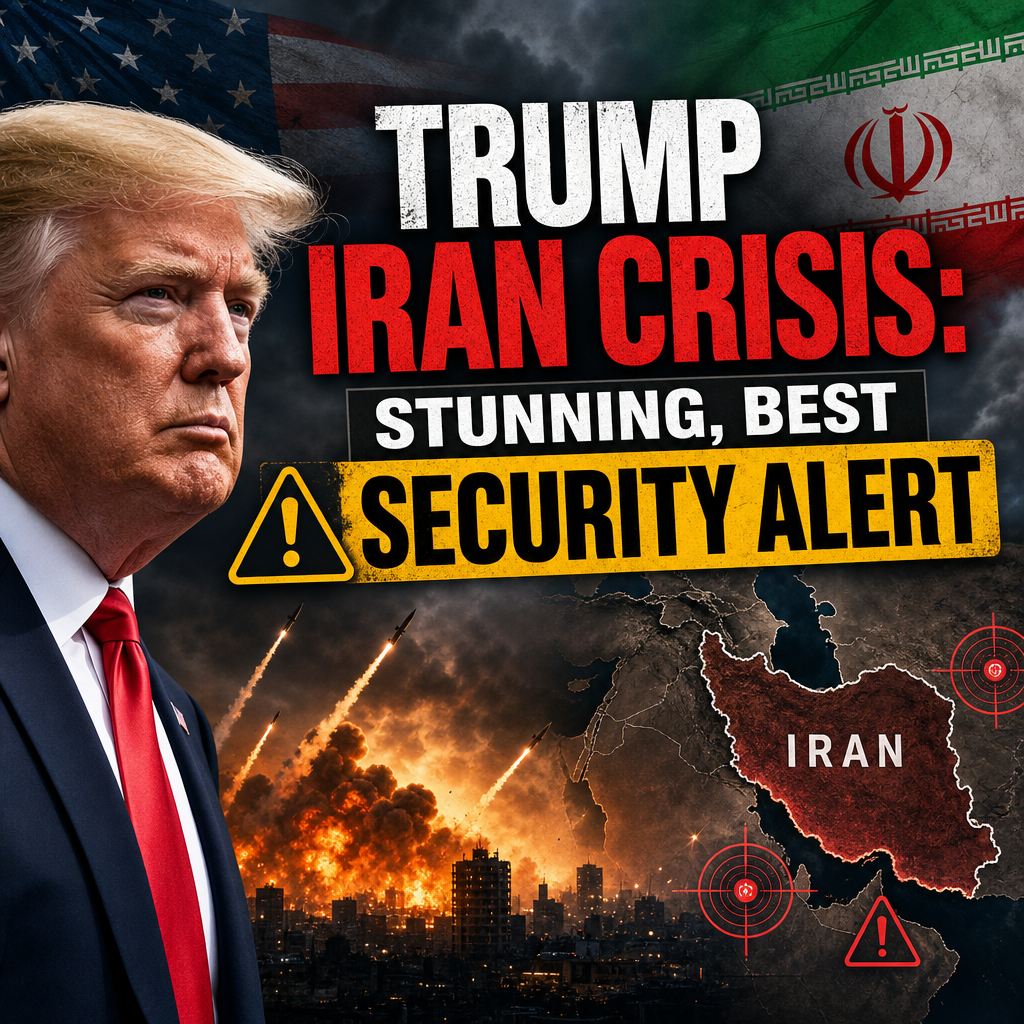
Trump Iran Crisis: Stunning, Best Security Alert


Trump Iran Crisis: a wave of renewed tension around Donald Trump’s security has once again pushed U.S.-Iran relations back into the spotlight, with reports of threats, counter-threats, and intensifying political fallout forcing officials and observers to revisit how fragile the situation remains.
What makes this moment especially striking is that it is not just about one alleged threat or one person’s safety. It sits at the intersection of past military conflict, present-day regional instability, and a highly charged U.S. election climate. News coverage across international outlets has reflected that complexity: some emphasize the immediate security concern, others focus on the broader geopolitical consequences, and still others frame it as part of a longer cycle of retaliation and mistrust between Washington and Tehran.



Why the Trump Iran Crisis is more than a security story
At first glance, the most obvious angle is personal protection. If a former U.S. president is believed to face a credible threat connected to a foreign adversary, the security response naturally becomes urgent. But the deeper issue is what such a threat represents. It suggests that the shadow of the 2020 killing of Iranian commander Qasem Soleimani still hangs over relations between the two countries, and that the risk of retaliation has not fully disappeared.
That helps explain why the reaction from U.S. political and security circles has been so sharp. For Trump, the danger is not merely physical; it is also political. Any security alert involving an ex-president can amplify perceptions of vulnerability and instability, while simultaneously hardening his rhetoric toward Iran. For Tehran, meanwhile, accusations of involvement in targeting an American political figure could intensify diplomatic isolation and further constrain already limited options for de-escalation.




Different outlets have highlighted different layers of that reality:
– RT’s framing has tended to stress the confrontation angle, portraying the issue as part of a wider hostility between Trump and Iran.
– Al Jazeera commonly places such developments in a regional context, tying them to broader Middle East tensions and the cycle of escalation.
– Sky News typically focuses on the practical security and political ramifications, especially the effect on U.S. institutions and the presidential race.
Taken together, those perspectives point to a key truth: this is not only a story about one threat, but about a relationship that has become structurally dangerous.
What the reporting suggests — and what remains uncertain
One of the most important things to recognize is that public reporting in moments like this often moves faster than verified evidence. That matters because allegations involving state-linked threats can quickly become politically explosive, especially when the source material is drawn from a mix of official briefings, anonymous intelligence references, and partisan commentary.
The cautionary note is not to dismiss the threat, but to distinguish between:
1. confirmed security assessments,
2. media interpretation, and
3. political messaging.
That distinction is especially important in the Trump case. He is a figure who draws intense support and equally intense criticism, which means any danger claim can be used by allies to argue that he is under attack from powerful enemies and by opponents to question whether the incident is being politically amplified. The result is a murky information environment in which facts and narratives compete almost immediately.
At the same time, a credible threat cannot be treated as routine. Even if details are incomplete, the fact that authorities take such reports seriously tells us something important about the perceived risk level. In recent years, threats against public figures have become more frequent, and the line between online rhetoric, proxy intimidation, and real-world violence has become increasingly difficult to police.
The geopolitical stakes behind the headlines
The Trump Iran Crisis also matters because it could shape policy far beyond the immediate security response. Any escalation between the U.S. and Iran affects a much wider region already strained by conflict, sanctions, proxy warfare, and shifting alliances. In that sense, the story is less about a single standoff than about whether diplomacy still has room to operate.
There are at least three possible consequences:
– Stronger U.S. security posture: If threats are seen as credible, protection around Trump and related figures will tighten, potentially setting a precedent for other high-profile politicians.
– Harder rhetoric in Washington: Politicians may use the incident to argue for a tougher line on Iran, which can reduce appetite for negotiations.
– Greater regional volatility: Any perception that confrontation is rising can complicate Middle East diplomacy, especially when multiple crises are already overlapping.
Still, a balanced reading suggests restraint is needed. It is tempting to interpret every new development as proof that direct conflict is imminent, but history shows U.S.-Iran tensions often move in cycles of provocation, threat, and partial containment. The danger is real, yet so is the tendency for political actors to exaggerate the certainty of worst-case outcomes.
A measured conclusion
The most responsible conclusion is that the situation deserves serious attention without rushing to absolutes. The Trump Iran Crisis exposes how unresolved grievances can linger for years and suddenly reappear as immediate security concerns. It also shows how quickly such threats become entangled in domestic politics, media framing, and strategic signaling.
What stands out across the different reporting angles is not consensus on motive or method, but agreement on one central point: relations between Trump, the U.S., and Iran remain deeply combustible. Whether the current alert leads to a short-term security tightening or a broader diplomatic hardening will depend on what officials can verify — and how carefully they resist turning uncertainty into certainty before the facts are clear.
For now, the lesson is sobering. In a world where political violence, regional conflict, and information warfare increasingly overlap, even a single warning can reverberate far beyond the person at its center.