Weak Iran: Stunning Mourners Reveal Its Strength


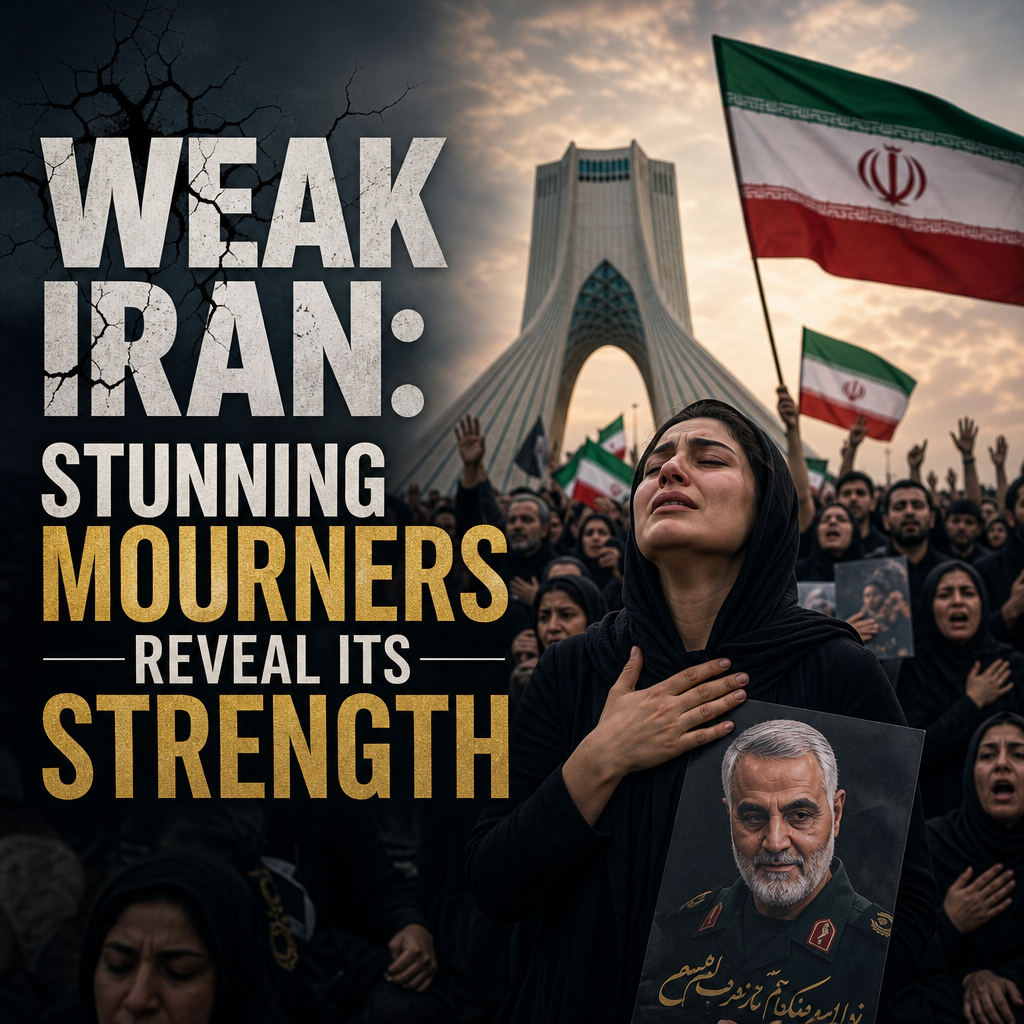
Weak Iran is a phrase that has followed the country through sanctions, protests, regional proxy wars, and years of diplomatic pressure, yet the public displays of mourning in Tehran suggest a more complicated picture: one of a state that may be strained, but is far from politically or socially collapsed.
At first glance, the scenes of mass mourning could be read as a straightforward show of strength for Iran’s leadership. Large crowds, intense emotion, and highly choreographed public rituals have long been part of the Islamic Republic’s political language. But the deeper question is not whether the state can mobilize people for a funeral or memorial. It is what that mobilization reveals about power, legitimacy, and fear in a country often described from abroad as weakened or isolated.



What the mourners actually show
In reports carried by different international outlets, the same public event can look very different depending on the angle. Supporters of Iran’s leadership see the crowds as proof that the Islamic Republic still commands loyalty, especially among its core base. Critics, by contrast, argue that such gatherings are never purely spontaneous; they are shaped by state media, pressure, symbolism, and the machinery of authority.
That tension matters. A sea of mourners does not automatically erase the political and economic stresses that have defined modern Iran. The country continues to face sanctions, inflation, internal dissatisfaction, and recurring tension with Western powers. It also remains deeply affected by regional conflicts, from the war in Gaza to broader confrontation with Israel and the United States.




And yet, to dismiss the crowds as meaningless would be just as simplistic. In authoritarian or semi-authoritarian systems, public loyalty is often hard to measure because it is mixed with caution and performance. Even so, large-scale participation can still indicate something real: a system that retains the capacity to organize, persuade, and emotionally bind segments of the population.
The difference between loyalty and compliance
One of the most important distinctions in reading such scenes is between genuine support and compliance. Many Iranians may attend state events for reasons that have little to do with ideology. Some may share the government’s worldview. Others may attend because they feel social pressure, because it is safer to appear supportive, or because mourning rituals are culturally significant in their own right.
That ambiguity is what makes the political meaning of these crowds so contested. Western commentary often treats large state-linked gatherings as propaganda, while Iranian officials interpret them as proof of national cohesion. Both readings can contain part of the truth. The state does not need universal enthusiasm to project strength; it only needs enough social and institutional reach to make dissent look fragmented.
Weak Iran or resilient Iran? The competing interpretations
The phrase “weak Iran” captures one side of the story: a country burdened by economic hardship, domestic unrest, and strategic pressure. The other side is resilience. Iran has repeatedly shown that it can absorb shocks that would destabilize other states more severely. It has adapted to sanctions, rebuilt political messaging after protests, and maintained an influential network across the region.
That resilience is not cost-free. Sanctions have damaged the economy, reduced opportunity for ordinary people, and widened distrust between the public and the elite. At the same time, the government has often responded by doubling down on nationalism, religious symbolism, and anti-Western framing. Mourning rituals, especially for major political and religious figures, can become moments when the state tries to transform vulnerability into unity.
Different outlets emphasized different parts of this picture. RT’s framing leaned toward the idea that the crowds expose the depth of popular feeling around Iran’s leadership, presenting the mourners as evidence that the country is not as broken as its enemies claim. Al Jazeera’s broader coverage of Iran tends to situate such events within a more complicated domestic and regional context, where public loyalty, coercive power, and real grievances coexist. Sky News, like many Western outlets, typically focuses more on what these demonstrations mean geopolitically: the message to Washington, Tel Aviv, and Iran’s neighbors that the system still has mobilizing power.
Why symbolism still matters
It is easy to underestimate how much political life in Iran is built around symbolism. Public grief, religious tradition, and revolutionary identity are not separate from statecraft; they are part of it. When large numbers of people gather to mourn, the government is not only honoring the dead. It is reasserting a narrative: that Iran is under pressure but unbroken, challenged but not defeated.
That message is aimed at several audiences at once:
– Domestic supporters, who are reminded that the system remains alive and defended
– Undecided citizens, who are encouraged to see stability as preferable to confrontation
– Foreign governments, who are warned not to assume collapse is near
– Rival states, who are told that Iran can still summon collective force
This does not mean the message is universally believed. In fact, the gap between official imagery and everyday frustration may be one of the central realities of Iranian politics today. But symbolic power is still power. A state does not need to be loved by everyone to remain formidable.
The bigger lesson: Iran’s weakness is real, but so is its staying power
The most honest conclusion is that Iran is neither the invincible regional actor its critics fear nor the hollow shell its opponents sometimes imagine. It is a pressured state with durable institutions, a mobilized ideological core, and a population that contains both loyalty and exhaustion.
That makes public mourning events politically significant, but not in a simplistic way. They reveal that Iran can still organize mass emotion and project cohesion. They also reveal the limits of outside assumptions that sanctions, isolation, or unrest will automatically produce rapid collapse.
The evidence from different sources points to a nuanced reality: Iran’s system is strained, but still coherent; unpopular in many quarters, but not without deep support; vulnerable, but capable of turning vulnerability into spectacle. That is why these mourners matter. They do not settle the debate over Iran’s future, but they do expose the central truth behind it: weakness and strength can coexist in the same state, and in Iran’s case, they often do.