Netanyahu: Must-Have Trump Iran Deal Analysis


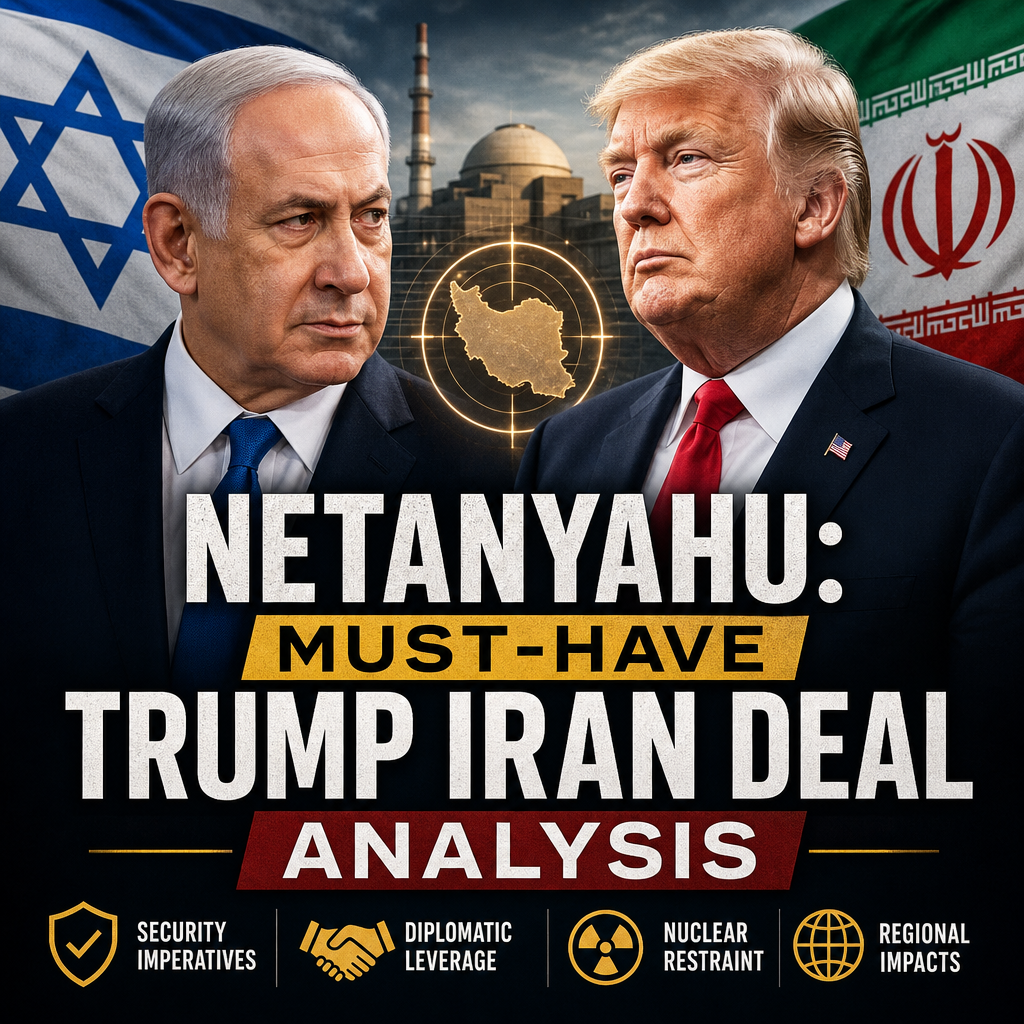
Trump Iran deal talk is back at the center of Middle East diplomacy, and Benjamin Netanyahu’s latest messaging suggests Israel is once again trying to shape the terms before Washington and Tehran can settle on anything that looks like a breakthrough.
For Netanyahu, the issue is not simply whether Iran returns to negotiations. It is whether any agreement would genuinely prevent Iran from moving toward nuclear weapons capability while also addressing the broader regional threat Israel believes Tehran poses through allied militias and proxy forces. For critics, that stance risks turning diplomacy into an impossible test: a deal strong enough for Israel might be too rigid for Iran, while a looser deal could leave serious security gaps in place.



Why Netanyahu is pressing the case now
Netanyahu’s argument fits a long-running pattern. Israeli leaders have consistently treated Iran’s nuclear program as the most urgent strategic danger in the region, and Netanyahu in particular has framed the issue as one where hesitation could be catastrophic. From that perspective, any new agreement must do more than delay uranium enrichment for a few years. It must build in verification, enforcement, and limits that survive changes in U.S. administrations.
That helps explain why the Israeli position often sounds more demanding than the public language coming from Washington. Netanyahu’s political style also matters. At home, he has frequently benefited from presenting himself as the leader who can stand up to hostile powers and pressure allies when needed. In that sense, a hard line on Iran is not only foreign policy; it is also a domestic political message.




But the timing of renewed discussion is complicated. The region remains tense, and diplomatic openings tend to appear alongside military risks. That makes any Iran file especially sensitive, because even small shifts in rhetoric can be read as signals about sanctions relief, nuclear limits, or possible escalation.
What the Trump Iran deal debate reveals
The Trump Iran deal debate is really about two competing definitions of success.
On one side are those who argue that a deal is only useful if it sharply restricts enrichment, inspection limits, and missile-related capabilities, while also addressing Iranian support for regional armed groups. They say the world learned from the flaws of past arrangements: temporary limits may slow a program, but they do not necessarily eliminate the danger.
On the other side are diplomats and analysts who believe the perfect should not become the enemy of the workable. They point out that if negotiations are held to standards Iran will never accept, then no deal is possible at all. That leaves the world with fewer inspections, less transparency, and a higher chance of miscalculation.
The sources covering this issue reflect that divide in tone. RT tends to emphasize the geopolitical clash and the framing of Israeli pressure as part of a larger confrontation with the West and the region. Al Jazeera often places the issue in the context of Palestinian suffering, regional power dynamics, and the broader cost of conflict in the Middle East. Sky News typically approaches the story through the lens of Western diplomacy and the practical question of whether a credible agreement can be reached without triggering new instability.
Taken together, those perspectives suggest one important conclusion: the debate is not just about Iran’s nuclear program, but about trust, enforcement, and who gets to define security.
The concerns behind Israel’s position
Israel’s skepticism is not difficult to understand. From Jerusalem’s point of view, Iran’s nuclear advances cannot be separated from a wider pattern of hostile activity in the region. Any deal that focuses narrowly on uranium levels but ignores the rest of the strategic picture may look incomplete.
Netanyahu’s camp also argues that past diplomacy has too often treated Iran as a conventional negotiating partner, when in their view the country behaves more like a spoiler with multiple arenas of pressure. If that is true, then verification alone may not be enough; enforcement mechanisms and credible consequences would be essential.
Still, there is a risk in assuming that a military or maximalist diplomatic approach can deliver the outcome Israel wants. Pressure can slow nuclear progress, but it can also harden positions. And if Iran concludes that sanctions relief will never come, or that U.S. commitments will always be reversed by the next administration, then it has little incentive to make concessions.
The wider regional stakes
The consequences of any Trump Iran deal would not stop at the Iran-Israel relationship. Gulf states, European governments, and U.S. policymakers all have interests in preventing another war while also limiting nuclear proliferation. A deal that reduces immediate tension could be welcomed broadly, even by countries that distrust Iran.
At the same time, a fragile agreement might calm markets and headlines without solving the deeper strategic rivalry. That is why many analysts see this issue as one of managed risk rather than final resolution. The question is not whether the Iranian file can be closed forever. It is whether diplomacy can buy enough stability to prevent the next crisis.
There is also a humanitarian and political dimension that often gets buried in the security debate. Regional escalation would almost certainly worsen civilian suffering, disrupt trade, and deepen the already severe instability across the Middle East. That is one reason even skeptical governments often prefer a flawed agreement to a breakdown in talks.
A balanced reading of the current debate suggests three things:
– Netanyahu is right that any serious agreement must be enforceable, not symbolic.
– Iran is unlikely to accept a deal that looks like unilateral surrender.
– The U.S. will probably have to choose between a broader but softer accord and a narrower, tougher one that may be harder to sustain.
No easy outcome, only hard choices
The most honest conclusion is that there is no clean solution here. Netanyahu’s insistence on a tougher Iran framework reflects real security fears, not just political theater. But it also reflects a worldview in which compromise is often seen as a trap rather than a tool.
That does not mean his warnings should be dismissed. Nor does it mean the only alternative is endless confrontation. The challenge is to design an agreement that is strict enough to reassure regional partners, flexible enough for Iranian acceptance, and durable enough to survive political turnover in Washington.
Whether that is possible remains uncertain. What is clear is that the stakes go far beyond a single headline or one leader’s statement. A deal that merely postpones the problem could create a false sense of safety, but no deal at all could leave the region drifting toward a far more dangerous collision.