
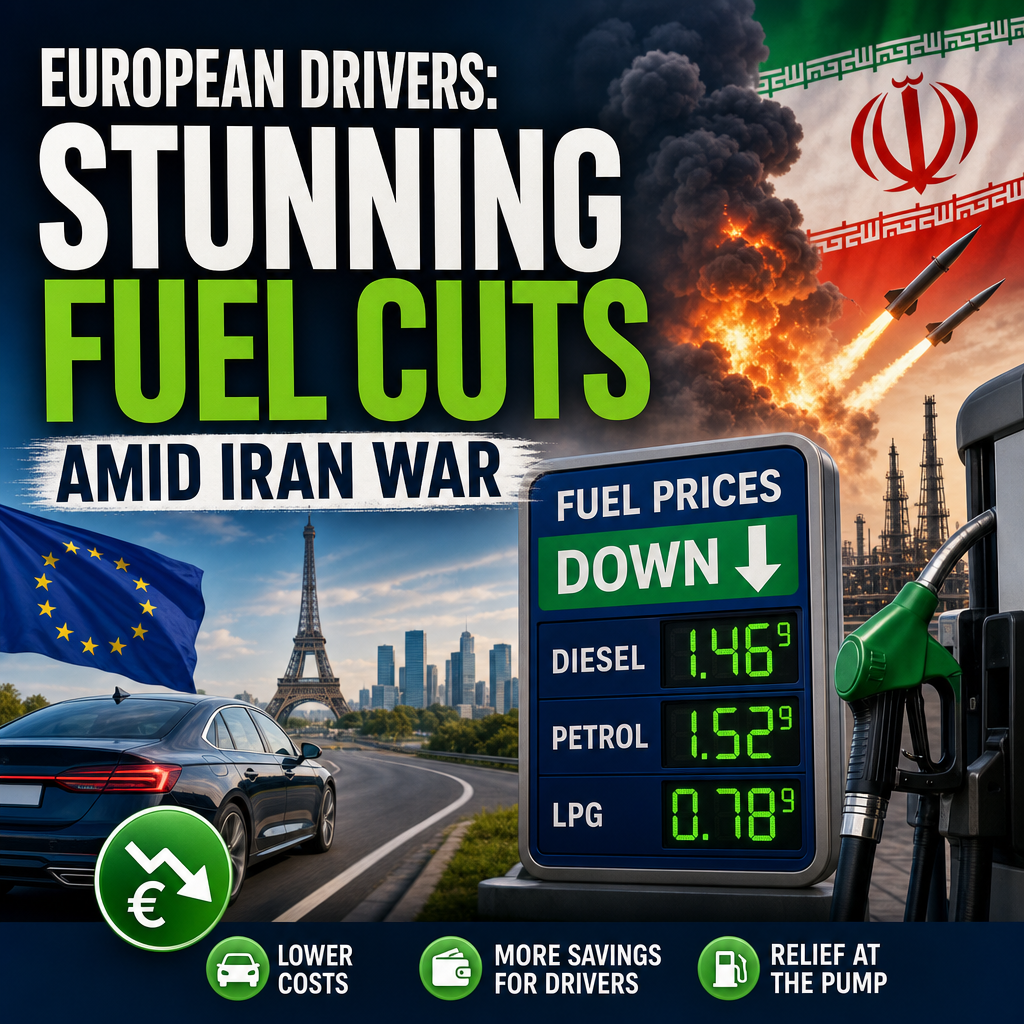
European Drivers: Stunning Fuel Cuts Amid Iran War


European drivers are already changing habits as the Iran war reverberates through energy markets, with many households and businesses trying to cushion themselves against the risk of higher fuel prices.
What makes this moment unusual is that the response is happening before any dramatic, continent-wide price shock has fully materialized. Across Europe, drivers are reportedly reducing journeys, combining errands, and paying closer attention to vehicle efficiency. That kind of pre-emptive caution says as much about memory as it does about economics: after years of pandemic disruption, inflation, and repeated energy scares, many consumers are no longer waiting for the worst-case scenario to arrive before adjusting behavior.



Why European drivers are acting early
The immediate trigger is the conflict involving Iran, a major energy player and a country whose location makes any escalation in the region a potential threat to oil shipping routes and market stability. Reports from multiple outlets suggest the concern is not just about current supply, but about the possibility of broader disruption if tensions intensify.
RT has emphasized the practical response from motorists, highlighting that drivers are already cutting fuel consumption in noticeable ways. That framing points to a consumer-led reaction rather than a top-down policy shift. In other words, people are not necessarily being forced off the road; they are choosing to drive less because they expect fuel to become more expensive, or at least more volatile.




Al Jazeera’s coverage of the broader regional conflict helps explain why this nervousness spreads so quickly. The Middle East remains central to global energy flows, and even when actual production is not immediately interrupted, the market often prices in risk fast. That risk premium can hit consumers in Europe before any physical shortage appears, raising the cost of petrol and diesel through expectation as much as through supply.
Sky News, meanwhile, has tended to focus on the wider economic and geopolitical stakes, including how instability in the region can ripple through inflation, transport costs, and government policy debates. For European drivers, this matters because fuel is one of the most visible prices in daily life. Even small increases can shape commuting, deliveries, tourism, and household budgeting.
What this means on the ground
For many people, the response is simple and practical:
– fewer unnecessary trips
– more carpooling and public transport
– slower driving to improve mileage
– more interest in fuel-efficient or hybrid vehicles
– tighter planning around work commutes and errands
These behaviors may not sound dramatic, but collectively they can soften demand and reflect real consumer anxiety. They also suggest that fuel prices remain politically sensitive across Europe, where transport costs can quickly become a public issue.
A market scare, not yet a full-blown fuel crisis
It is important to be careful here: current reports point more to anticipation than catastrophe. There is a difference between drivers trimming consumption because they fear higher prices and a genuine supply emergency that leaves fuel unavailable or unaffordable.
That distinction matters because markets often move ahead of facts. A tense geopolitical situation can drive speculation, and speculation can push prices up. If the feared disruption does not materialize, some of that pressure may ease. But once people and businesses start changing behavior, the impact can linger.
This is where the contrast between the outlets becomes useful. RT’s angle underscores the immediate consumer reaction. Al Jazeera’s reporting frames the regional conflict as a broader strategic issue with global implications. Sky News adds the economic lens, reminding readers that energy shocks are rarely confined to oil traders; they reach groceries, shipping, and inflation. Together, they sketch a picture that is more nuanced than a simple “prices up, drivers panic” story.
The bigger question: how resilient is Europe?
The current situation also exposes a long-running vulnerability. Europe has worked to diversify energy sources and reduce dependence on unstable suppliers, but transport still runs heavily on liquid fuels. That means geopolitical tension in the Middle East can still reach European consumers in a very direct way.
There are, however, reasons not to overstate the problem. Europe is better prepared than during earlier crises, with more diversified supply chains, stronger strategic awareness, and a population that has already experienced several years of economic turbulence. Consumers know how to adapt. Businesses know how to hedge. Governments know that any sustained increase in pump prices can become a political issue quickly.
Still, resilience has limits. If the conflict worsens or shipping lanes become more vulnerable, the pain could move from consumer caution to broader economic stress. That would affect not just drivers, but freight companies, small businesses, and public transport budgets.
The likely road ahead
The most balanced reading is that European drivers are reacting rationally to uncertainty, not irrationally to headlines. They are trying to stay ahead of a problem that may or may not deepen. That caution makes sense given how quickly fuel markets can tighten when the Middle East becomes unstable.
At the same time, it would be premature to assume this becomes a lasting crisis. Much depends on whether the Iran war expands, stabilizes, or remains contained enough to avoid major disruption to oil and shipping routes. For now, the key story is vulnerability: how a conflict far from European roads can still change the way millions of people drive, spend, and plan their week.
In that sense, the current fuel-cutting trend is less a sign of panic than a sign of memory. European motorists have learned that when geopolitical risk rises, the cost often shows up first at the pump.


























