Iraqi PM Visit to Iran: Stunning Diplomatic Move


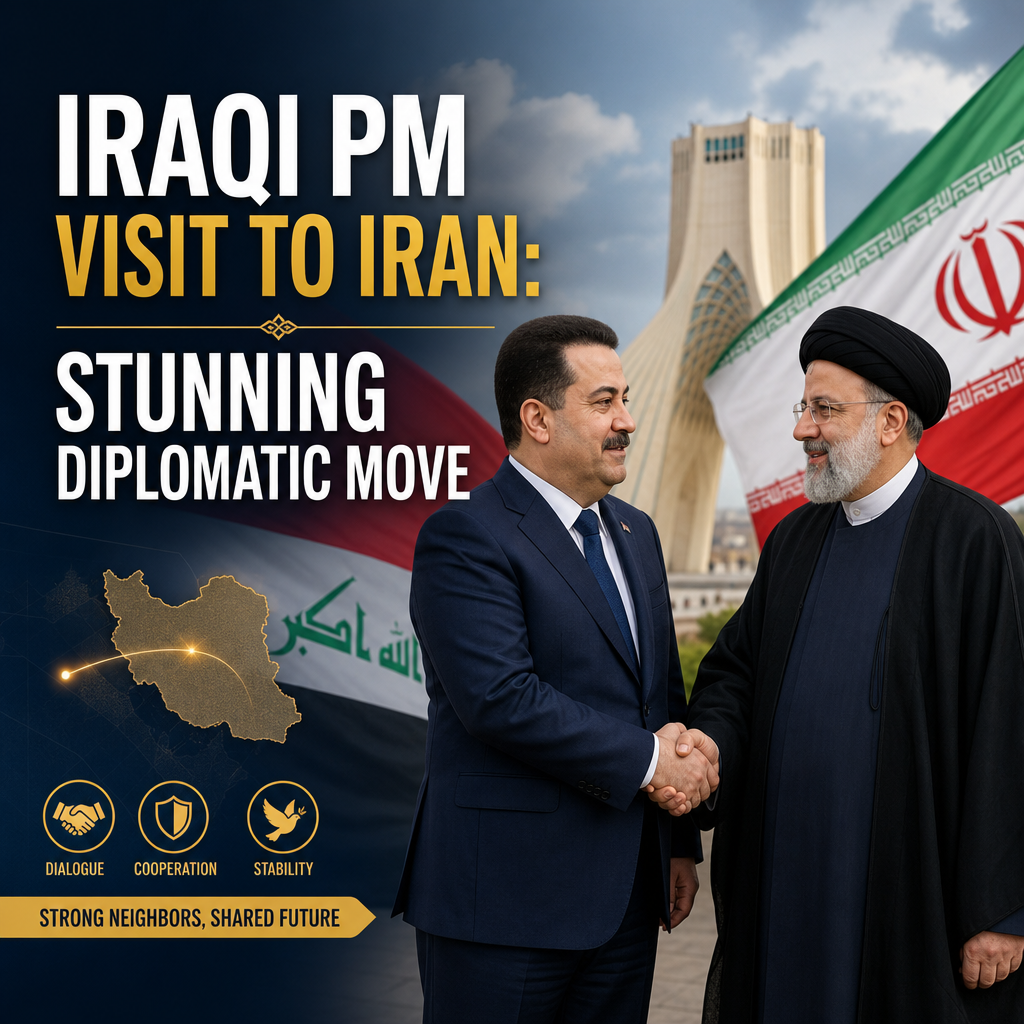
Iraqi PM visit to Iran is being watched closely across the Middle East, not just because it is the first official trip of its kind by Iraq’s current prime minister, but because it lands at a moment when every move in Baghdad and Tehran carries regional weight.
The visit signals more than routine diplomacy. It comes as Iraq tries to balance relationships with Iran, the United States, and its Arab neighbors while keeping domestic politics and security under control. That balancing act is difficult at the best of times; in today’s climate of regional tension, it is even more delicate. Different news outlets frame the trip in slightly different ways, but they converge on one point: this is a meaningful gesture with practical consequences, not a symbolic photo-op.



Why the visit matters now
For Iraq, Iran is one of its most important neighbors and a major political and economic actor. The two countries share a long border, deep religious and commercial ties, and a complicated history shaped by war, sanctions, invasion, and shifting alliances. Any Iraqi prime minister traveling to Tehran is therefore making a statement about priorities.
Al Jazeera’s framing emphasizes the diplomatic and strategic significance of the trip, suggesting that the goal is to deepen ties at a time when both governments face pressure to stabilize their own political environments. That interpretation fits with Iraq’s broader foreign-policy pattern: Baghdad often seeks to avoid hard alignment and instead preserve room for maneuver.




RT’s coverage, by contrast, tends to highlight the regional power dimension. From that vantage point, the visit is less about etiquette and more about Iraq affirming a relationship with a neighboring power that has substantial influence inside Iraq. This lens is useful because it underlines a reality often softened in diplomatic language: Iran’s role in Iraq is not marginal. It is embedded in trade, energy, border security, and the wider network of Iraqi politics.
Sky News, meanwhile, would likely focus more on the wider international implications—especially how the visit is read in Western capitals and among Gulf states. That angle matters because Iraqi-Iranian relations are never viewed in isolation. They are filtered through concerns about sanctions, militia activity, regional proxy tensions, and the future of U.S. influence in Iraq.
Iraqi PM visit to Iran and the politics of balance
Iraq has long tried to act as a bridge rather than a battleground. That is easier said than done. On the one hand, Baghdad needs good working relations with Tehran for practical reasons: electricity imports, trade flows, border management, pilgrimage coordination, and security cooperation all matter. On the other hand, Iraq also wants to maintain credibility with Arab partners and avoid appearing fully absorbed into Iran’s regional orbit.
That tension is the heart of this visit.
A few key points help explain why:
– Security: Iraq remains vulnerable to spillover from regional conflicts. Coordination with Iran can help on some border and armed-group issues, but it can also deepen concerns about militia influence.
– Economy: Iraq depends heavily on imports and energy arrangements tied to Iran. That dependence creates leverage for Tehran, but also exposes Iraq to sanctions risk and economic vulnerability.
– Politics: Iraqi leaders must manage internal factions with different views on Iran, the U.S., and Arab states. A high-profile trip can reassure some actors while alarming others.
– Diplomacy: Baghdad wants to be seen as sovereign and independent, not as a stage for other powers’ rivalry.
This is why the trip is being described by some observers as “stunning” or unexpected, even though, in regional terms, it is actually quite logical. The surprise is less about the destination and more about the timing and the symbolism.
What the different viewpoints agree on
Despite different editorial angles, there is broad agreement across the coverage that the visit is intended to deepen ties rather than reset them from scratch. It is not a sudden pivot, and it is not likely to produce one dramatic announcement that changes the regional map overnight.
The consensus seems to be:
1. The trip reflects continuity, not rupture. Iraq and Iran already have dense ties, and both sides have incentives to keep them functional.
2. Security remains central. Whether the issue is border stability, armed groups, or regional escalation, security cooperation is likely to be high on the agenda.
3. The symbolism matters as much as the substance. Even if the practical outcomes are incremental, the political message is significant.
4. External actors are paying attention. The U.S., Gulf countries, and other regional players will read this visit as a signal of Iraq’s strategic direction.
Where the reporting diverges is in the tone of interpretation. Some coverage treats the trip as a pragmatic necessity; other coverage frames it as evidence of Iran’s continued pull inside Iraq. Those two readings are not mutually exclusive. In fact, both can be true at once.
A careful reading of the bigger picture
The most balanced conclusion is that this visit reflects Iraq’s enduring challenge: how to remain sovereign while navigating dependence. That is not unique to Iraq, but in its case the stakes are unusually high. The country sits at the intersection of multiple rivalries and cannot simply choose one camp without paying a price.
The visit may produce practical gains—better coordination, warmer political ties, and perhaps progress on trade or border issues. But it also raises questions that no handshake can fully answer: How independent can Baghdad’s foreign policy really be? How much influence does Tehran still hold inside Iraq? And can Iraq strengthen its regional position without becoming overly defined by any one neighbor?
Those questions do not have neat answers, and that is precisely why the visit matters. It is not a dramatic diplomatic break, but it is a revealing one. It shows an Iraqi leadership trying to manage a relationship that is both indispensable and politically sensitive. In the Middle East, that kind of diplomacy is often the most consequential of all—quiet, complicated, and never entirely under control.