US House Iran War Vote: Stunning Breakthrough After Ceasefire Breakdown


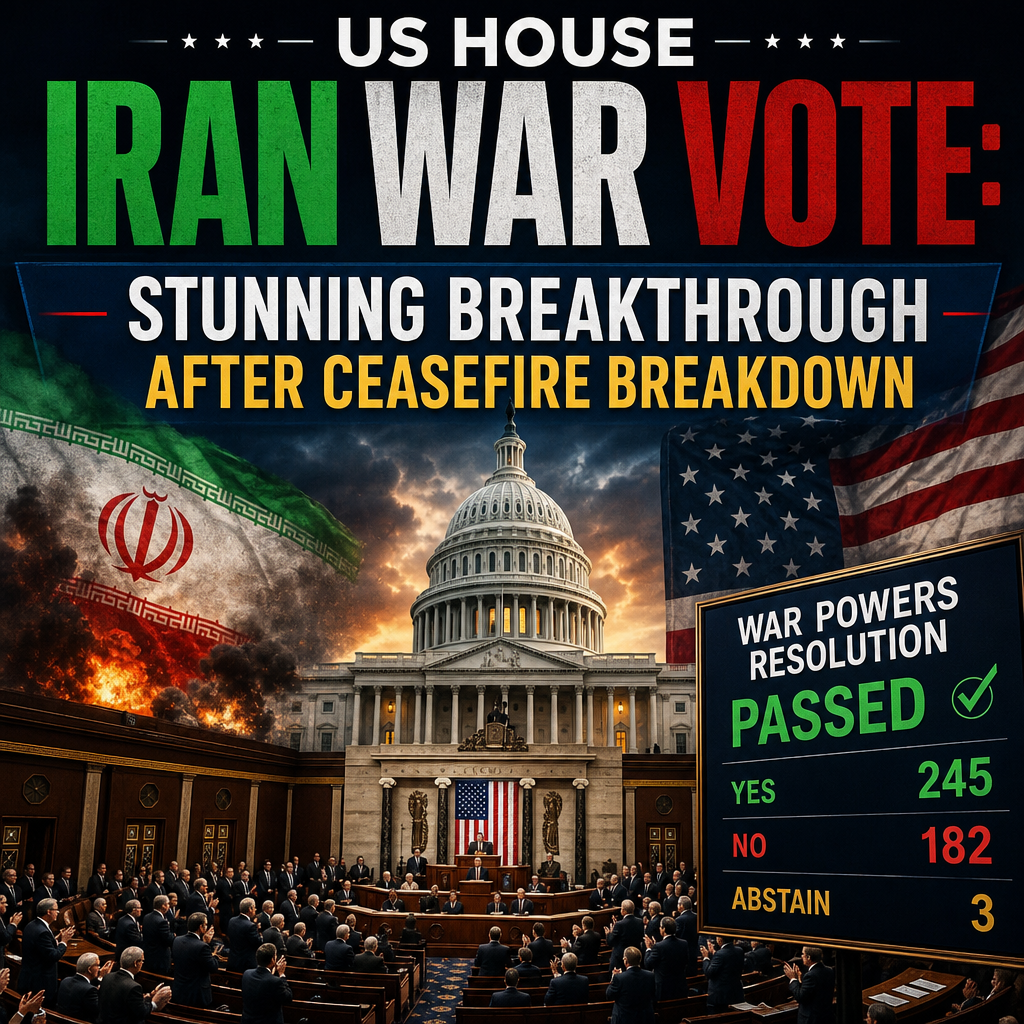
US House Iran war vote has opened a fresh debate in Washington over who gets to decide when America goes to war, and it has done so at a moment when tensions in the Middle East remain highly unstable.
The House vote to limit the president’s ability to launch military action against Iran is being described by supporters as a long-overdue assertion of congressional authority, and by critics as a politically timed gesture that may be too little, too late. What makes the moment striking is not just the substance of the measure, but the context around it: a fragile ceasefire environment, fears of escalation, and a political system still grappling with how much power the executive branch should hold in crises that can turn global overnight.



US House Iran war vote: why it matters now
The central issue behind the vote is constitutional as much as strategic. Congress has often been wary of ceding too much war-making authority to the White House, yet in practice presidents have repeatedly acted first and asked for backing later. That tension is especially sharp when Iran is involved, because any military clash could spread quickly beyond bilateral confrontation and pull in regional actors, energy markets, and allied forces.
Coverage from Al Jazeera framed the vote as a notable break from recent patterns, highlighting that lawmakers moved to restrict war-making authority after a ceasefire-related breakdown raised the risk of renewed conflict. The significance lies in the fact that this is not merely a statement of concern. It is a legislative effort to reassert congressional oversight in a situation where diplomacy appears fragile and military miscalculation could be costly.




Sky News’ reporting, meanwhile, places the vote in a broader international-security context. From that perspective, the question is not just whether the House can constrain the president, but whether Washington’s internal struggle sends a message of restraint or division to allies and adversaries alike. Supporters of the measure would argue that a clear legal barrier reduces the chance of an impulsive strike. Opponents might respond that ambiguity is dangerous in itself, especially if Iran interprets debate in Congress as hesitation.
RT’s coverage, as is often the case, tends to emphasize how US decision-making can be portrayed abroad as politically fractured and strategically inconsistent. That angle is useful because it reflects how the vote may be read outside Washington: less as a clean defense of constitutional checks and more as evidence of a superpower trying to define its own limits after the fact. Whether one agrees with that interpretation or not, it captures an uncomfortable truth — global crises often expose the seams in American governance.
What the vote says about war powers
At its heart, the House action is about the War Powers dynamic that has dogged US politics for decades. The Constitution gives Congress the authority to declare war, but presidents have increasingly relied on broad interpretations of their commander-in-chief powers to carry out strikes and operations without an explicit declaration.
This vote signals that some lawmakers want to pull that balance back toward Capitol Hill. That matters for three reasons:
– It could make it harder for any president to launch unilateral action against Iran.
– It reopens a long-running constitutional debate that has often been sidelined by immediate security concerns.
– It may shape how both allies and adversaries assess the likelihood of US military escalation.
Still, even if the measure passes one chamber, it does not automatically settle the issue. A war-powers resolution can face procedural hurdles, veto threats, and questions over enforcement. In other words, the political symbolism may be clearer than the practical result.
The bigger problem: restraint versus deterrence
The strongest argument for the vote is straightforward: a war with Iran should not begin on executive impulse. Advocates of restraint say that any conflict of that scale would need broad democratic legitimacy, not just legal flexibility. They point to the human cost, the risk of regional spillover, and the possibility that one strike could trigger retaliation and a cycle of escalation.
That view has understandable appeal, especially after a ceasefire breakdown has reminded everyone how quickly tensions can flare. In such an environment, clarity and caution are not signs of weakness; they are essential risk management.
But the opposing argument is also serious. Some analysts and lawmakers worry that tightening presidential options could weaken deterrence at exactly the wrong moment. If Tehran believes the United States is boxed in politically, it may calculate that Washington lacks the will to respond decisively. From this perspective, too much legislative friction can undermine the credibility of US warnings and complicate crisis response.
The truth is that both concerns are valid. A rigid system that makes it easy to start wars is dangerous. But a system that leaves America unable to react quickly in a real emergency may also invite miscalculation. That is why the debate is so difficult: it is not a choice between peace and war, but between different kinds of risk.
A cautious conclusion
The House vote is best understood as a warning shot, not a resolution. It tells us that lawmakers are uneasy about unchecked military escalation, and that Iran remains one of the few issues capable of forcing Congress to confront its dormant war powers. It also shows how fragile the current moment is, with diplomacy under strain and the possibility of renewed confrontation still hanging over the region.
What remains unclear is whether the vote will lead to meaningful restraint or simply add another layer to Washington’s already tangled decision-making process. That uncertainty is exactly why the debate matters. In a crisis involving Iran, the cost of acting too quickly could be enormous — but so could the cost of failing to act with enough unity, clarity, and purpose.
For now, the most responsible reading is that the House has done something politically important, but strategically incomplete. It has reminded the White House that war powers are not limitless. Whether that reminder changes events on the ground is another question entirely.