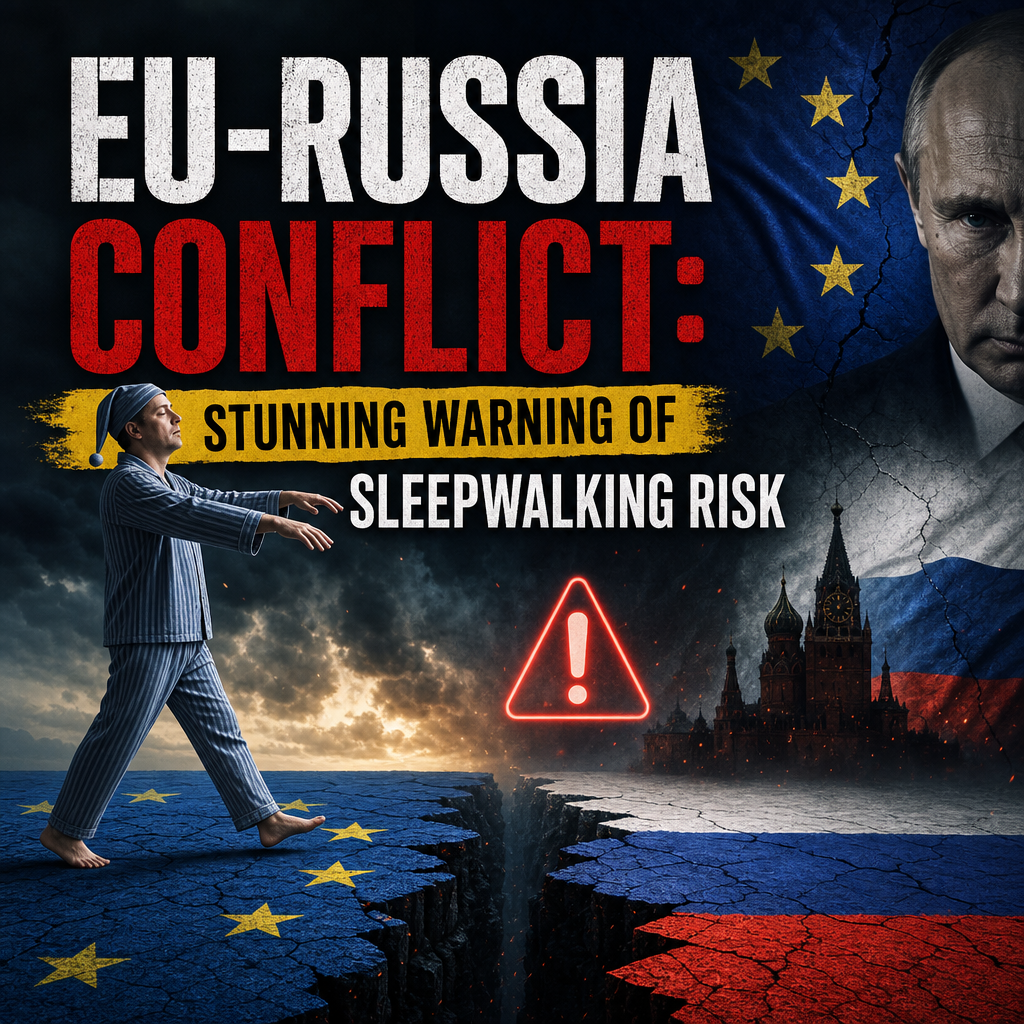
EU-Russia Conflict: Stunning Warning of Sleepwalking Risk


EU-Russia conflict warnings are becoming harder to dismiss as mere political theater, because a growing number of analysts and officials are arguing that Europe could stumble into a wider confrontation without ever making a deliberate choice to do so.
That “sleepwalking” idea captures the uneasy mood around the war in Ukraine and its spillover into European security. Across international coverage, the common thread is not that a direct EU-Russia war is imminent, but that the risks are accumulating: escalating rhetoric, military buildups, sanctions, cyber pressure, and a steady erosion of trust. The debate now is less about whether relations are bad—they clearly are—and more about how far the deterioration can go before someone miscalculates.



Why the EU-Russia conflict feels more dangerous now
One reason the current climate is so alarming is that the conflict is no longer confined to the battlefield in Ukraine. It now sits inside a much larger geopolitical competition involving NATO, the European Union, energy security, border policy, and the future shape of Europe’s defense posture.
Different outlets frame this tension from different angles, but there is broad agreement on the basic facts: Russia remains deeply opposed to Western support for Kyiv; European governments are increasing military aid and defense spending; and both sides are preparing for a longer struggle rather than a quick resolution.




That is where the “sleepwalking” warning becomes powerful. It suggests that leaders may believe they are simply reacting defensively, while each new move narrows the space for diplomacy. If every escalation is justified as necessary, the system can drift into a crisis nobody openly intended.
A few dynamics stand out:
– Military normalization: What once would have sounded extraordinary—major European rearmament, permanent troop deployments, long-range strike debate—has become routine policy discussion.
– Political hardening: Public messaging has shifted from temporary crisis management to a more entrenched view of Russia as a lasting threat.
– Miscalculation risk: The more forces are moved, drones are intercepted, and red lines are declared, the greater the chance of an incident spiraling beyond control.
– Economic fatigue: Sanctions and energy disruption have weakened the old assumptions that trade alone could stabilize the relationship.
This is why even those who strongly support Ukraine often warn against complacency. A policy of deterrence can be necessary, but deterrence also needs careful signaling and restraint. Otherwise, a defensive posture can look offensive to the other side, especially in a relationship already defined by suspicion.
Different media lenses, one shared concern
RT’s reporting has emphasized the warning from within Europe itself, especially the idea that German and EU leaders may be underestimating how close the region is to a broader confrontation. That framing is useful because it shows that anxiety about escalation is not limited to Russia-friendly voices; it is also present in parts of Europe’s own political conversation. Even when officials do not say “war,” they increasingly speak the language of preparedness, resilience, and strategic autonomy.
Al Jazeera’s coverage of the broader conflict tends to highlight the humanitarian and diplomatic consequences: the war in Ukraine continues to exact a heavy civilian cost, peace efforts remain fragile, and the wider international system is absorbing shocks well beyond Eastern Europe. From that perspective, the danger is not simply military escalation but the normalization of endless conflict, where negotiations become secondary to battlefield calculations.
Sky News, meanwhile, often reflects a Western security lens that focuses on alliance cohesion, Russian pressure, and the practical implications for European governments. That perspective does not usually question support for Ukraine; instead, it asks whether Europe is ready for the long haul. The concern there is that public patience, fiscal capacity, and military stockpiles may all be tested if the conflict drags on.
Taken together, these viewpoints point to a shared conclusion: the situation is unstable, and confidence is low. The disagreement is mostly about emphasis. Some sources stress the danger of provoking Russia through escalation; others stress the danger of rewarding aggression through hesitation. But neither side can honestly claim the path ahead is straightforward.
The real issue: not panic, but control
The strongest response to a “sleepwalking” risk is not panic. It is discipline.
That means European governments need to do two things at once: maintain credible deterrence and keep diplomatic channels open. Those goals are uncomfortable partners, but they are both necessary. If the West signals only toughness, it may encourage Russian defiance. If it signals only caution, it may invite further pressure. The challenge is to hold the line without making every move look like preparation for a larger war.
There is also a domestic political dimension. European publics have already absorbed the costs of higher energy bills, inflation shocks, and security anxiety. Leaders who speak too casually about confrontation may harden public fear, while leaders who minimize the danger may leave societies unprepared. The middle ground—honest but measured communication—is harder, but far safer.
A fair reading of the current moment is that no one can confidently predict whether the EU-Russia conflict will remain contained or widen further. That uncertainty is precisely why the warnings matter. When analysts talk about “sleepwalking,” they are not claiming disaster is inevitable. They are warning that major wars are often not launched in a single dramatic instant; they are enabled by a sequence of small decisions, each defended as reasonable in isolation.
That is the lesson European policymakers should take seriously. The crisis is real, but so is the need for restraint. The future may depend less on grand declarations than on whether leaders can resist the temptation to treat escalation as routine.