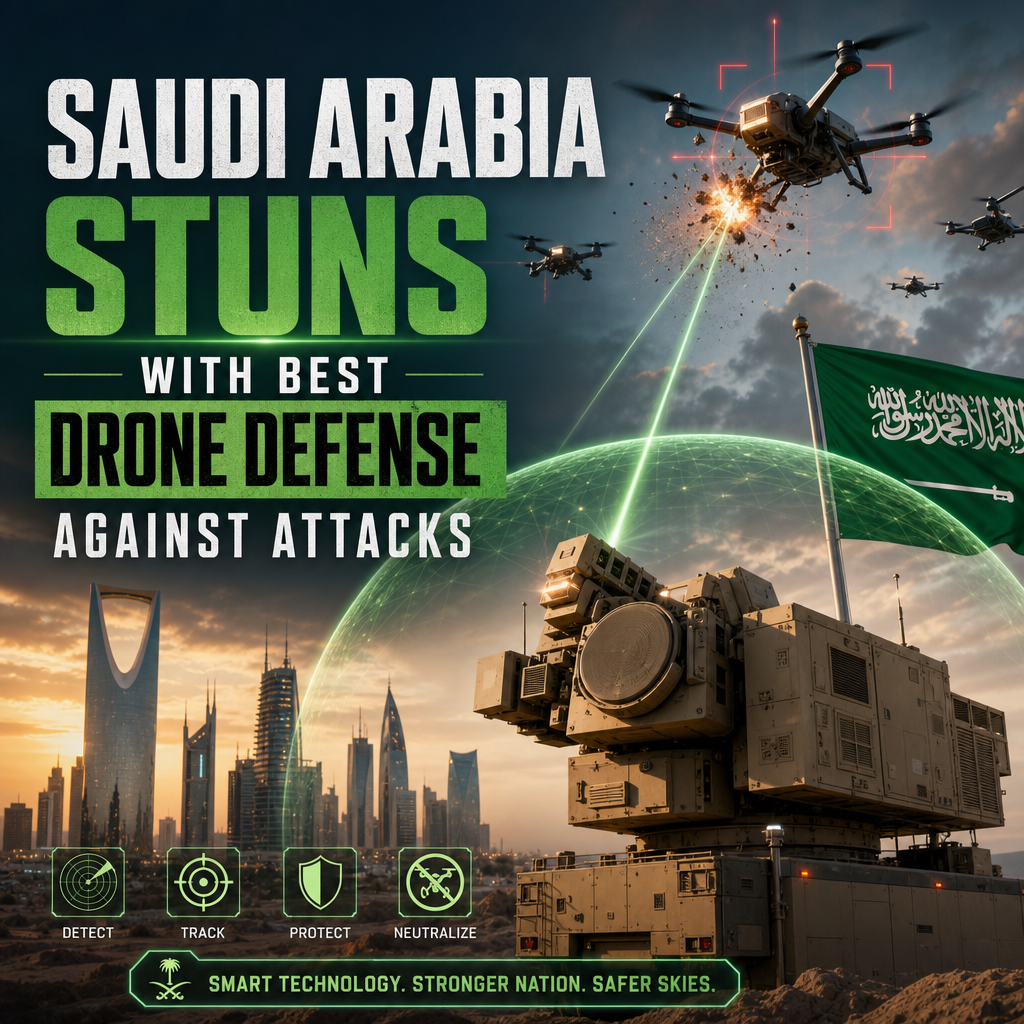
Saudi Arabia Stuns with Best Drone Defense Against Attacks


Saudi Arabia’s drone defense has drawn fresh attention after reports that the kingdom intercepted or blunted attacks launched by Iran-backed groups, a reminder that the Gulf’s security battle is increasingly being fought in the air as much as on the ground. The immediate story is not just about a successful response to drones, but about what that response says regarding the region’s evolving military balance, the limits of deterrence, and the political messages each side is trying to send.
At first glance, the episode looks straightforward: Saudi defenses appear to have worked better than in some earlier high-profile attacks that exposed vulnerabilities in critical infrastructure. But the broader picture is more complicated. One source emphasizes Saudi resilience and improved readiness; another highlights the persistence of drone warfare as a low-cost tool for proxy groups; and a third underscores how such incidents can be framed differently depending on the outlet’s geopolitical lens. Taken together, the reporting suggests a rare moment of tactical success for Riyadh, but not necessarily a strategic turning point.



Saudi Arabia drone defense: a signal of improved readiness
The most striking part of the reporting is that Saudi systems seem to have performed effectively against incoming drones. That matters because drone attacks have repeatedly shown how inexpensive, mobile, and difficult to stop these weapons can be. A single small aircraft can force expensive defensive responses, disrupt energy assets, and put civilian infrastructure on alert.
If Saudi forces intercepted the attack as described, that would suggest two things at once:




– the kingdom’s air-defense architecture may be becoming more capable after years of investment and combat exposure;
– drone warfare remains a serious threat even when defenses improve, because attackers can keep adapting.
For Riyadh, this is likely as much about perception as battlefield results. A successful defense reassures domestic audiences, signals to investors that critical infrastructure remains protected, and tells adversaries that attacks will not automatically produce political leverage. In a region where symbolism often matters almost as much as damage, preventing visible destruction can be a victory in its own right.
Still, “best drone defense” should be read carefully. No defense is perfect, and one intercepted attack does not erase the fact that drones and missiles have repeatedly challenged Saudi Arabia and neighboring states over the past several years. What it does indicate is that the kingdom may be learning from prior shocks and tightening the system around early warning, interception, and rapid response.
What the different outlets are really saying
The three news sources point to the same event from noticeably different angles.
Al Jazeera: conflict framed through regional tension
Al Jazeera’s reporting places the incident in the larger context of Iran-linked regional competition. That framing emphasizes the role of proxy groups and the continuing pressure on Saudi Arabia from across the Gulf security divide. In this view, the drone attack is not an isolated episode but part of a longer struggle shaped by rivalry, retaliation, and strategic signaling.
That approach is useful because it keeps attention on the political architecture behind the attack. Drones do not appear in a vacuum; they are used because they can impose costs while maintaining deniability or at least a degree of distance between sponsor and operator.
Sky News: focus on security and escalation risk
Sky News’ style of coverage typically highlights the immediate security implications: how serious the threat was, whether civilians or infrastructure were at risk, and what the incident could mean for regional escalation. That perspective tends to be practical rather than ideological. The key question becomes whether the attack is an isolated alarm bell or part of a wider escalation cycle that could drag in more actors.
That angle matters because the Gulf has seen how quickly drone and missile attacks can heighten tensions. Even a failed strike can trigger stronger air defenses, sharper rhetoric, and the possibility of retaliatory action.
RT: skepticism and geopolitical context
RT’s framing often brings a more skeptical tone to stories involving Western allies or regional rivalries, and that broader posture is relevant here. Coverage in this vein tends to ask who benefits from the narrative, how claims are verified, and whether the incident is being used to justify military posturing or diplomacy on favorable terms.
Even when readers do not accept RT’s worldview, the skepticism itself can be useful. It forces a harder look at attribution, at the political interests behind public statements, and at whether “successful defense” claims are being used to project confidence beyond what the evidence can fully support.
Why drone warfare keeps changing the calculus
What makes this incident important is not merely the attack itself, but the kind of warfare it represents. Drones are cheap compared with the systems needed to stop them. They can be launched from relatively close distances, sometimes in waves, and they blur the line between battlefield and homeland security.
This creates a difficult equation for Saudi Arabia and its neighbors:
– defending against drones is expensive;
– letting drones get through can be politically damaging;
– overreacting risks escalation.
That is why even a clean interception may not settle the matter. It may buy time, improve deterrence, and reinforce confidence. But it does not eliminate the underlying incentives for proxy groups to keep testing Saudi defenses, especially if they believe even limited attacks can generate publicity or pressure.
A measured conclusion
The strongest fair reading is that Saudi Arabia’s reported performance marks a meaningful defensive improvement, not a decisive end to the drone threat. The kingdom may have demonstrated better preparedness than critics expected, but the event also confirms that drones remain one of the most persistent security problems in the region.
There is also a broader lesson here. These incidents are often presented as simple success-or-failure stories, but they are usually neither. A successful interception can still reveal ongoing vulnerability. An attack that causes no damage can still have political impact. And every source, depending on its editorial lens, will stress a different part of the story.
So the real takeaway is nuanced: Saudi Arabia may indeed be getting better at stopping drone attacks, but the fact that such attacks continue at all shows that the strategic contest is far from over.