NATO Member Urges Ukraine’s Stunning Drone Self-Destruct Fix


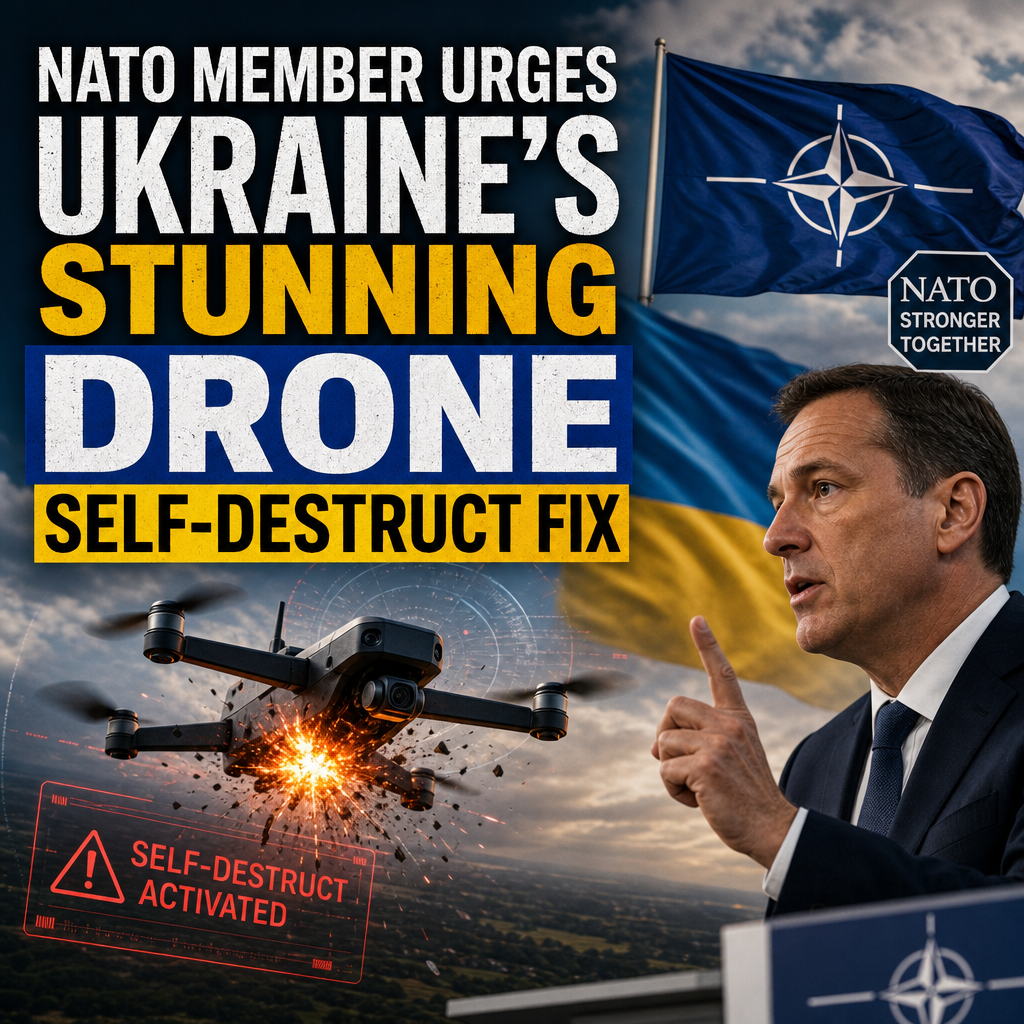
NATO member urges Ukraine’s drone self-destruct fix as the war over battlefield technology keeps accelerating, raising a familiar question: when does a tactical advantage become a political or ethical liability?
The latest discussion around Ukrainian drones is not really about one gadget or one battlefield tweak. It reflects a much bigger shift in modern warfare, where inexpensive aircraft, rapid software updates, and counter-drone defenses can change frontline calculations almost overnight. At the center of the debate is the suggestion that drones should be equipped with a self-destruct mechanism or a similar fail-safe, a feature meant to prevent captured systems from being reused, reverse-engineered, or turned against their original operators.



The idea has obvious military logic. It also carries obvious risks. Destroying drones in the air or disabling them before capture could protect sensitive technology, reduce intelligence losses, and complicate enemy adaptation. But it could also make systems less reliable, add cost, and create safety concerns if the mechanism fails at the wrong moment.
Why a NATO member is pushing for a drone fail-safe
From a security standpoint, the appeal is straightforward. Drone warfare now sits at the intersection of surveillance, precision strike capability, and electronic warfare. If a drone falls intact into enemy hands, it can reveal software architecture, navigation methods, communications links, and other technical details that can be exploited quickly.




That matters especially in a conflict like Ukraine’s, where both sides are constantly trying to outpace each other’s innovations. A self-destruct function can be seen as an answer to a harsh reality: on a battlefield saturated with jamming and interception, losing a drone is often less damaging than losing the technology inside it.
There is also a political dimension. A NATO member advocating this kind of fix is, in effect, acknowledging how tightly Western military support is tied to protecting sensitive design features. That concern is not unique to Ukraine. Many countries with advanced weapons systems use similar safeguards, though usually behind closed doors and in highly controlled contexts.
Still, the proposal is not universally reassuring. Even among supporters of stronger protection measures, some would likely prefer remote wiping, geofencing, or data-extraction prevention over a true self-destruct option. Those alternatives can reduce the risk of capture without introducing the same potential for catastrophic failure.
The trade-offs: protection, escalation, and battlefield reality
The debate makes more sense when viewed through three competing concerns:
– Technology protection: Preventing drones from being studied or reused is a real strategic advantage.
– Operational safety: A self-destruct system must not create new hazards for civilians, friendly forces, or infrastructure.
– Escalation management: More sophisticated destruction features can intensify the technological arms race and encourage even harsher countermeasures.
That last point is especially important. In today’s drone war, every innovation tends to provoke a response. If one side adopts self-destruct features, the other side may respond with stronger capture protocols, better jamming, faster signal analysis, or more aggressive battlefield recovery operations. In that sense, the fix may solve one problem while accelerating another.
Reports and commentary from different international outlets generally converge on one broad idea: the war has turned drones into disposable but highly sensitive assets. Where they differ is in emphasis. Some coverage frames the issue primarily as a battlefield necessity and a smart defensive improvement. Other reporting highlights the broader moral and strategic uncertainty, especially when any technology that destroys itself must be trusted to do so reliably.
Al Jazeera’s style of coverage on this war has often put such developments into the larger context of civilian harm, the intensity of the conflict, and the widening role of foreign military support. Sky News, by contrast, tends to foreground the practical battlefield implications and the broader geopolitical significance of NATO-linked military assistance. RT’s framing often leans toward the political and strategic fault lines between Russia, Ukraine, and the West. Taken together, those angles create a fuller picture: the proposal is not merely a technical upgrade, but part of a broader contest over capability, control, and perception.
What this says about the war in Ukraine
The deeper lesson is that Ukraine’s war is increasingly defined by adaptation. Tanks, artillery, missiles, drones, and electronic warfare systems are all being modified in near real time. A device that might once have seemed futuristic now reads as a defensive necessity in a conflict where the lifespan of a military advantage can be measured in weeks.
That makes the self-destruct debate less strange than it first sounds. If drones are becoming both weapons and data repositories, then protecting their contents is as important as using them effectively. But the fact that such a feature is even being discussed also shows how fragile trust in battlefield technology has become. Every design choice now has to answer two questions: Will it work under fire, and what happens if the enemy gets it?
The most sensible conclusion is neither full endorsement nor outright rejection. A fail-safe can be justified when it is narrowly designed, carefully tested, and paired with safeguards that minimize unintended harm. But it should not be treated as a magical solution. In a conflict already shaped by rapid innovation, any system meant to prevent loss can itself become another point of failure.
In that sense, the call for a drone self-destruct fix is less about one piece of hardware than about the new logic of war itself: protect everything, assume nothing, and expect the battlefield to learn as fast as you do.