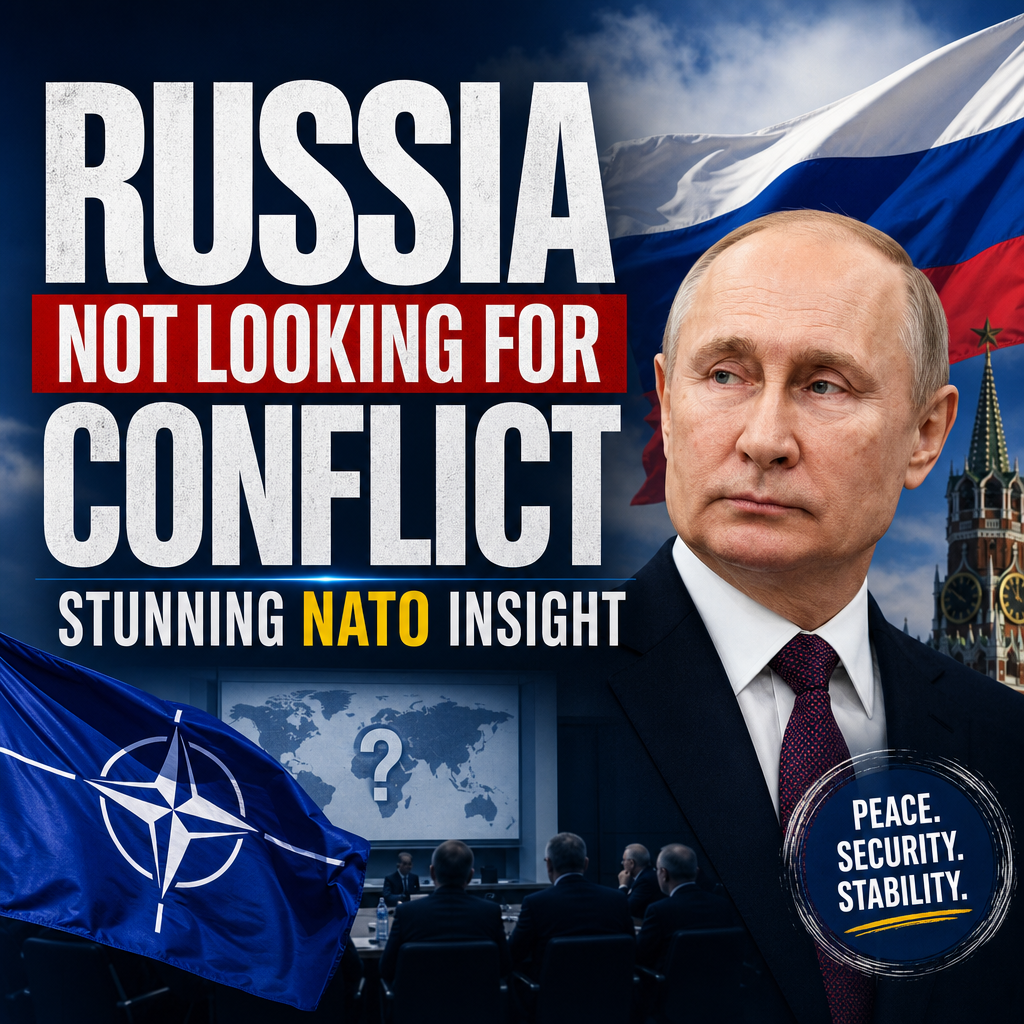
Russia Not Looking for Conflict: Stunning NATO Insight


Russia not looking for conflict with NATO, at least according to Moscow’s latest public messaging, but that claim lands in a Europe where suspicion, military buildup, and political warning signs still dominate the conversation. The gap between what Russia says it wants and what NATO members say they need to prepare for is now wide enough to shape budgets, alliances, and the daily language of security across the continent.
At the heart of the debate is a familiar but unresolved question: is Moscow signaling restraint, or is it trying to lower tensions while preserving room to pressure the West elsewhere? Different newsrooms and political camps answer that differently, and the truth may sit somewhere in between. Russia’s position, as presented in state-linked reporting, is that it does not seek a direct clash with NATO. Western governments, meanwhile, continue to treat Russian behavior as evidence that deterrence still matters more than reassurance.



What Russia is trying to signal
From Moscow’s perspective, the message is straightforward: Russia does not want war with the alliance. That framing serves several purposes at once. It projects confidence, attempts to blunt accusations of aggression, and suggests that the Kremlin is acting defensively rather than expansively. It also puts the burden on NATO to explain why it keeps expanding its military posture if, as Russia argues, the West is the side escalating the situation.
That position is not meaningless. In international relations, public statements can be an important part of de-escalation, especially when tensions are high. A government that truly wants to avoid conflict usually tries to make that clear. But statements alone rarely settle the issue, because credibility depends on behavior, not just language.




That is where skepticism enters. For many in Europe and North America, Russia’s assurances are viewed through the lens of recent history: the annexation of Crimea, the war in eastern Ukraine, the full-scale invasion launched in 2022, and years of hybrid pressure that have included cyberattacks, disinformation, and coercive energy policy. Even if Moscow says it is not seeking direct conflict with NATO, many governments are reluctant to assume that means the threat has passed.
Why NATO is still bracing for trouble
NATO’s view is shaped less by one statement than by a pattern of risk. Sky News coverage of European security has consistently shown how alliance members are responding to Russian activity with more defense spending, new deployments, and stronger border readiness. That is not necessarily because leaders believe a NATO-Russia war is imminent, but because they believe weakness could invite miscalculation.
There are several reasons the alliance remains cautious:
– Russia has continued to invest heavily in its military despite battlefield losses and sanctions.
– NATO states bordering Russia and Belarus see little room for complacency.
– Public warnings from officials in capitals like London, Warsaw, and the Baltics reflect domestic pressure as much as strategic analysis.
– The war in Ukraine has made the whole region more sensitive to any sign of broader escalation.
In that context, NATO’s posture is not only about responding to Russia. It is also about reassuring member states that the alliance remains credible. For smaller frontline countries, reassurance can be just as important as deterrence. A statement from Moscow that it does not seek conflict may sound calming in theory, but for governments living next to the borderlands of war, trust is earned slowly and lost quickly.
The wider picture: diplomacy, fatigue, and mixed signals
Al Jazeera’s coverage of the war and its international consequences tends to emphasize the political and humanitarian cost of prolonged confrontation. That perspective is useful here because it highlights something that can get lost in military analysis: many countries outside the NATO-Russia core would prefer a lowering of tensions, not because they endorse Moscow’s line, but because they are exhausted by a conflict that keeps reshaping global food prices, energy markets, and security calculations.
That broader fatigue matters. It helps explain why some officials and commentators are eager to interpret even limited signs of restraint as meaningful. If Russia is truly not seeking conflict with NATO, then diplomacy should be possible. But if the statement is mainly tactical, aimed at splitting Western opinion or softening the image of Russian policy, then it should be treated carefully.
The challenge is that both interpretations can seem plausible at once. Russia may well be trying to avoid a direct war with NATO, which would be catastrophic for everyone involved. At the same time, it may still use pressure, brinkmanship, and military signaling to defend its own interests and keep the alliance off balance. Those two things are not mutually exclusive.
The most realistic reading
The most responsible conclusion is probably not that Russia is harmless, nor that war is inevitable. It is that both Russia and NATO are operating in a security environment where fear drives policy on both sides. Moscow wants to convince the world that it is being misread. NATO wants to ensure that it is not being fooled.
That creates a dangerous but familiar dynamic: each side describes its actions as defensive, while the other side sees escalation. In such a setting, even a sincere effort to calm tensions can be overshadowed by decades of mistrust and current battlefield realities.
A balanced reading of the situation suggests three things:
1. Russia has an incentive to say it does not want conflict with NATO.
2. NATO has an incentive not to take that claim at face value.
3. The risk of miscalculation remains real even if neither side wants a full-scale direct war.
What to watch next
If the goal is to understand whether this is a genuine shift or just a messaging exercise, the clues will be found in actions rather than headlines. Watch for:
– changes in Russian military posture near NATO borders
– any renewed diplomatic contacts or arms-control discussions
– shifts in NATO troop levels and exercises in Eastern Europe
– the language used by Russia’s leadership versus its military planners
For now, the safest conclusion is that Russia may indeed not be looking for an outright conflict with NATO, but that does not mean the danger has disappeared. In today’s Europe, restraint and risk are sharing the same space, and neither side seems ready to trust the other enough to lower its guard.