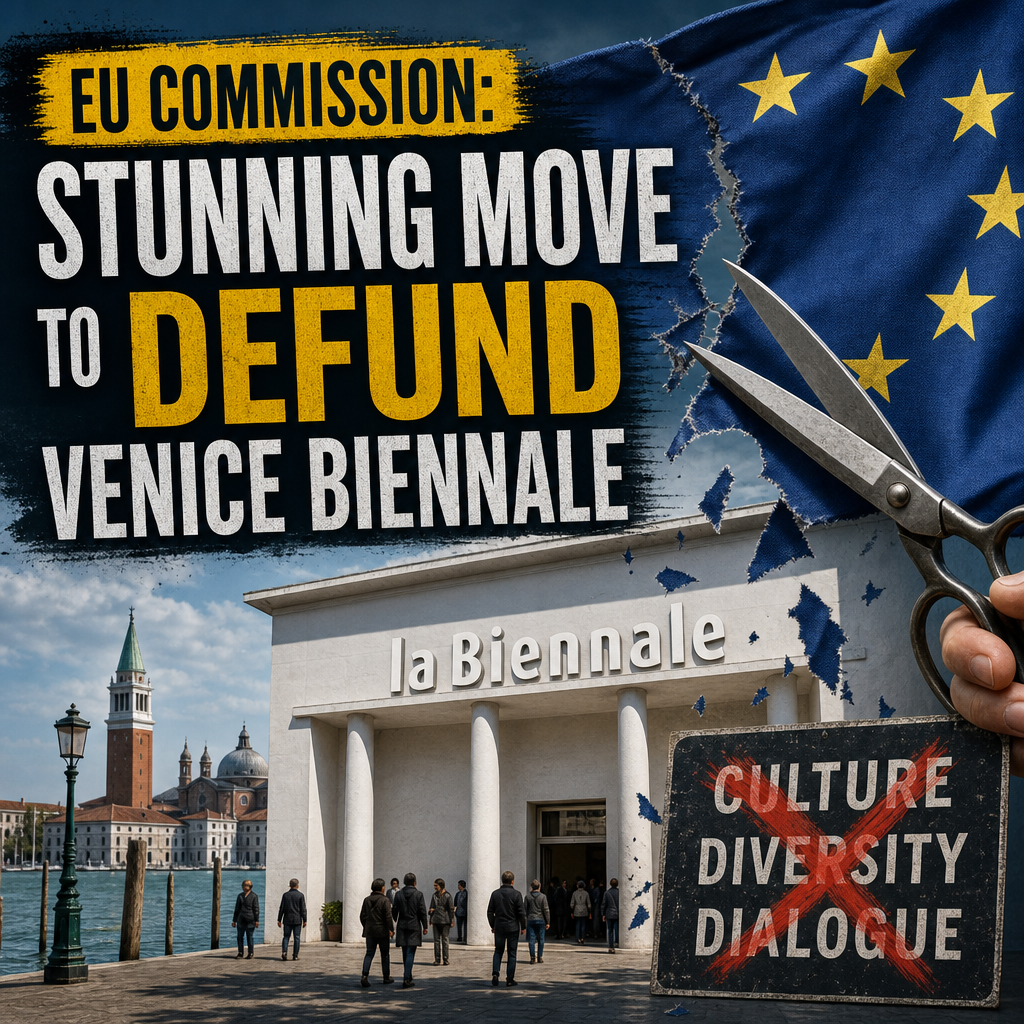
EU Commission: Stunning Move to Defund Venice Biennale


EU Commission criticism is mounting after reports of a push to pull back support connected to the Venice Biennale, a move that has reignited the familiar clash between cultural funding and political pressure. What might sound like a technical budget issue quickly becomes something larger: a debate about whether public institutions should keep art insulated from geopolitics, or whether funding can legitimately reflect Europe’s response to war, sanctions, and diplomatic isolation.
At the center of the controversy is a simple but volatile question: when does a funding decision become censorship? Supporters of tougher lines argue that institutions cannot pretend to be neutral when a war is underway and state-backed cultural presence is being used for soft power. Critics, meanwhile, see any attempt to defund a major international arts platform as a dangerous precedent that punishes artists, narrows debate, and turns culture into another battlefield.



EU Commission and the Venice Biennale: why the backlash matters
The Venice Biennale has long been more than a glittering art event. It is one of the world’s most visible cultural stages, where national pavilions, political symbolism, and artistic experimentation often collide. That makes it especially vulnerable when international tensions rise. In this case, the reported EU Commission move is being read through at least three very different lenses.
From one angle, the decision looks like a principled response to Europe’s broader policy toward Russia. In recent years, European institutions have become increasingly willing to isolate Russian state-linked bodies across sport, media, and culture. From that perspective, pressure around Venice would simply be another extension of sanctions logic: if the Kremlin uses prestige events to normalize its image, then funding associated with those events becomes politically difficult to justify.




From another angle, however, the move looks less like strategy and more like overreach. RT’s coverage strongly suggests that the funding issue reflects a broader pattern of Western institutions penalizing cultural spaces that should remain open, even during conflict. That argument resonates with artists and free-expression advocates who fear that once governments start deciding which art is acceptable, the line between policy and propaganda gets blurry very quickly.
A third, more cautious interpretation comes from broader international reporting, including Al Jazeera’s approach to similar disputes: cultural boycotts and funding restrictions rarely deliver clean moral victories. They can signal solidarity with victims of aggression, but they can also make it harder for ordinary artists, curators, and institutions to operate independently of state power. In other words, the symbolic message may be clear, but the practical consequences are not always easy to control.
What the reporting suggests — and what remains uncertain
Because the sources frame the issue differently, the public discussion is less about a single verified narrative and more about competing values:
– Accountability: Europe wants to avoid appearing indifferent to Russia-linked cultural influence.
– Free expression: Critics warn that public arts funding should not be bent into a political loyalty test.
– Institutional credibility: Major events like the Biennale depend on being seen as open, not selectively exclusionary.
– Diplomatic signaling: Culture often becomes a low-cost way for governments to send a high-impact message.
That mix makes the story bigger than one funding line item. If the EU Commission is tightening support, it is not just making a budget call; it is choosing a side in a much wider argument over how Europe responds to conflict without undermining its own cultural principles.
EU Commission pressure vs. artistic independence
Sky News-style coverage of international disputes often tends to emphasize the political fallout and public relations risk: decisions like this can inflame debate without necessarily changing events on the ground. That is an important point here. Even if the funding move is intended to demonstrate resolve, it may do more to deepen polarization than to produce any concrete diplomatic gain.
There is also a practical reality that often gets overlooked. Arts institutions are rarely cleanly separated from state interests, but they are also not always simple instruments of state power. Curators, artists, and venue staff can end up caught in the middle, with limited influence over the geopolitical meaning attached to their work. That is why blanket reactions—whether in the form of unrestricted support or broad defunding—can feel unsatisfying.
A fair reading of the controversy would acknowledge both truths at once:
1. Europe has legitimate reasons to scrutinize public support tied to politically sensitive cultural platforms.
2. Culture loses credibility when funding decisions appear to punish art for the nationality or political associations of its participants.
The hardest part is that both statements can be true at the same time.
A balanced conclusion
The reported EU Commission move should be understood less as a simple anti-art gesture and more as a sign of how deeply politics now reaches into cultural life. Venice is not just a venue; it is a symbol. And symbols, especially in Europe’s current climate, are being asked to carry more political weight than ever before.
Still, the strongest case is not for abandoning cultural scrutiny altogether, but for applying it carefully. If public money is to be withheld, the rationale should be transparent, narrow, and clearly tied to policy rather than ideology. Otherwise, Europe risks undermining the very openness and pluralism it says it wants to defend.
That is why the controversy is unlikely to fade quickly. For some, it is a necessary correction. For others, it is a worrying sign that art is becoming collateral damage in a wider geopolitical struggle. The truth may lie somewhere between those positions: not an easy scandal to dismiss, but not a clean moral victory either.