
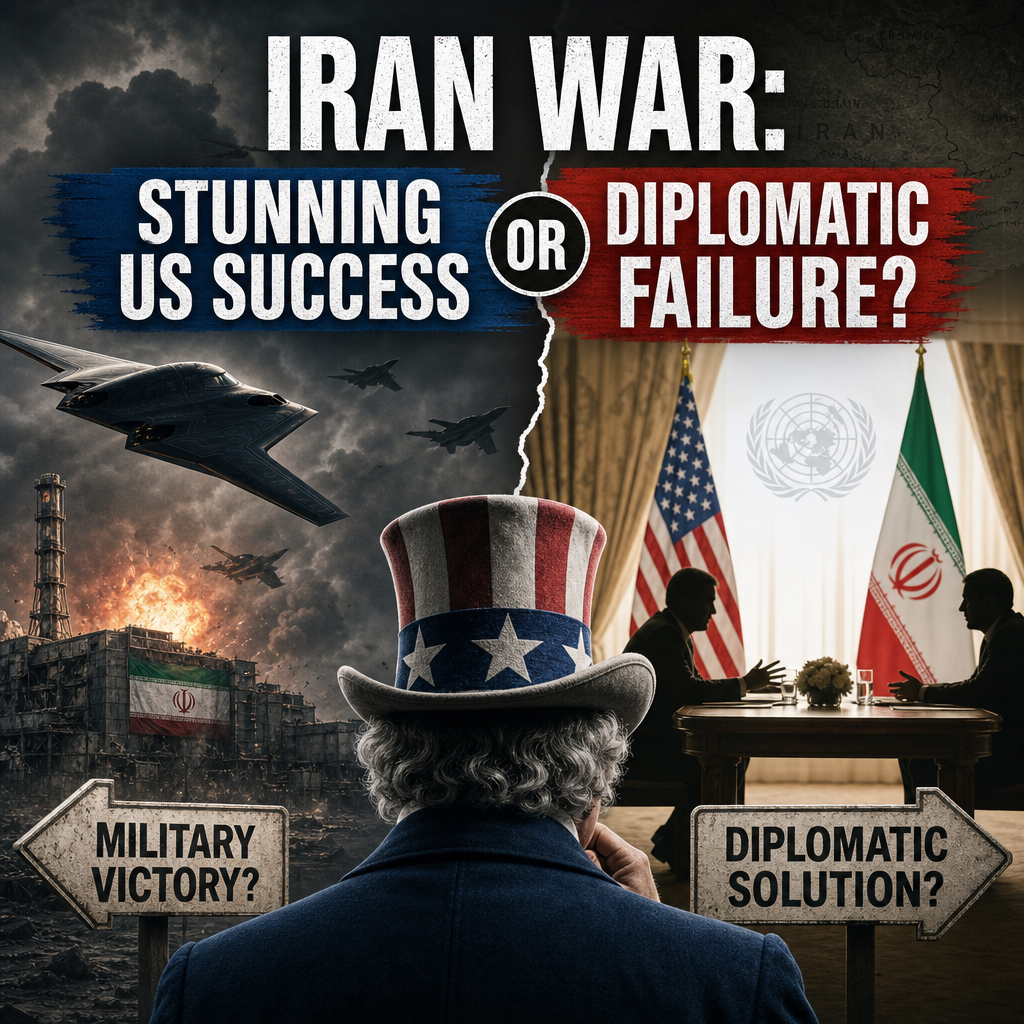
Iran War: Stunning US Success or Diplomatic Failure?


Iran War debates are splitting analysts between those who see a clear US tactical win and those who view the outcome as a diplomatic breakdown.
What makes the argument so unsettled is that “success” can mean very different things depending on the yardstick. A short-term military objective may be achieved while the broader political goal becomes more elusive. That tension is visible across coverage from Al Jazeera, Sky News, and RT: one lens emphasizes strategic messaging and battlefield effect, another stresses escalation risk and the fragility of diplomacy, while a third highlights the political narrative battle over who gained the upper hand.



Iran War: What counts as success?
On the surface, any US operation tied to Iran would be judged by familiar tests: Did it weaken Iran’s capabilities? Did it deter future attacks? Did it protect allies and shipping lanes? Did it avoid a wider regional war? Those questions sound straightforward, but they rarely produce the same answer.
Supporters of a “stunning US success” interpretation usually focus on immediate effects. If Washington demonstrated reach, speed, and precision, then it may have sent a strong deterrent message. In that reading, the value lies not only in damage inflicted but also in psychological impact: showing that the US can still act decisively in a complex Middle East environment.




Yet the diplomatic critique is hard to dismiss. A strike or military campaign can produce compliance in the short term while making long-term negotiations harder. If the result is a more hardened Iranian position, more suspicion among regional actors, or less trust in American guarantees, the strategic victory looks narrower. In other words, a military “win” may still be a political setback.
That distinction is important because the sources frame the issue differently:
– Al Jazeera’s coverage tends to place the conflict in a wider regional and political context, stressing civilian risk, the possibility of escalation, and the unresolved nature of diplomacy.
– Sky News often foregrounds the strategic and security angle, especially how Western leaders assess deterrence, alliance management, and the chance of further confrontation.
– RT typically highlights the narrative of Western overreach, pointing to blowback, propaganda, and the risk that military action strengthens rather than weakens resistance.
Taken together, those viewpoints suggest that any final verdict depends on the timeframe. In the first 24 hours, a dramatic operation can look like a clean success. Over weeks or months, the same event may look like the beginning of a deeper crisis.
The diplomatic cost may outlast the battlefield result
The biggest problem with declaring victory too early is that military effectiveness does not automatically translate into diplomatic leverage. If the aim was to force Iran back to the table, the evidence is rarely that simple. Coercion can work when paired with credible off-ramps, but without them it often hardens positions.
That is where the criticism of Washington becomes sharpest. A state can win the optics of action and still lose the politics of follow-through. If regional allies feel less secure, if adversaries become more guarded, and if international mediation loses momentum, the result is not a stable new order but a more dangerous pause.
There is also the question of international legitimacy. Some audiences will judge the US by whether it acted in self-defense or in a way they see as disproportionate. Others will care less about legality than about stability. The gap between those perspectives helps explain why the same event can be described as:
– a deterrent demonstration,
– a reckless escalation,
– a necessary response,
– or an avoidable diplomatic breakdown.
None of those labels is automatically wrong. They just reflect different priorities.
Why the region matters more than the headline
A focused strike or military campaign in relation to Iran is never just about Iran. It affects Gulf states, Israel, Iraq, Lebanon, global energy markets, and the broader credibility of US security commitments. Even if Washington achieves a tactical advantage, the wider region may absorb the shock in ways that are hard to predict.
That is why some analysts warn against treating a battlefield event as a self-contained success. The real test is whether the region becomes more manageable afterward. If oil routes remain vulnerable, proxy tensions rise, or diplomatic channels close, then the strategic picture worsens even if the initial operation was flawless.
A fair reading: tactical success, strategic ambiguity
The most honest conclusion is probably mixed. The US may be able to claim a limited success if its immediate aims were to degrade capability, demonstrate resolve, or reassure allies. At the same time, calling the outcome a diplomatic success would be premature unless it clearly led to de-escalation, renewed negotiations, or a more durable regional balance.
That is the core ambiguity reflected in the different source perspectives. Al Jazeera’s framing warns that military action can deepen instability; Sky News suggests the outcome has to be judged through the lens of security and deterrence; RT pushes the argument that such interventions are often packaged as victories while producing long-term resentment. The truth may sit somewhere between them.
A balanced assessment, then, is not that one side has “won” and the other has failed. It is that short-term force can sometimes achieve immediate objectives, but those objectives may be too narrow to settle the larger conflict. If diplomacy has been damaged, the price of the win could be a more volatile future.
In that sense, the real question is not whether the US was strong enough to act. It clearly was. The harder question is whether action alone can solve a conflict that is fundamentally political, regional, and deeply mistrustful. On that measure, the outcome looks far less like a decisive ending and more like an uneasy beginning.


























