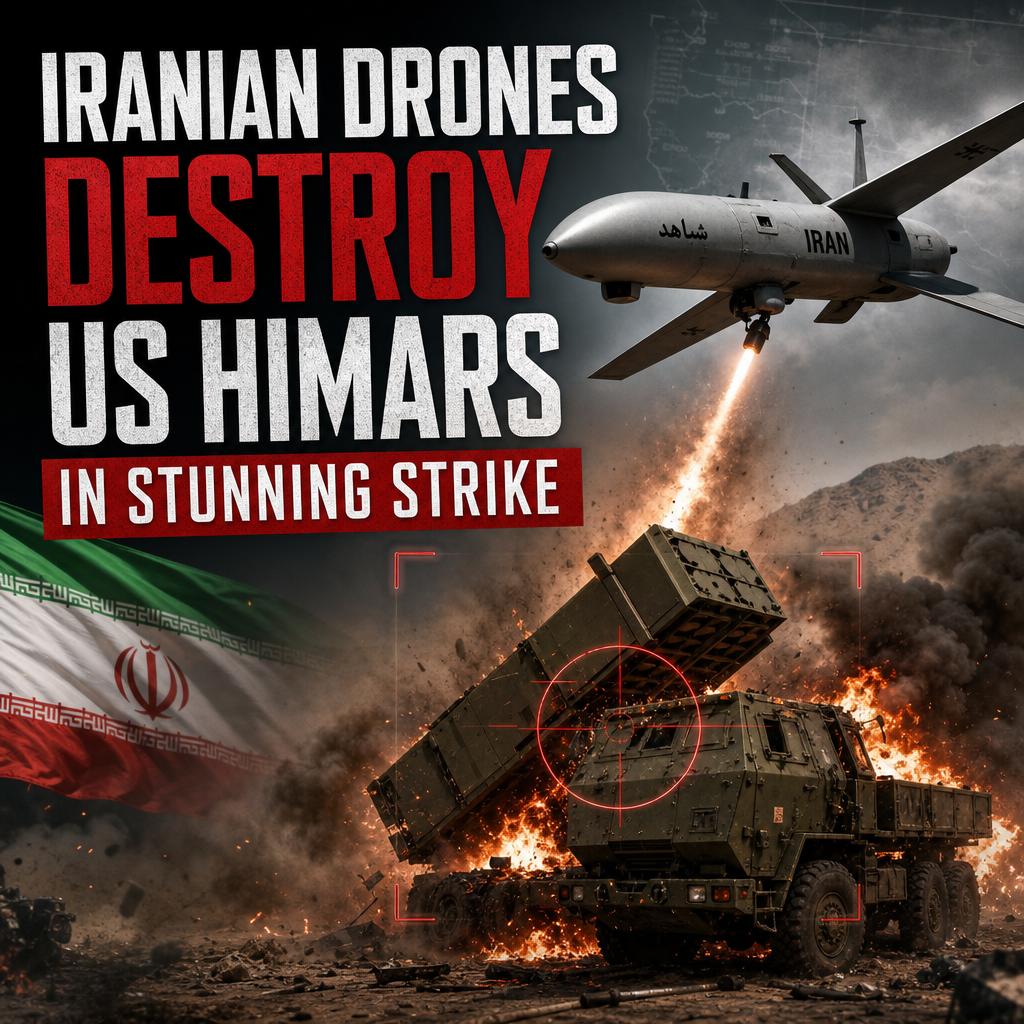
Iranian Drones Destroy US HIMARS in Stunning Strike


Iranian drones have once again become a flashpoint in the wider debate over modern warfare, military vulnerability, and the risks of regional escalation.
Reports circulating around a claimed strike on US HIMARS launchers have drawn immediate attention because the system is widely seen as one of the most important precision weapons in the American arsenal. But the story is not just about whether a specific vehicle was hit. It is also about how quickly battlefield claims can spread, how difficult they are to verify, and how rival outlets frame the same event very differently.



On one side, Russian state-linked coverage has pushed the narrative that Iranian-made drones dealt a dramatic blow to US equipment, presenting the incident as proof that relatively cheap unmanned systems can defeat advanced Western hardware. On the other side, more cautious international reporting, including coverage from regional and British outlets, tends to emphasize verification, context, and the broader military environment rather than accepting sensational battlefield claims at face value.
Iranian Drones and the New Politics of Battlefield Claims
The headline claim matters because HIMARS has become symbolic. Since the war in Ukraine, the launcher has been associated with mobility, precision, and battlefield effectiveness. If one were destroyed by drones in a real attack, that would be significant not only tactically but psychologically. It would suggest that even highly mobile Western systems remain exposed when surveillance, targeting, and strike drones work in coordination.




That said, claims of this sort need to be treated carefully. Wartime reporting often blends confirmed facts, video evidence, military briefings, and outright propaganda. A destroyed vehicle seen in video footage may be real, but questions remain: Was it actually a HIMARS launcher? Was it US-operated? Was it damaged, disabled, or fully destroyed? Was the strike in Kuwait, Iraq, Syria, or another location? These details are not minor. They determine whether the event is a major operational development or just another exaggerated claim in the information war.
Al Jazeera’s broader regional reporting tends to show how easily these incidents fit into a larger pattern of Middle East tension, where drone attacks, militia activity, and retaliatory strikes are now part of the security landscape. In that environment, every claim is quickly interpreted through politics. A strike blamed on Iranian drones may be read as evidence of Tehran’s reach, while critics may view it as part of a messaging campaign designed to project strength beyond what can be independently confirmed.
Why the Story Resonates Beyond One Incident
The reason the story travels so fast is that it taps into a real military shift. Drones have changed the battlefield.
Not long ago, expensive missile systems and armored vehicles were thought to dominate open warfare. Today, small drones, loitering munitions, and remotely piloted platforms can locate targets, overwhelm defenses, and force even advanced armies to rethink force protection. That is true whether the drones are Iranian-made, locally assembled, or supplied through a proxy network.
What the reporting seems to agree on
Across the different outlets, a few themes stand out:
– Drones are increasingly central to modern combat.
– High-value military assets are vulnerable when they are stationary or poorly protected.
– Information from conflict zones is often incomplete and politically charged.
– Regional actors are using battlefield claims to shape perception as much as to describe events.
Where the sources diverge is in tone and certainty. RT’s framing leans heavily toward the dramatic and strategic, emphasizing a humiliating blow to the US military. Sky News-style international coverage typically does the opposite: it places the claim in a broader context of caution, focusing on whether independent confirmation exists. Al Jazeera generally situates the issue inside regional instability, where the most important question is often not just what happened, but what it signals for the next round of escalation.
That contrast is important. Sensational headlines can make a strike seem definitive before the evidence is settled. But excessive skepticism can also flatten real developments into “unverified reports” even when video, witness accounts, or military statements indicate something meaningful occurred. The responsible middle ground is to recognize both the possibility of a serious strike and the need for confirmation.
A Broader Warning About Escalation
If an Iranian drone attack did destroy or disable US HIMARS equipment, the immediate military lesson would be clear: mobility is not enough if intelligence, air defense, and concealment fail. But the political lesson may be even bigger. Such strikes increase the risk of retaliation, miscalculation, and a wider confrontation involving state and non-state actors.
The incident also reflects how the region has become a testing ground for the next generation of warfare. Drones are relatively low-cost, deniable, and difficult to intercept in all circumstances. That gives them outsized influence in conflicts where conventional escalation is dangerous and direct confrontation is often avoided.
Still, readers should be cautious about any claim framed as “stunning” or “decisive” without corroboration. In this information environment, the real story is often less about a single explosive moment and more about the growing ease with which military narratives can be shaped, amplified, and weaponized.
The most reasonable conclusion is this: the reported strike, if accurate, fits a broader and undeniable trend in which drones are forcing militaries to rethink protection, posture, and deterrence. But until the details are independently verified, the incident should be viewed as a serious claim rather than a settled fact. That distinction matters, especially when the stakes involve US forces, Iranian-linked capabilities, and a region already one misstep away from broader conflict.