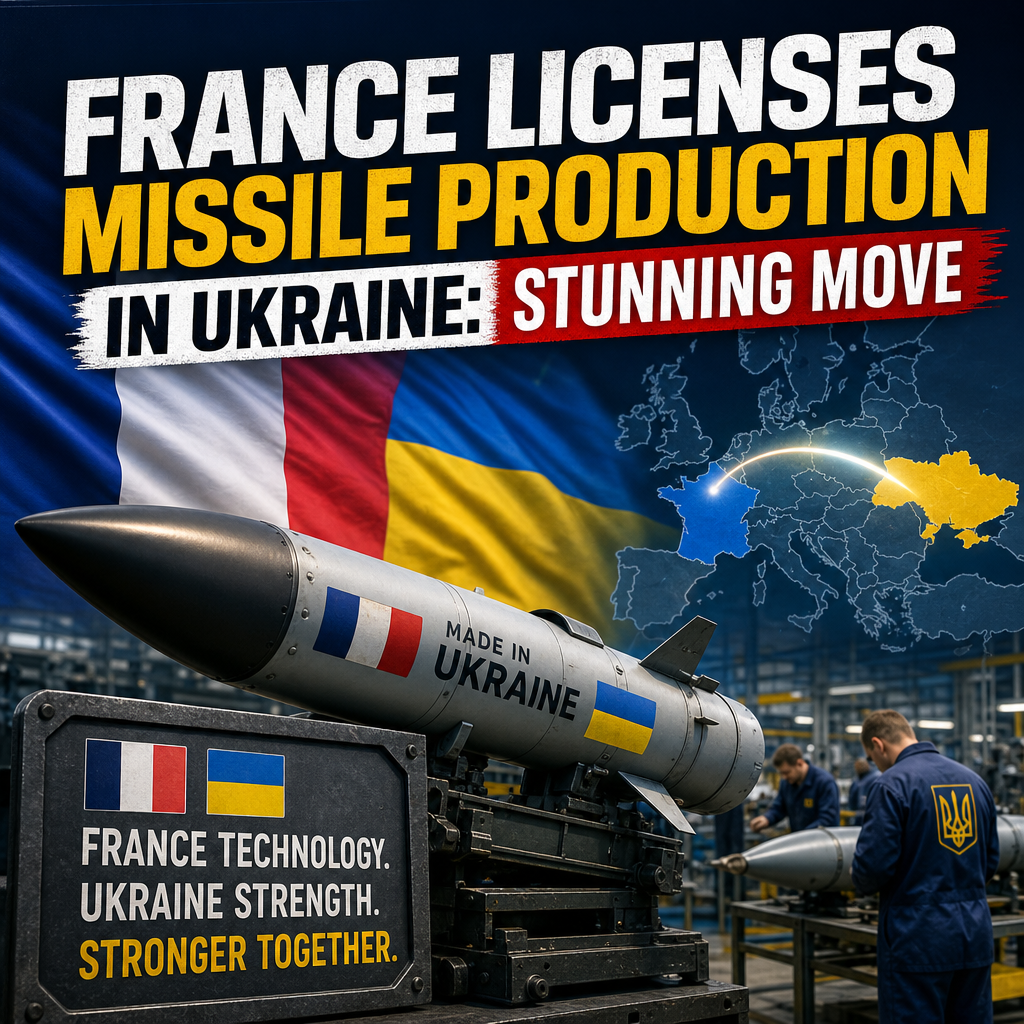
France Licenses Missile Production in Ukraine: Stunning Move


France licenses missile production in Ukraine in a move that signals a deeper shift in how European allies are supporting Kyiv’s war effort. Rather than relying only on battlefield deliveries from abroad, the plan points toward more direct industrial cooperation inside Ukraine itself, a step that could strengthen supply resilience while also widening the political and security stakes for everyone involved.
At first glance, the logic is straightforward: Ukraine needs faster access to weapons, spare parts, and production capacity; France wants to help without fully depleting its own stockpiles; and both countries have an interest in making Ukrainian defense less dependent on long, vulnerable supply chains. But the consequences are more complicated. A licensed production arrangement is not just a technical fix. It is also a signal of confidence, escalation management, and long-term commitment.



Why France licenses missile production in Ukraine matters
The biggest significance of this move is not simply that missiles may be assembled or produced on Ukrainian soil. It is that a major Western military power appears willing to help Ukraine move from being mainly a recipient of aid to becoming a more capable defense manufacturer in its own right. That is a meaningful change in strategy.
Supporters of the plan would argue that this is exactly the kind of practical assistance Ukraine needs. Weapons donations can be slowed by politics, depleted inventories, and transport risks. Domestic or licensed production, by contrast, can shorten delivery times and reduce dependence on foreign approval cycles. If parts of the supply chain are localized, Ukraine may be better able to sustain its forces during prolonged conflict.




There is also a strategic message here. By enabling production rather than only shipment, France is effectively telling Moscow that support for Kyiv is not fading into a temporary emergency measure. Instead, it is becoming embedded in industrial cooperation. That matters because one of Russia’s long-running assumptions has been that Western support will eventually weaken under the strain of cost, fatigue, and domestic debate. A production license challenges that assumption.
Still, the arrangement is unlikely to be simple. Missile systems involve highly sensitive technology, export controls, quality assurance, and strict rules about end use. Even if the political decision is made, implementation can take time. Factories need to be secured, trained workers must be available, and production lines must survive the realities of war, including air-raid threats and infrastructure damage.
The security and political risks are real
Critics of the move would point out that any missile production in Ukraine creates obvious security concerns. Facilities could become military targets. Technology transfer can be difficult to manage. And if the arrangement involves advanced systems, allies will want reassurance that production will remain tightly controlled.
There is also the risk of escalation in perception, if not necessarily in practice. Russia has often framed Western military support as proof that NATO countries are participating indirectly in the conflict. Licensed production inside Ukraine could be used by Moscow in the same narrative, even if the legal and operational reality is more nuanced. That does not mean the move is illegitimate, but it does mean the messaging around it will matter.
What the broader coverage suggests
Across international reporting, the underlying pattern is clear: Ukraine’s war effort is increasingly being shaped not just by immediate battlefield needs but by industrial capacity. That is a point on which many analysts tend to agree. The debates arise over whether this is a smart long-term adaptation or a step that could deepen risk without guaranteeing enough output to change the war’s balance.
Some coverage emphasizes the practical upside: local production can reduce bottlenecks, improve responsiveness, and build a more durable defense base for Ukraine. Other reporting is more cautious, noting that any licensed military manufacturing in an active war zone is vulnerable to disruption and may take longer to matter than political leaders hope.
Both views contain truth. The optimistic case is that this arrangement helps Ukraine become more self-sufficient and less exposed to shifting foreign politics. The skeptical case is that the war could intensify faster than industrial cooperation can scale. In other words, the announcement is important, but it should not be mistaken for an immediate battlefield game-changer.
The likely impact on Europe’s defense posture
This development also says something larger about Europe. Since Russia’s full-scale invasion, European governments have been slowly adjusting to the reality that collective defense now requires more than diplomatic statements and emergency aid packages. It needs factories, stockpiles, and long-term planning.
If France’s move proves workable, it may encourage more such agreements, not only for Ukraine but for European defense cooperation generally. Countries may begin to think less in terms of one-off donations and more in terms of shared production ecosystems. That would be a major structural shift, especially at a time when many governments are trying to rebuild military inventories that were reduced after years of peacetime cuts.
Still, this will not solve every problem. Ukraine’s needs remain immense, and missile production is only one piece of a much larger puzzle that includes air defense, ammunition, drones, maintenance, training, and financing. A licensed factory does not replace broader military support; it complements it.
A cautious but important step
On balance, France’s decision looks less like a shocking gamble and more like an acknowledgment of where the war has gone. Ukraine’s defense is no longer just about emergency shipments from allies. It is about building a war economy capable of surviving pressure over time.
That does not mean the policy is risk-free. It is exposed to military attack, political criticism, and the realities of slow industrial ramp-up. But it also reflects a hard lesson from the conflict: sustainable support often matters more than symbolic support. If the arrangement is protected, properly managed, and actually delivered at scale, it could become one of the more consequential forms of aid yet.
For now, the clearest conclusion is this: the move is bold, strategically meaningful, and highly dependent on execution. It is not a guarantee of success, but it is a sign that Europe is thinking more seriously about how to support Ukraine for the long haul.