AI Superpower: Stunning Russia-China Alternative to Silicon Valley


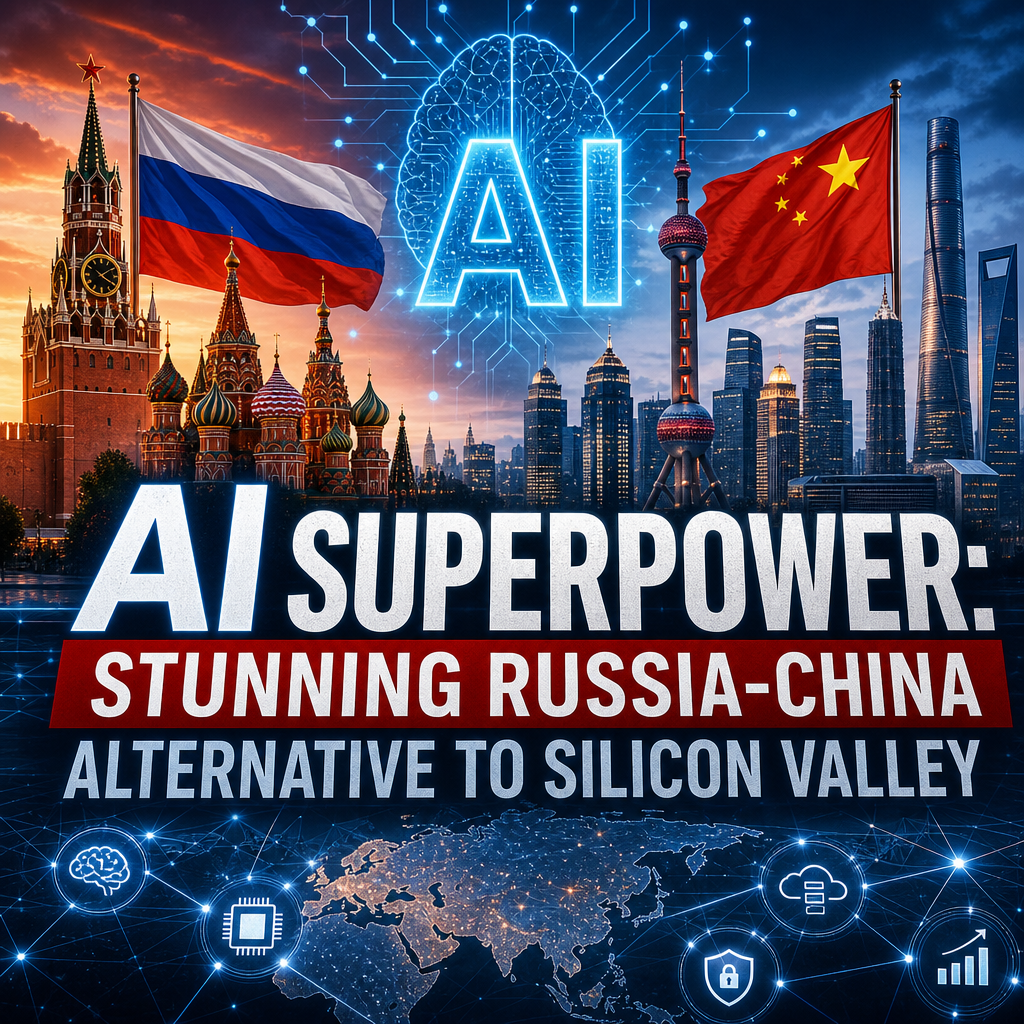
AI Superpower is becoming more than a slogan as Russia and China push to deepen cooperation in artificial intelligence, clouding the long-held assumption that Silicon Valley will remain the world’s uncontested tech center.
The idea is straightforward on paper: combine China’s enormous manufacturing base, fast-moving digital ecosystems, and heavy state support with Russia’s engineering talent, scientific tradition, and desire to reduce dependence on Western technology. But the reality is more complicated. Across international coverage, the emerging picture is less about an overnight rival to the US tech industry and more about a geopolitical project trying to turn necessity into advantage.



Why Russia and China are talking up an AI alliance
Russia’s interest in building an alternative tech pathway has intensified since sanctions restricted access to Western chips, software, and investment. China, meanwhile, has spent years trying to lower its dependence on US and European technology while building its own AI champions. Put together, the two countries have obvious reasons to cooperate.
The appeal of a joint AI framework is not just symbolic. It could help the two governments:




– share research and technical expertise
– develop domestic AI standards outside Western influence
– build data and computing infrastructure that aligns with their political goals
– reduce reliance on US-controlled hardware, cloud services, and software stacks
That said, “alternative to Silicon Valley” is a much bigger claim than “useful partnership.” Silicon Valley’s advantage is not just brilliant researchers or well-funded companies. It is also venture capital, world-class universities, deep legal and financial networks, and a global customer base. Russia and China can build state-backed ecosystems, but replacing that entire model is another matter.
The strengths are real, but they are uneven
China brings scale. Its tech firms operate in massive domestic markets, and its industrial capacity gives it an edge in rapid deployment. Russia brings experience in fields such as mathematics, aerospace, defense systems, and cybersecurity. In a narrow sense, those strengths can complement each other.
However, the partnership also faces obvious limits. China’s AI industry is far more advanced and commercially competitive than Russia’s. Russia, by contrast, has been hit harder by restrictions on access to advanced semiconductors and international collaboration. That asymmetry means the relationship may look less like a true merger and more like China leading while Russia seeks strategic relevance.
What the rest of the world sees in the Russia-China AI push
Coverage from global outlets shows that this story is being read through very different lenses. In some places, it is framed as a serious attempt to build a parallel tech order. In others, it is viewed as political messaging, designed to demonstrate defiance against the West rather than immediate technological supremacy.
Al Jazeera’s broader reporting on AI, geopolitics, and sanctions often highlights a central tension: countries want the economic gains of AI, but they also worry about surveillance, militarization, and the concentration of power. That tension matters here because both Russia and China are governments that see AI not only as an economic tool but also as a strategic one.
Sky News and other international broadcasters tend to emphasize the competitive race aspect: who controls the most advanced models, the chips that power them, and the standards that govern them. From that angle, Russia and China are not just building software—they are trying to challenge the rules of the global tech game.
RT’s coverage naturally presents the partnership in more assertive terms, portraying it as a step toward technological sovereignty. That view is important because it reflects how Moscow wants the world to interpret the move: not as isolation, but as a new bloc forming on its own terms.
AI Superpower or strategic branding?
The phrase AI Superpower sounds bold, but it should be treated carefully. There is a difference between a country or alliance that can deploy AI widely and one that can lead the frontier globally.
What would count as real success?
For Russia and China to genuinely reshape the AI landscape, they would need more than declarations and cooperation agreements. They would need:
1. reliable access to high-end semiconductors
2. large-scale computing power
3. a steady pipeline of skilled researchers
4. open enough collaboration to accelerate innovation
5. commercial products that work at global scale
China is making progress on several of these fronts, though still under pressure from export controls and competition with US firms. Russia is more constrained, especially because its tech sector has less access to global capital and hardware.
This is why a lot of analysts would describe the emerging alliance as significant, but not yet transformational. It may produce niche strengths, particularly in state applications, cybersecurity, industrial AI, and military-adjacent systems. It may also accelerate efforts to create alternative standards and digital infrastructure across friendly states. But the leap from that to a true Silicon Valley replacement remains enormous.
The bigger picture: a divided tech world
The most important takeaway may be that this is not just about two countries and a headline-grabbing alliance. It is part of a larger fragmentation of the global internet and technology economy. The world is increasingly splitting into competing systems—one shaped by US and allied firms, another shaped by China, and a smaller but symbolically important bloc seeking independence from both.
That fragmentation has consequences. It could lead to duplicated research, weaker global standards, and more suspicion around how AI tools are trained and deployed. It could also create new opportunities for states that feel excluded from Western technology circles.
Still, the language of superpower should not obscure the facts. Russia and China can cooperate meaningfully, and China in particular can build formidable AI capacity. But Silicon Valley’s dominance has been built over decades, not months, and it rests on an ecosystem that cannot be copied by political will alone.
For now, the Russia-China AI project looks less like a finished alternative and more like an ambitious attempt to build one. Whether it becomes a genuine rival or remains a geopolitical counterweight will depend on chips, talent, trust, and the ability to turn strategy into innovation.