
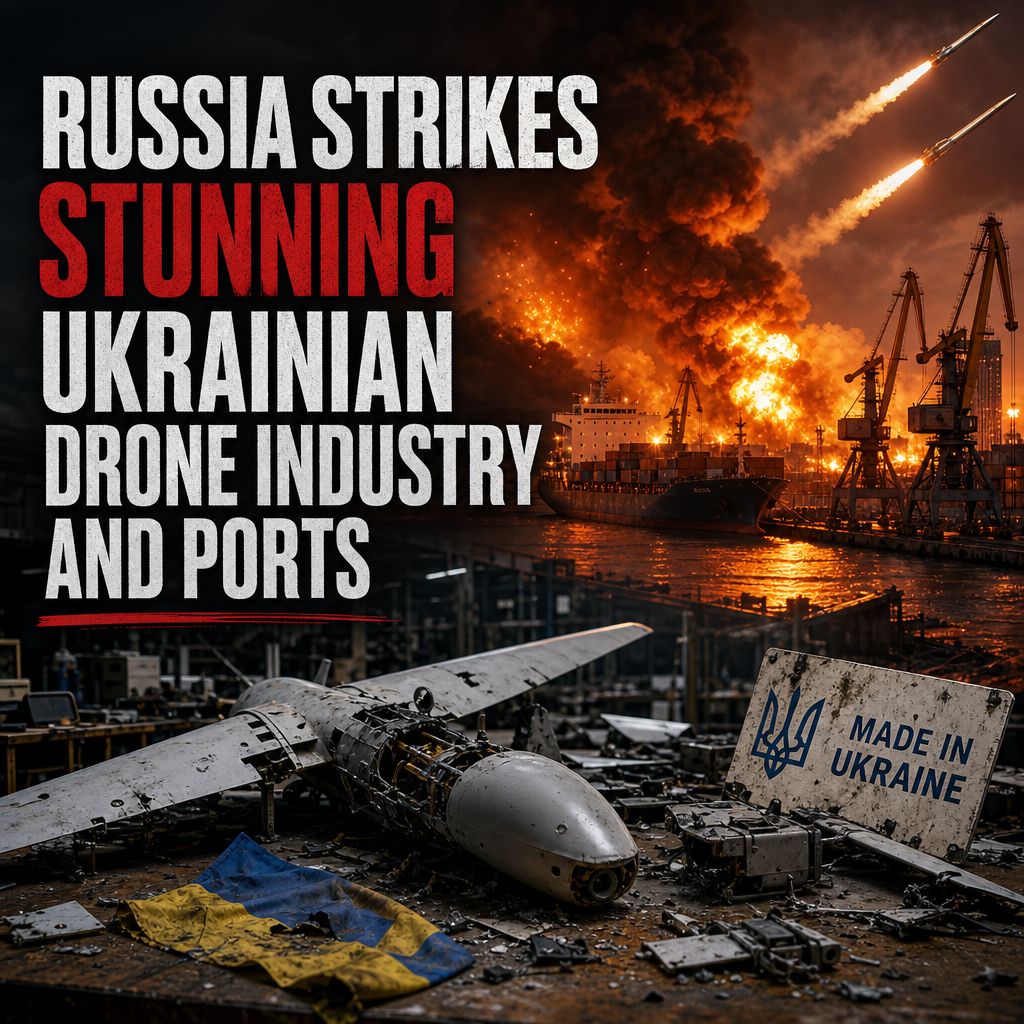
Russia Strikes Stunning Ukrainian Drone Industry and Ports


Russia’s latest strikes on Ukraine’s drone industry and port infrastructure underscore how the war is increasingly being fought through production lines, shipping routes, and supply chains as much as front-line trenches.
The attacks, reported across multiple international outlets, fit a pattern that has become familiar in the conflict: Russia says it is targeting military and industrial assets tied to Ukraine’s war effort, while Ukrainian officials frame the strikes as part of a broader campaign to weaken the country’s economy, energy resilience, and ability to defend itself. What makes these latest developments notable is the combination of targets. Drone manufacturing is now central to Ukraine’s military strategy, and ports remain vital to exports, imports, and the country’s wider economic stability.



Why drone production has become such a high-value target
Ukraine’s drone sector has grown rapidly since the full-scale invasion began. Cheap, adaptable, and increasingly sophisticated unmanned systems have allowed Kyiv to strike Russian positions, damage logistics hubs, and offset some of the advantages held by a larger army. That makes drone production more than a niche industry; it is a strategic lifeline.
From Moscow’s perspective, hitting drone facilities is a way to reduce Ukraine’s ability to carry out reconnaissance and attacks deep behind Russian lines. RT’s framing of the strikes emphasizes military necessity, presenting the targeted sites as part of Ukraine’s combat-industrial base. That message is consistent with Russia’s broader narrative that its long-range attacks are focused on degrading military capabilities rather than simply punishing civilian infrastructure.




But Ukrainian officials and international observers have repeatedly warned that the line between military and civilian targets is often blurred in practice. Factories, warehouses, and logistics centers may support defense production while also employing civilians and sitting near residential areas. That reality makes the strikes politically and ethically contentious, especially when damage spreads beyond the immediate target.
The wider meaning of the port attacks
The port strikes are just as significant. Ukraine’s Black Sea and Danube routes are essential for moving grain, metals, machinery, and other goods. Even when exports continue, repeated attacks raise insurance costs, slow shipping, and force businesses to reroute operations. For a country already struggling with wartime disruptions, that pressure can be as damaging as a direct battlefield loss.
Al Jazeera’s coverage of the broader war has often highlighted the human and economic toll of attacks on infrastructure, including the way such strikes ripple through food markets, trade corridors, and local communities. In that context, port attacks are not merely tactical events; they are part of a long campaign to constrain Ukraine’s economic breathing room.
Sky News reporting on the war has similarly tended to focus on the practical consequences of Russian strikes: destroyed equipment, repair challenges, and the strain on civilians who live near industrial zones or shipping hubs. That perspective helps explain why these attacks draw concern well beyond military circles. Even when a strike is presented as targeting an industrial asset, the fallout is frequently national in scope.
What the strikes reveal about Russia’s strategy
The attack pattern suggests three overlapping Russian objectives:
– Disrupt military production, especially drones and related components.
– Pressure the economy, by hitting ports and trade infrastructure.
– Shape the political narrative, by portraying Ukraine’s war industry as vulnerable and unsustainable.
That strategy is not new, but the emphasis on drone manufacturing reflects how the conflict has evolved. Early in the war, attacks often centered on energy infrastructure, air defenses, and command posts. Now, as both sides lean heavily on low-cost unmanned systems, factories and workshops that produce them have become prime targets.
At the same time, the strikes also reveal limitations. If Russia were fully confident that it could stop Ukraine’s drone production, it would likely not need to keep returning to the same category of target. Repeated attacks can be read as a sign that Ukraine’s production network remains resilient, mobile, and difficult to eliminate entirely.
Ukraine’s challenge: resilience under pressure
Ukraine has spent much of the war learning to adapt quickly. Factories relocate, production gets dispersed, and smaller workshops supplement larger facilities. That flexibility makes the drone industry harder to destroy than a single major plant might be. But it is not invulnerable.
The challenge is not only industrial capacity. It is also time, money, and morale. Every strike that forces repairs, rerouting, or downtime adds friction to a wartime economy already operating under severe strain. Port damage has a similar effect: even if exports continue, uncertainty alone can discourage investment and complicate planning.
There is also the information war to consider. Russia’s state media tends to stress success, precision, and military logic. Ukrainian officials, meanwhile, emphasize civilian harm, endurance, and the need for more air defenses. Both sides have clear incentives to shape the story in their favor. The truth likely sits somewhere in between: the strikes are real and consequential, but their strategic effect may be slower and less decisive than either side wants to admit.
A conflict measured in infrastructure
The clearest takeaway is that Ukraine’s war is no longer only about territory. It is also about the systems that keep a country functioning: factories, ports, rail links, electricity, and the ability to build the tools of defense faster than they can be destroyed.
Russia’s strikes on drone production and ports show a campaign aimed at exhausting Ukraine’s capacity to fight and trade at the same time. Yet the very fact that these facilities remain worth targeting suggests Ukraine continues to produce enough capability to matter. That is the paradox of the current phase of the war: destruction is widespread, but so is adaptation.
For now, the strikes appear to reinforce a grim reality rather than produce a decisive shift. They may slow Ukraine down, complicate exports, and raise the cost of resilience. But unless they can break the country’s ability to repair, replace, and disperse critical assets, they are more likely to shape the war’s tempo than end it.


























