
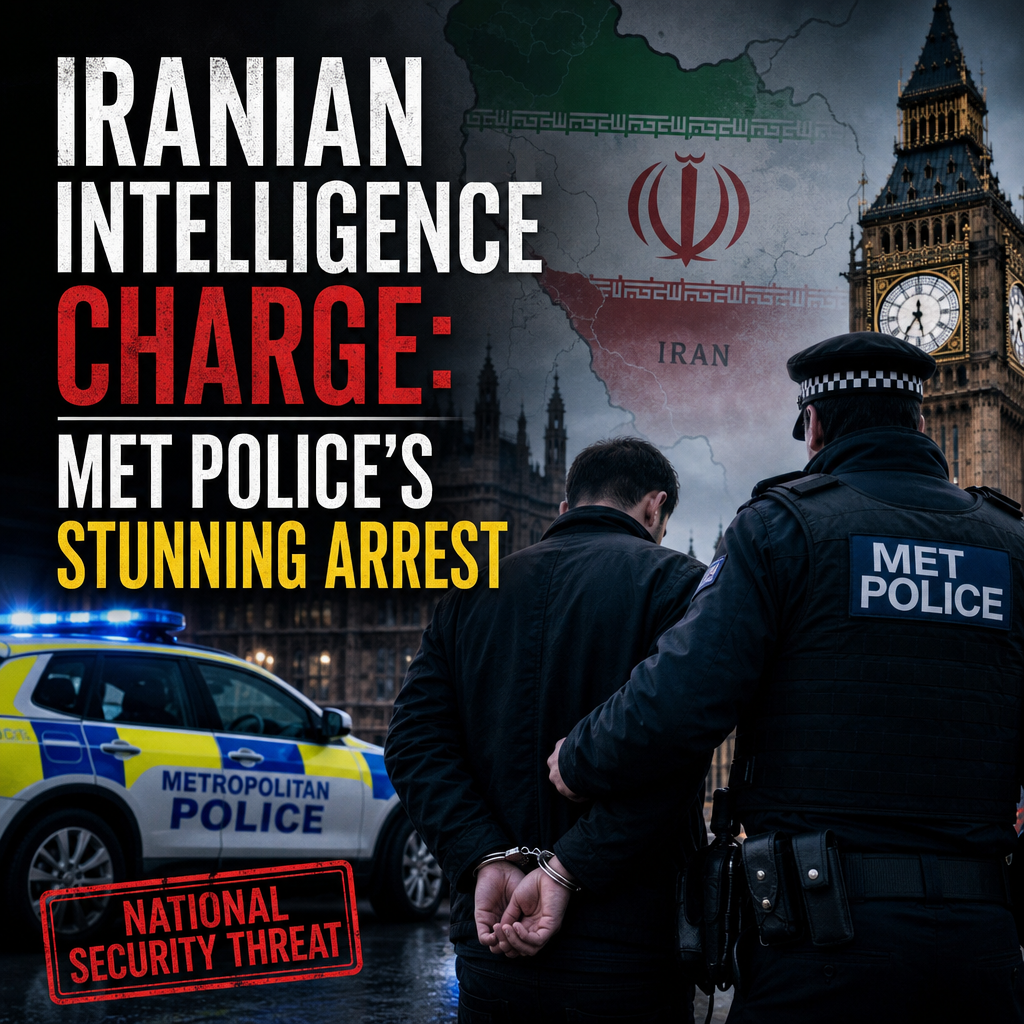
Iranian Intelligence Charge: Met Police’s Stunning Arrest


Iranian Intelligence Charge: the Met Police’s arrest has put Britain’s counter-espionage concerns back in the spotlight, but the case also shows how quickly national security headlines can run ahead of the evidence.
The Metropolitan Police say a man has been charged with allegedly assisting the Iranian intelligence service, a serious accusation that immediately raises questions about foreign influence, domestic security, and the line between suspicion and proof. On the surface, the case looks like a straightforward law-enforcement story: investigators acted, prosecutors reviewed the evidence, and charges followed. But the broader picture is more complicated. The arrest sits at the intersection of rising UK concern about state-linked activity, an increasingly strained relationship with Iran, and a public debate about how much information can be shared when a national security case is underway.



What stands out most is how carefully official language is being used. Police and prosecutors have described an allegation, not a conclusion. That distinction matters. In intelligence-related cases, the facts that can be released are often limited by the need to protect sources, methods, and wider investigations. The result is that the public hears the headline first, while the reasoning behind it stays mostly behind closed doors.
What the Met Police arrest means
The immediate significance of the Met Police’s action is that the case has crossed a legal threshold. A charge means investigators believe there is sufficient evidence to proceed, not that guilt has been established. In cases involving alleged assistance to a foreign intelligence service, the charges can be especially sensitive because they may involve communications, meetings, financial transfers, surveillance activity, or attempts to gather information for a hostile state.




That sensitivity is one reason officials tend to speak cautiously. If the allegation is correct, the implications are serious: it would suggest an attempt by an overseas service to reach into the UK and use a person on the ground to advance intelligence aims. If the allegation is overstated, however, the damage can be equally significant, feeding suspicion and encouraging political overreach.
Different news outlets tend to frame that tension differently. Some focus on the security risk, treating the arrest as evidence of an active foreign threat. Others place more emphasis on due process and the danger of drawing conclusions before a trial. A balanced reading of the story has to hold both ideas at once. The UK may have genuine concerns about foreign-state activity, but the accused is still entitled to a fair hearing.
Why the timing matters
This charge lands at a time when Britain and its allies are already alert to hybrid threats, covert influence, and transnational surveillance. In recent years, Western security agencies have repeatedly warned that hostile states may use nontraditional methods: recruitment through online contact, pressure on diaspora communities, surveillance of dissidents, or exploiting people who may not understand the full consequences of their actions.
Iran has frequently been discussed in that context, especially in relation to dissidents, journalists, and political opponents living abroad. That does not prove anything about this specific case, but it does explain why the allegations are being taken seriously. A charge like this is not just about one suspect; it connects to a wider climate of distrust and vigilance.
At the same time, the story should not be flattened into a simple morality play. State security cases can involve complex personal circumstances. People can be vulnerable, manipulated, coerced, ideologically motivated, financially pressured, or simply caught in the wrong place at the wrong time. That is why the legal process matters so much. It is designed to test whether the state’s suspicions are supported by admissible evidence, not just intelligence concerns.
Iranian intelligence charge and the bigger UK debate
The phrase “Iranian intelligence charge” may sound like a finished verdict, but in reality it marks the beginning of a public legal process. That process will likely remain partly opaque, because courts must balance open justice with national security. Even so, the case is likely to fuel several broader debates.
First, there is the question of how the UK should respond to alleged foreign intelligence operations on its soil. Stronger counterintelligence measures may reassure the public, but they also carry risks if they expand secrecy too far or create a climate of suspicion around legitimate political activity.
Second, there is the issue of community trust. Cases linked to a foreign government can have ripple effects well beyond the individual accused. People with ties to the relevant country may worry about being viewed with suspicion, even when they have no connection to any illegal activity. Responsible reporting and careful official communication are essential to avoid collective blame.
Third, the case raises the challenge of accountability. National security claims are hard for outsiders to assess, which makes transparent legal scrutiny even more important. If the evidence is strong, the prosecution should be able to withstand questioning. If it is weak, the public has a right to know that too.
What can be said with confidence
A few points are clear even before the case goes further:
– The Met Police and prosecutors believe the matter is serious enough to bring charges.
– The allegation involves assistance to a foreign intelligence service, which places it squarely in the national security realm.
– Public details are limited, so strong conclusions about guilt would be premature.
– The case is likely to draw attention not only because of the arrest itself, but because it reflects broader tensions around foreign influence and espionage.
What remains uncertain is the strength and scope of the evidence, the exact nature of the alleged assistance, and whether the case points to a wider network or a single isolated incident. Until those questions are tested in court, caution is the most responsible stance.
In that sense, the arrest is both significant and unfinished. It signals that British authorities are paying close attention to possible foreign intelligence activity, but it also reminds us that national security cases are often more complex than the headlines suggest. The right response is neither panic nor dismissal. It is scrutiny, patience, and respect for the legal process.


























