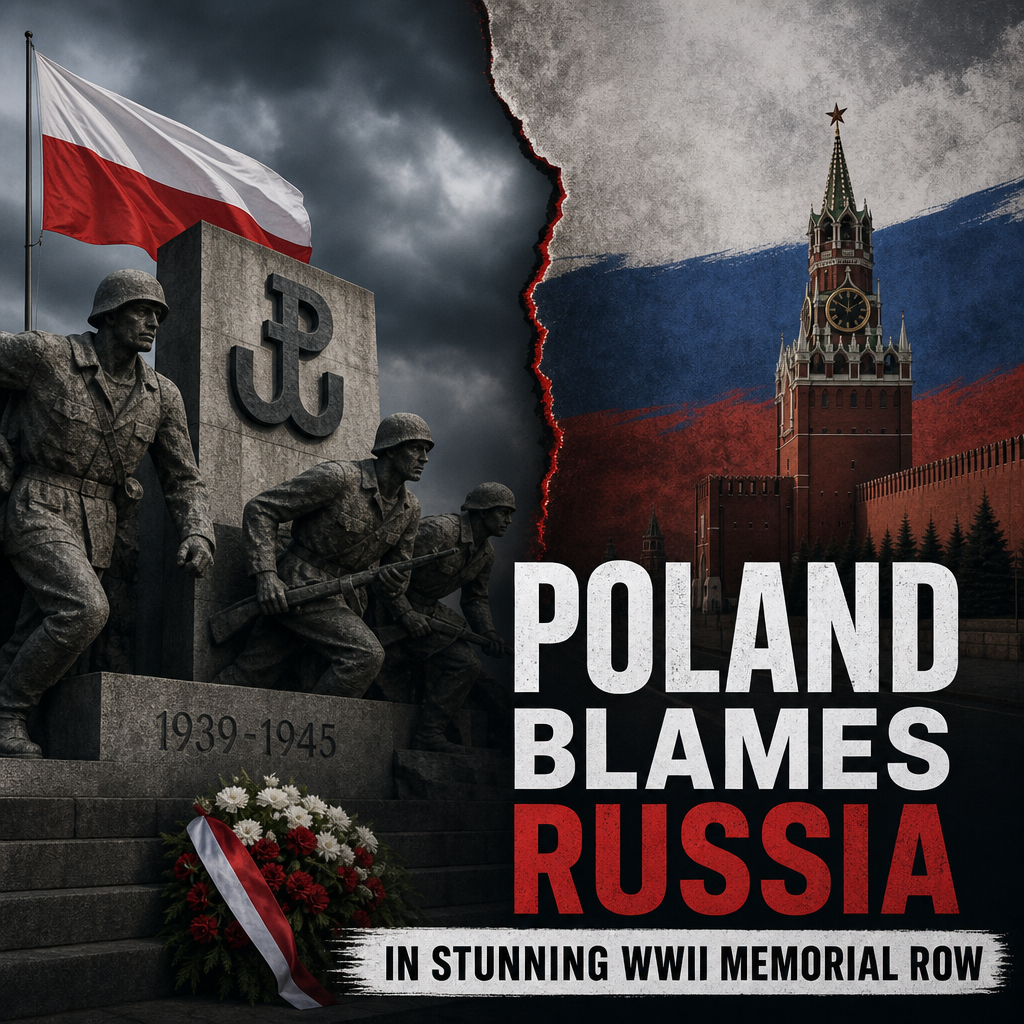
Poland Blames Russia in Stunning WWII Memorial Row


The Poland-Russia WWII memorial dispute has become the latest reminder that history in Europe is never just about the past—it is also a live argument about power, identity, and the war in Ukraine.
At the center of the row is a familiar but still combustible question: who gets to control the public memory of the Second World War, and how should monuments tied to Soviet sacrifice be treated today? Different outlets frame the dispute differently, but they converge on one point: this is not merely a local memorial issue. It sits inside a much larger confrontation between Warsaw and Moscow, one that has been sharpened by Russia’s full-scale invasion of Ukraine.



Poland-Russia WWII memorial dispute: history, memory, and politics
From Russia’s perspective, disputes over Soviet-era memorials in Poland are often presented as acts of disrespect toward the Red Army’s role in defeating Nazi Germany. Russian state-linked coverage tends to argue that Poland is rewriting history and using memorial removals or restrictions to score political points against Moscow. In that telling, the issue is not only about stones, plaques, or statues, but about what Russia sees as an attempt to erase the Soviet contribution to Europe’s liberation.
Poland, however, sees the matter very differently. Polish officials and commentators have long argued that Soviet monuments can’t be treated as neutral memorials because they symbolize not just liberation from Nazi rule, but also the arrival of another authoritarian power. For many in Poland, the postwar era was not a clean break from occupation but the beginning of decades of Moscow-dominated control. That historical memory remains powerful, especially given the current war in neighboring Ukraine.




Al Jazeera’s broader coverage of the region’s tensions helps explain why these arguments land so differently across Europe. In countries that experienced Soviet domination, memorial politics often intersects with national sovereignty and the right to define public space. In Russia, by contrast, the memory of the “Great Patriotic War” is central to national identity and state legitimacy. Once those narratives collide, even a memorial can become a diplomatic flashpoint.
Sky News-style reporting on similar standoffs usually emphasizes the practical side of the dispute: the political fallout, diplomatic accusations, and the way such controversies feed a wider East-West divide. That lens matters because it shows this is not just a symbolic quarrel. These rows often come with real consequences—frozen dialogue, sharper rhetoric, and even public pressure on governments to take harder lines.
Why the timing matters now
The timing of this row makes it especially charged. Before Russia’s invasion of Ukraine, disputes over Soviet memorials in Eastern Europe were already contentious. Since 2022, they have become far more politically loaded. In much of Central and Eastern Europe, Russia’s war has reinforced the belief that Soviet-era symbols are not distant history but part of a long pattern of domination.
That context helps explain why Poland is likely to resist Russian criticism more forcefully than it might have in earlier years. It also explains why Moscow responds so aggressively. In wartime, memory becomes strategy. Each side uses the past to support a present-day narrative:
– Poland emphasizes sovereignty, national trauma, and freedom from foreign control.
– Russia emphasizes sacrifice, liberation from fascism, and moral entitlement to remembrance.
– International observers tend to see a mix of both, along with clear political calculation.
The uncomfortable truth is that both countries are drawing on real historical experiences, but they are not weighting those experiences the same way. Soviet soldiers did help defeat Nazi Germany, and many memorials honor genuine wartime suffering. At the same time, for Poles, the Red Army’s victory did not bring lasting independence. That duality makes compromise difficult.
What the dispute reveals about Europe’s memory wars
This memorial argument also reflects a bigger European pattern: the struggle over whose history gets public recognition in an age of resurgent nationalism and geopolitical insecurity. Monuments are rarely just about the dead. They are also about the living—who belongs, whose version of events is official, and which past is allowed to shape the future.
A balanced reading of the sources suggests three important takeaways:
1. Russia sees symbolic attacks as political provocation.
That view is consistent with Moscow’s broader insistence that Soviet war memory should remain honored and protected.
2. Poland sees the memorial issue through the lens of occupation and sovereignty.
For Warsaw, removing or reinterpreting Soviet symbols is part of reclaiming historical agency.
3. The international context makes reconciliation harder, not easier.
With the Ukraine war ongoing, neither side is likely to soften its position soon.
There is also a risk here that public debate collapses into moral simplicity. Russia is not wrong to say the Soviet Union suffered staggering losses in World War II. Poland is not wrong to argue that postwar Soviet influence was deeply coercive. Both can be true at once, which is precisely why these disputes are so volatile.
The most responsible conclusion is that this is less a question of which side “owns” history and more a question of whether competing memories can coexist without being weaponized. Right now, the answer seems to be no. The memorial row is a reminder that in Europe’s east, the past remains an active front in the present—and one that can escalate quickly when politics are already on edge.