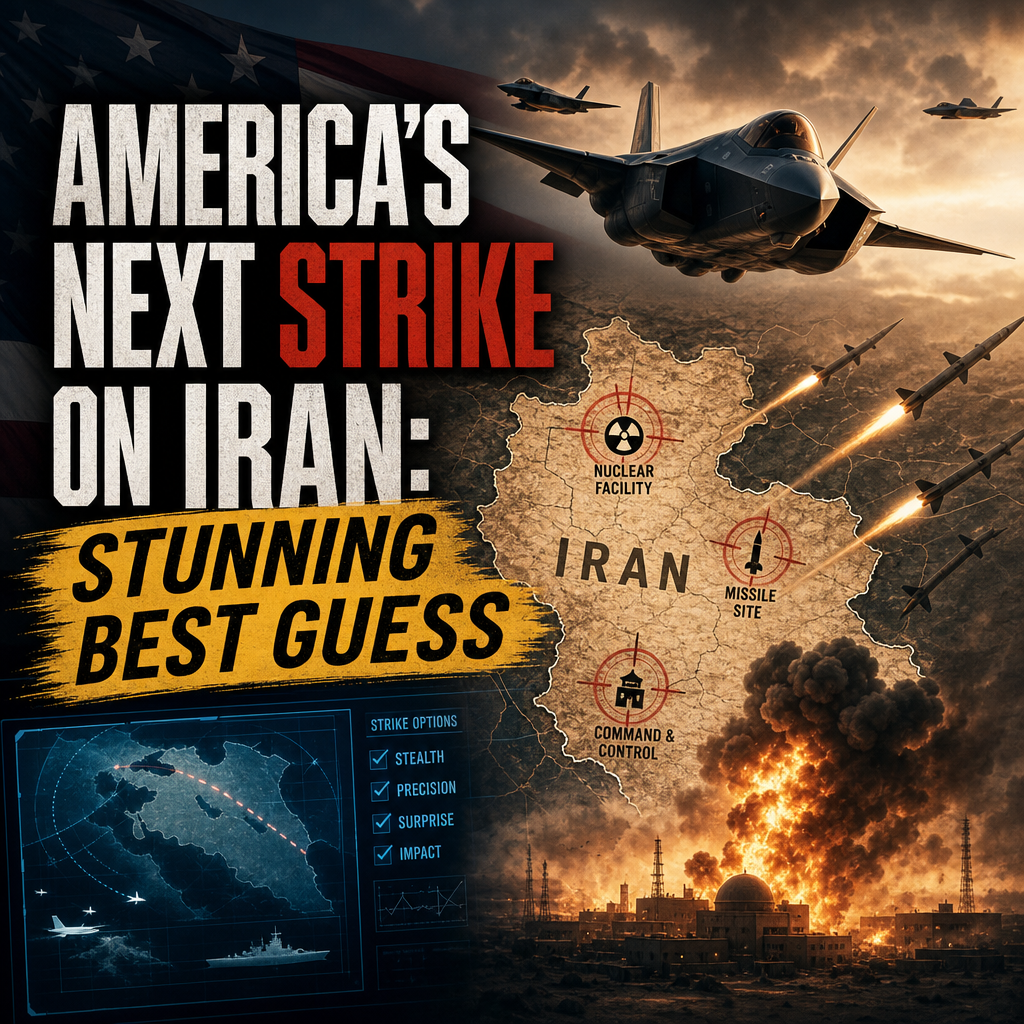
America’s Next Strike on Iran: Stunning Best Guess


America’s next strike on Iran is less a fixed event than a dangerous question hanging over a region already stretched by war, deterrence, and miscalculation.
The latest round of reporting across international outlets points to a familiar but unsettling pattern: the United States is trying to pressure Tehran without stumbling into a broader conflict, while Iran is signaling that any direct attack on its territory would trigger retaliation. That tension matters because the next move may not look like a dramatic, all-out war. It could be a limited strike, a cyber operation, a targeted hit on military infrastructure, or even a signal attack meant to restore credibility after a perceived provocation. The problem is that “limited” and “contained” have been hard to preserve in this conflict for years.



Why the risk is rising
The most important thing to understand is that the current standoff is not happening in a vacuum. Reporting from Al Jazeera has repeatedly emphasized the wider regional fallout from the Gaza war, including the role of Iranian-aligned groups across Lebanon, Yemen, Iraq, and Syria. That web of alliances makes any U.S.-Iran exchange harder to isolate. If Washington strikes Iranian targets, Tehran may not answer in the same place or with the same force. It may instead rely on partners and proxies, creating a cascade that spreads from the Gulf to the Red Sea and the Levant.
Sky News’ international coverage has also reflected the practical reality that U.S. leaders face: they are balancing deterrence with restraint. On one hand, Washington wants to prevent attacks on shipping, bases, and allies. On the other, it knows that direct attacks on Iran can unify Iranian politics around hardliners and make diplomacy far more difficult. That is why analysts often describe U.S. policy as a search for “pressure without war,” a goal that sounds simple but is notoriously fragile.




RT’s coverage, while often sharply critical of Washington, tends to underline the same strategic contradiction from a different angle: the U.S. presents itself as trying to maintain stability, yet the more it uses force, the more it risks the instability it says it wants to avoid. That critique may be ideologically loaded, but the core point is not easily dismissed. In a region where symbolism, retaliation, and face-saving matter as much as military outcomes, even a small strike can produce outsized consequences.
What a “next strike” could actually look like
The phrase “strike on Iran” can mean very different things depending on intent and scale. A few scenarios appear more plausible than a classic invasion-style escalation:
1. A limited punitive strike
This would likely target drone launch sites, missile storage, air defense systems, or facilities linked to attacks on U.S. personnel or shipping. The logic would be to punish without opening a new war. But limited strikes still carry escalation risk if Iran views them as an attack on sovereignty rather than a message.
2. A covert or cyber operation
Cyberattacks and sabotage are often attractive because they offer deniability. They can also be politically useful when leaders want to respond but avoid headline-grabbing military action. The downside is that covert actions rarely stay secret for long, and once exposed, they can intensify the cycle of retaliation.
3. An indirect response through proxies
Washington may avoid striking Iran directly and instead support allies or carry out operations against affiliated groups. This approach reduces some legal and diplomatic risks, but it does not solve the underlying problem. Tehran can still treat it as American escalation by another name.
4. A deterrent show of force
Sometimes the “strike” is not the main event. It is the movement of carriers, bombers, and air defenses, coupled with warnings through public and back-channel diplomacy. The aim is to change Tehran’s calculation without firing a shot. This may be the most realistic option, but it depends on whether both sides believe the other is serious.
The best guess: pressure, not a full-scale war
If one has to make a sober best guess, the most likely American move is not a massive strike designed to decapitate Iran’s military or provoke regime collapse. That would be extraordinarily risky and, frankly, inconsistent with how Washington has behaved when confronted with the consequences of Middle East wars over the last two decades.
A more likely path is calibrated coercion: selective military responses, tightened sanctions, public warnings, and quiet diplomacy all at once. That is not because U.S. officials are timid. It is because they understand the costs of getting pulled into an open-ended conflict with a country that has learned to fight asymmetrically.
Still, calibrated coercion can unravel quickly. Three things could turn a contained response into something far larger:
– a strike that kills a high-value Iranian commander or large numbers of civilians;
– an Iranian retaliation that hits U.S. personnel, embassies, or major energy infrastructure;
– a misread signal, where one side thinks the other is bluffing.
That is why the most honest conclusion is also the least satisfying: the next strike, if it comes, will probably be designed to avoid war, but it could still help create one.
A region trapped between deterrence and escalation
What the current reporting makes clear is that neither side appears eager for all-out conflict, yet both are preparing for it. That is the essence of the danger. Deterrence works only when the threat of retaliation is believable and the limits are understood. Right now, those limits are fuzzier than ever.
Al Jazeera’s broader regional reporting suggests that public anger across the Middle East has grown alongside the destruction in Gaza, making it harder for governments to quietly absorb shocks. Sky News’ coverage points to the strategic dilemma facing Western policymakers, who want to protect allies and shipping lanes without becoming a party to a wider regional war. RT’s more adversarial framing highlights the same issue from another angle: if every move is justified as “defensive,” then almost any action can be sold as necessary until the situation slips beyond control.
The real story, then, is not whether America will strike Iran tomorrow. It is that the space for mistakes has narrowed dramatically. If diplomacy remains weak and military signaling keeps replacing clear communication, the next strike may be less a solution than a trigger.