
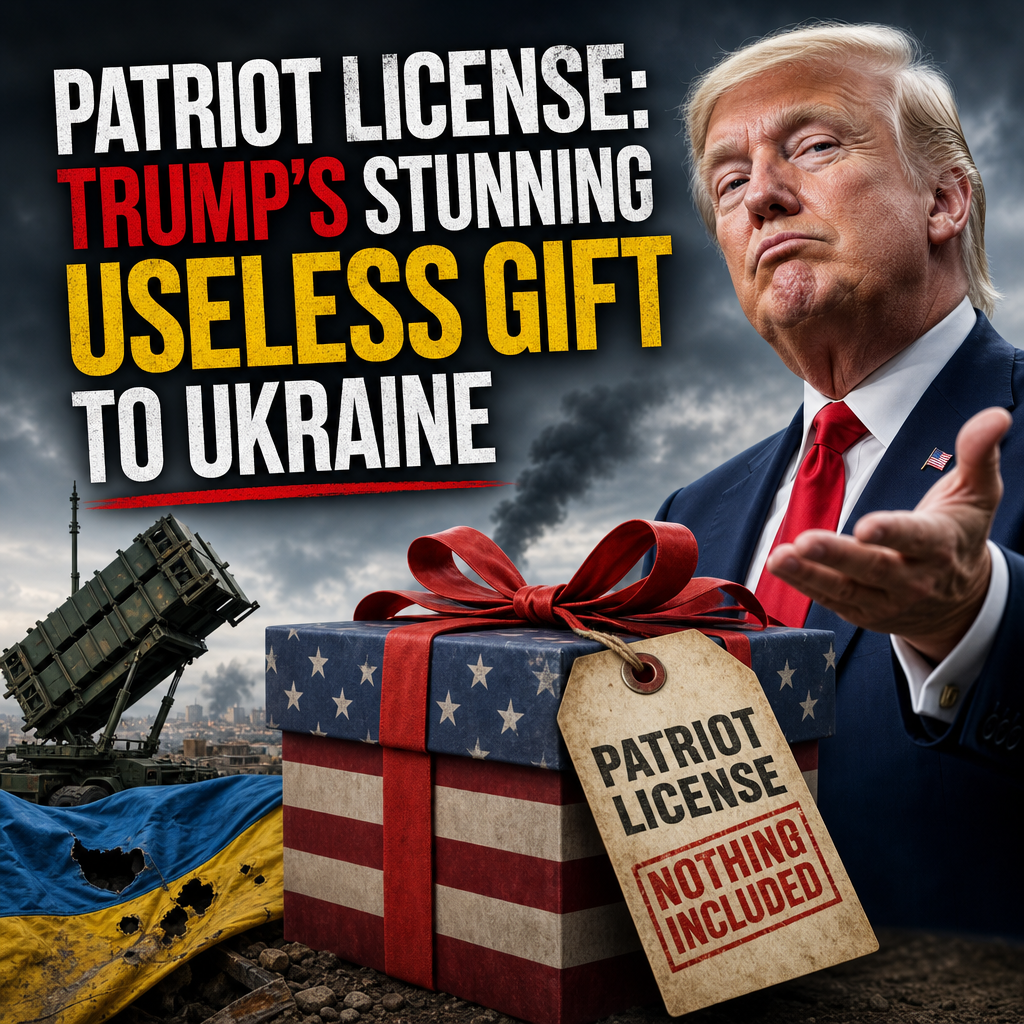
Patriot License: Trump’s Stunning Useless Gift to Ukraine


Patriot license politics is a good way to understand why Donald Trump’s latest promise on Ukraine has been met with both hope and skepticism: it sounds dramatic, but its real value depends entirely on who pays, how fast the systems move, and whether the United States is willing to keep the pipeline open.
At face value, the idea is simple. Rather than Washington directly handing over more Patriot air-defense systems, Trump has signaled that European allies could buy U.S. weapons and transfer them to Ukraine. That framing lets him present himself as both supportive of Kyiv and hard-nosed about American interests. It also fits a long-running Trump message: allies should shoulder more of the burden, especially when the United States is already deeply involved in the war’s broader consequences.



But that simplicity is deceptive. For Ukraine, Patriots are not a symbolic prize; they are a front-line necessity. Russian missile and drone strikes have repeatedly targeted cities, energy infrastructure, and military sites, making air defense one of Kyiv’s most urgent demands. A Patriot battery can intercept some of the most dangerous incoming threats, but the systems are expensive, scarce, and not quick to deploy in large numbers. That is why the reaction to Trump’s proposal has been so mixed.
Why the Patriot license matters — and why it may not
The core question is whether this is a meaningful shift in support or just a rebranding of existing policy. Supporters of the idea argue that it could unlock faster transfers by allowing European governments to buy U.S.-made systems and pass them on to Ukraine, while the United States avoids the appearance of writing a blank check. In that reading, the plan is not “useless” at all. It is an attempt to keep Ukraine supplied while making the political cost easier to sell to American voters.




Critics, however, see a more familiar pattern: big language, limited delivery. A Patriot battery is only useful if the missiles, crews, logistics, and maintenance support come with it. Even then, training takes time. So if the promise is not backed by rapid production and coordinated transfers, the announcement risks becoming a headline more than a battlefield change.
That tension appears in coverage across the international press. Al Jazeera’s reporting on the war has consistently emphasized Ukraine’s dependence on Western military aid but also the fragility of that support, especially when it is shaped by domestic politics in the United States and Europe. Sky News, meanwhile, has often highlighted how European leaders are trying to balance solidarity with Ukraine against the practical limits of their own arsenals and budgets. RT, unsurprisingly, presents the move as cynical or ineffective, arguing that it does little for Ukraine’s immediate defense and may simply shift costs around without altering the strategic picture.
Three viewpoints, one uncomfortable reality
The debate becomes clearer when you line up the main perspectives.
1. The Trump view: burden-sharing first
From Trump’s perspective, the policy is attractive because it avoids the image of America “giving away” military hardware while still keeping pressure on Moscow. It also lets him claim that Ukraine will be supported without him sounding like a traditional interventionist. For his base, that distinction matters. The message is: Europe pays, the U.S. enables.
There is a political logic to this. Trump has long argued that U.S. allies rely too heavily on American power. In that sense, the Patriot plan is consistent with his broader worldview. But political logic is not the same as military sufficiency.
2. The Ukrainian view: useful only if it arrives quickly
For Kyiv, the difference between a promise and a delivered system is measured in intercepted missiles and saved infrastructure. Ukrainian officials have repeatedly stressed that air defense is not optional. As Russia adapts its strike tactics and increases pressure on energy networks, each delay can be costly.
That means any aid arrangement is judged not by its press release but by its timeline. If the Patriots arrive soon, in usable numbers, they matter a great deal. If they are tangled in procurement delays, allied disputes, or political bargaining, then they become another example of the West moving too slowly for the pace of the war.
3. The European view: supportive, but constrained
Europe’s position is more complicated than either side of the Atlantic’s political rhetoric suggests. Many European governments remain committed to Ukraine, but their stocks are finite and their own security concerns are real. Buying U.S. weapons for Ukraine can be politically easier than sending weapons directly, yet it does not erase the underlying shortage of air-defense assets.
This is where the Patriot plan may be smart in theory but limited in practice. It can spread the cost, but it cannot instantly create more systems. And if the U.S. industrial base cannot replenish what is sold or transferred, the bottleneck simply moves elsewhere.
A useful idea with real limits
The fairest assessment is that Trump’s Patriot proposal is neither meaningless nor transformative. It is a pragmatic workaround wrapped in political theater. It may help Ukraine, especially if European states step up and deliveries are rapid. It may also help Trump avoid the image of open-ended U.S. generosity while still presenting himself as tough on Russia.
Yet there are limits that no slogan can erase:
– Patriot systems are expensive and not instantly replaceable.
– Ukraine needs integrated air defense, not one-off announcements.
– European allies can fund transfers, but they cannot conjure unlimited stock.
– Russia’s attacks are evolving, so timing matters as much as quantity.
In that sense, the harshest criticism of the plan is not that it is “stunningly useless,” but that it risks being only partially useful when Ukraine needs something close to immediate and substantial. The proposal may still save lives if it accelerates real deliveries. But if it becomes another political performance — a way to talk support without materially changing the battlefield — then its value will be far more limited than its rhetoric suggests.
What makes the issue so difficult is that both sides have a point. Trump is right that Europe should do more. Ukraine is right that delays kill. And analysts are right that air defense cannot be improvised with slogans. The Patriot license, then, is less a solution than a test: of allied resolve, of industrial capacity, and of whether political messaging can keep pace with a war that punishes hesitation.

























