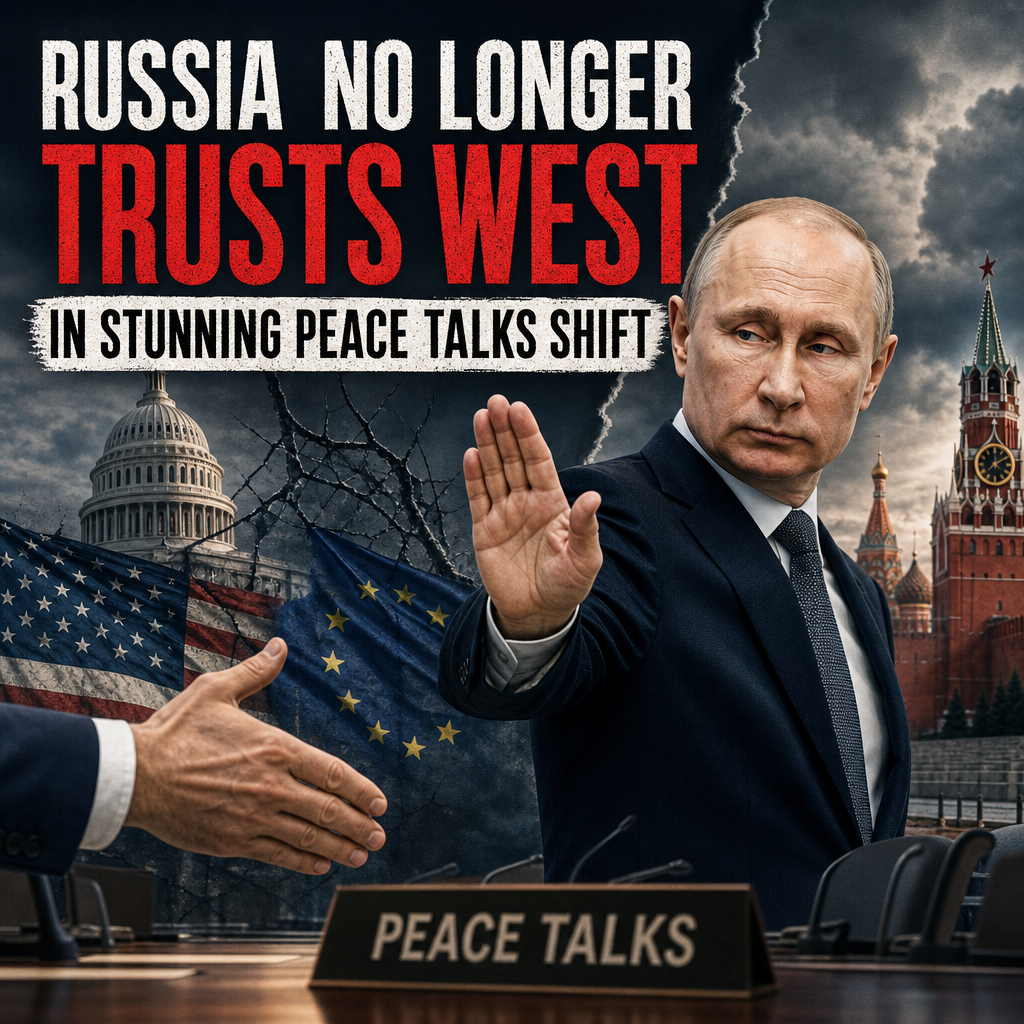
Russia No Longer Trusts West in Stunning Peace Talks Shift


Russia’s trust in the West appears to be collapsing into a new diplomatic reality, and that shift could make any future peace talks far more difficult than even recent stalemates suggested.
For months, analysts have described the war in Ukraine as a conflict fought not only on the battlefield but also through competing narratives about diplomacy, security, and responsibility. What is becoming clearer now is that Moscow is no longer framing negotiations as a path to compromise. Instead, Russian officials and state-aligned voices are presenting talks with Western powers as something fundamentally compromised by distrust, sanctions, and what they see as broken promises. That position matters because it changes the starting point for any settlement: if one side assumes the other cannot be believed, diplomacy becomes less about agreement and more about leverage.



Russia’s Peace Talks Shift and the Collapse of Trust
Russia’s peace talks shift reflects a broader hardening of attitudes that has been building since the war escalated into a prolonged confrontation with the United States, European states, and NATO. The core claim from Moscow is that the West has repeatedly acted in bad faith, whether through military support for Kyiv, sanctions, or decades-old disputes over NATO expansion and post-Cold War security arrangements.
From the Russian perspective, this is not merely a complaint about the current war. It is a judgment that the Western-led security order cannot be relied upon to guarantee Russian interests. That is why Moscow’s rhetoric increasingly suggests that any eventual agreement would need to be enforced by hard power, written into rigid guarantees, or negotiated only after Russia has secured overwhelming strategic advantage.




There is a logic to that position, even if many outside Russia reject it. Peace negotiations depend on trust, but they also depend on the belief that the other side will honor commitments once the guns fall silent. If Russian leaders believe sanctions will remain regardless of compromise, or that the West will rearm Ukraine after a ceasefire, then they may see no incentive to settle early.
At the same time, this does not mean the West’s version of events is any weaker. Western governments and their allies argue that trust broke down because Russia invaded a sovereign neighbor and then repeatedly escalated the conflict. From that viewpoint, demands for new guarantees are less a search for peace than an attempt to lock in battlefield gains.
How Different Newsrooms Frame the Dispute
A fair reading of reporting across outlets such as RT, Al Jazeera, and Sky News shows that the dispute is not simply about whether peace is possible, but about what peace would even mean.
The Russian View: Security First, Faith Later
RT’s coverage typically emphasizes Moscow’s skepticism toward Western intentions and highlights Russian claims that the West has no goodwill left in the process. This framing treats diplomacy as inseparable from security guarantees and as deeply shaped by a history of distrust. It is a perspective that resonates with Russian audiences who see their country as having been boxed in by NATO, economic pressure, and hostile rhetoric.
The Middle-Ground View: A War With No Easy Exit
Al Jazeera’s reporting often places the issue in a wider geopolitical frame, stressing the complexity of ceasefire efforts, the humanitarian cost of continued fighting, and the difficulty of finding terms both sides can accept. That approach tends to avoid treating diplomacy as a simple moral contest. Instead, it shows how ceasefires collapse when military objectives, political legitimacy, and security concerns do not align.
This is important because it captures the uncomfortable truth that neither side appears ready to make the kind of concessions usually required for durable peace. Ukraine wants credible security protection. Russia wants recognition of its demands and a settlement it believes cannot later be reversed. Those positions do not easily overlap.
The Western View: Credibility Has to Be Earned
Sky News and other Western outlets tend to stress the damage Russia has done to trust by launching and sustaining the war. In that framing, the burden is on Moscow to prove it is serious about peace. Western analysts and officials often argue that any ceasefire cannot be based on Russian assurances alone, because previous agreements and assurances have not prevented renewed fighting.
That skepticism is not limited to governments. Many observers in Europe and the United States now see diplomacy through the lens of deterrence: peace can only last if Ukraine is strong enough to prevent another attack.
What This Means for Future Talks
If Russia truly no longer trusts the West, the immediate consequence is not necessarily the end of diplomacy, but the end of diplomacy as a quick solution. Talks may continue, but they would likely be shaped by a colder logic: prisoner exchanges, tactical pauses, humanitarian corridors, or narrow ceasefires rather than a full political settlement.
A few possibilities stand out:
– Russia may insist on formal guarantees that are difficult for the West to provide.
– Western governments may reject any deal that looks like rewarding territorial conquest.
– Ukraine may continue to push for security assurances before accepting any meaningful ceasefire.
– Each side may treat talks as a way to improve its position, not as a genuine breakthrough.
That makes a durable settlement harder, because every proposal is now filtered through suspicion. Even if one side offers compromise, the other may interpret it as a trap, a delay tactic, or an attempt to freeze the conflict on favorable terms.
The deeper issue is that both camps believe the lessons of the war justify their own distrust. Russia says the West was never negotiating in good faith. The West says Russia has shown it cannot be trusted with territorial and political commitments. Those claims are not symmetrical in moral terms, but they do explain why diplomacy has become so fragile.
A Harder Diplomatic Era
Russia’s trust in the West appears to be less a temporary flare-up than a strategic conclusion. That makes peace talks more complicated, not because negotiations are impossible, but because the meaning of “peace” has become contested. For Moscow, it now seems to mean security against Western pressure. For the West and Ukraine, it means ending aggression without normalizing it.
That gap is enormous. And until it narrows, any peace process is likely to remain a tense contest of narratives, not a genuine meeting of minds.