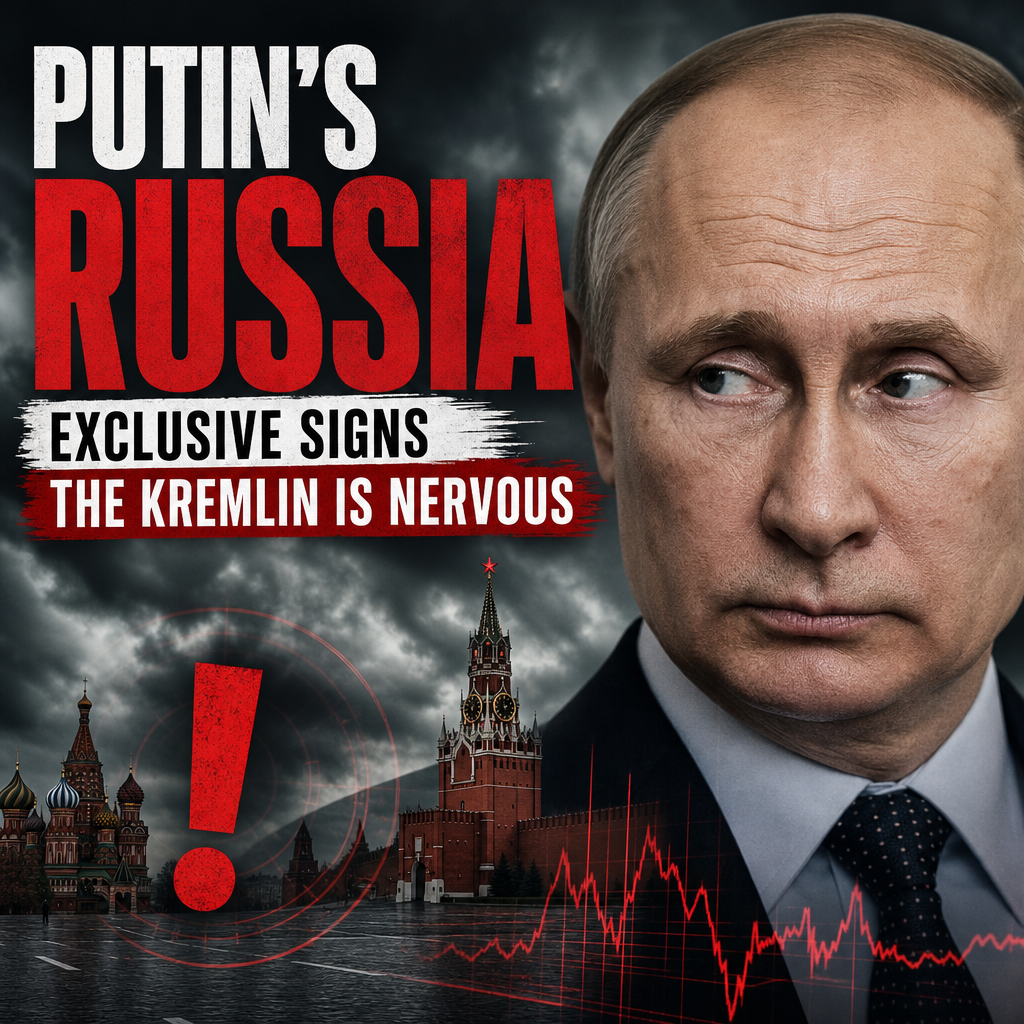
Putin’s Russia: Exclusive Signs the Kremlin Is Nervous


Putin’s Russia is showing a mix of confidence and unease that is hard to ignore.
At first glance, the Kremlin still projects the image of control: state television remains disciplined, public dissent is heavily restricted, and official messaging continues to frame Russia as resilient under pressure. But several recent signs suggest that beneath that polished surface, the leadership is working harder to manage instability than it may want to admit. Different news outlets offer different interpretations, yet a common thread runs through them all: Russia’s rulers appear less relaxed than their public posture suggests.



Signs of pressure inside Putin’s Russia
One reason analysts are watching closely is that nervous governments rarely look nervous in obvious ways. Instead, they tend to tighten the screws. That pattern appears to be visible in Russia, where the state has doubled down on security, information control, and punishment for dissent. The impression is not of a government in panic, but of one determined to prevent panic from spreading.
Sky News’ reporting on the subject points to the Kremlin’s increasingly defensive posture, suggesting that the leadership is reacting to a more complicated political environment than it would like the public to see. That sense matters because the Russian system depends heavily on projecting stability. If people start sensing cracks—whether through battlefield setbacks, economic strain, or elite anxiety—the state’s credibility can weaken even if no single dramatic event occurs.




Other coverage in the international press helps explain why this matters. Al Jazeera’s broader Russia reporting has repeatedly highlighted the strain created by war, sanctions, and the need for the Kremlin to keep domestic opposition tightly controlled. In practical terms, that means the government is balancing several pressures at once:
– the costs of the war in Ukraine
– the need to suppress criticism at home
– the challenge of preserving elite loyalty
– the long-term strain of sanctions and isolation
– the risk that public frustration builds beneath the surface
That combination does not automatically mean the regime is close to collapse. But it does mean the Kremlin has reasons to be watchful.
What the Kremlin may be most worried about
The biggest threat to Putin’s Russia is not necessarily a single protest wave or one military setback. It is the possibility that multiple smaller problems begin to reinforce each other.
War fatigue and battlefield uncertainty
Russia’s war effort has placed heavy demands on the state. Even when official messaging insists that everything is under control, war creates pressure on manpower, budgets, and public morale. Casualties are politically sensitive, and uncertainty about the pace and purpose of the conflict can erode confidence over time.
That does not mean Russians are uniformly turning against the Kremlin. Far from it. Many people remain cautious, apathetic, or supportive of the state narrative. But war fatigue can grow quietly. A government that relies on controlled optimism has to work harder when the public starts asking how long the burden will last.
Economic strain without obvious collapse
Western sanctions were expected by some observers to produce quick, dramatic breakdowns. That did not happen. Russia adapted, rerouted trade, and kept key sectors functioning. Still, resilience is not the same as health. Inflation, labor shortages, shifting trade patterns, and dependence on wartime spending all create vulnerabilities.
RT’s coverage often emphasizes Russia’s ability to withstand external pressure and portray sanctions as backfiring on the West. That viewpoint reflects a genuine part of the story: Russia has not been isolated out of existence, and the economy has shown more durability than many predicted. But durability can hide stress. A system can remain upright while becoming less efficient, less innovative, and more dependent on state direction.
Different newsrooms, different lenses
A fair reading of the media landscape shows why this story is complicated. Sky News tends to frame the Kremlin’s behavior through the lens of political strain and strategic anxiety. Al Jazeera often places Russia’s actions in a wider global and domestic context, emphasizing how war, sanctions, and authoritarian control interact. RT, by contrast, usually stresses sovereignty, resistance, and the idea that Russia is under siege from hostile foreign powers.
Taken together, these perspectives do not cancel each other out. Instead, they reveal the central tension in Putin’s Russia: the state wants to appear invulnerable, but it behaves like a system that is constantly managing risk.
That is the key reason the word “nervous” resonates. Not because the Kremlin is obviously losing control, but because it seems to be acting as though control cannot be taken for granted.
A stronger state, or a more fragile one?
There is a temptation to read every restrictive move as proof of weakness. That can be misleading. Authoritarian states often become more repressive when they feel secure enough to do so, not only when they fear collapse. Crackdowns can signal strength as well as insecurity.
So what is the more accurate conclusion?
Probably this: Putin’s Russia is not on the edge of immediate failure, but it is managing a growing set of pressures that make the leadership more cautious than confident. The Kremlin still has powerful tools—media control, security services, legal repression, and a long experience of surviving crises. Yet those tools are being used in an environment that is less predictable than the government would prefer.
The result is a state that looks steady from far away, but more tense up close. That tension may not produce a dramatic turning point tomorrow. Still, it is a reminder that even highly controlled systems can be anxious beneath the surface—and that in Russia, the gap between public confidence and private concern is often where the real story begins.