Trump Lego Effigy Burns in Iran: Stunning Video


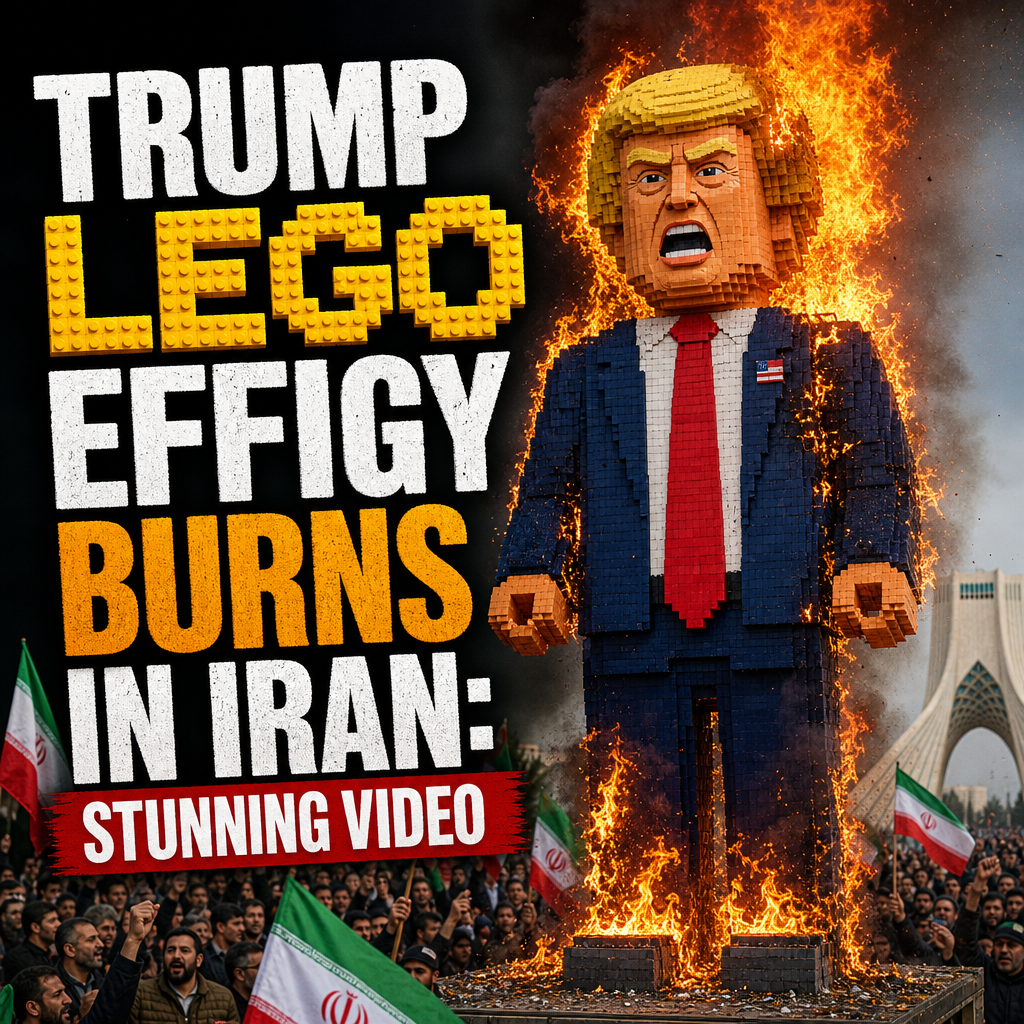
Trump Lego effigy burns in Iran in a video that quickly spread far beyond social media, becoming another flashpoint in the long-running political theater between Tehran and Washington.
At first glance, the footage is easy to read as a stunt: a small, deliberately childish-looking figure made of building blocks, set alight in a public display of anger. But the reaction to the video shows that it is more than just a spectacle. For some viewers, it is a symbol of anti-American defiance. For others, it is a reminder of how quickly political symbolism can harden into provocation, especially when the United States, Iran, and their allies are already locked in a cycle of distrust.



The video matters not because of the object itself, but because of what it tries to communicate. In the Middle East, symbolic acts often carry as much weight as official statements. A burning effigy is not subtle. A Trump figure rendered in Lego-like blocks adds another layer: it turns a global political personality into something toy-like, disposable, and mockable. That visual language is designed to be instantly legible, even to people who know little about the underlying political dispute.
What the burning effigy says about the moment
The scene arrives at a time when tensions between Iran and the West remain high, with every dramatic image feeding a wider narrative of confrontation. RT’s coverage naturally frames the incident as a striking anti-Trump protest, emphasizing the spectacle and the symbolism of the act. That angle treats the video as a political statement first and foremost, one meant to be seen as defiance.




Al Jazeera’s broader reporting style on Iran tends to place such moments inside a larger geopolitical frame: sanctions, security pressures, regional rivalries, and the domestic politics of resistance. That context matters because Iranian public displays rarely happen in isolation. They often reflect a mix of state messaging, public frustration, and the need to project strength outward even when the country is under pressure inwardly.
Sky News, by contrast, is more likely to stress the international reaction and the optics of the incident. From that perspective, the video is not just a domestic gesture but a media event with global reach. In an age when short clips can shape perceptions faster than policy papers, the image of a burning effigy can become a shorthand for the state of diplomacy itself.
Taken together, these viewpoints suggest a simple conclusion: the video is politically useful to people on different sides for different reasons.
– For hardline voices in Iran, it signals resistance and refuses deference.
– For critics of Tehran, it reinforces the idea that hostility is embedded in the political culture.
– For international media, it is a vivid example of how symbolism can escalate a story even when no new official policy has been announced.
Why symbolic gestures still matter in Iranian politics
It would be a mistake to dismiss the burning effigy as empty theater. Symbolic acts often reveal more about political mood than formal speeches do. In Iran, anti-U.S. imagery has a long history, tied to the 1979 انقلاب and to decades of sanctions, conflict, and suspicion. That history gives such acts a ready-made audience, especially among people who view the United States as a destabilizing force.
At the same time, the symbolism can be double-edged. What one audience sees as righteous protest, another sees as a sign of extremism or theatrical anger. That split matters, because international politics is partly about perception. A single viral clip can strengthen narratives already in place, making compromise harder by feeding the emotional logic of confrontation.
There is also an important question about intent. Was the effigy-burning a spontaneous act, a staged protest, or a carefully managed media moment? Without clear, independent verification of the organizers and their aims, it is best to be cautious. Videos can be authentic and still be misleading if they are presented without context. The image may be real; its meaning is less certain.
The broader lesson: outrage travels faster than explanation
What stands out most is how quickly a small visual event can become an international story. The burning figure is not significant because it changes policy. It is significant because it compresses a complicated relationship into one unforgettable image.
That compression is exactly why it spreads. It is easier to share than an analysis of sanctions, nuclear diplomacy, regional proxy conflicts, or domestic pressures inside Iran. It is also easier to react to emotionally than to interpret carefully. In that sense, the video is a reminder of how modern political communication works: attention gravitates toward the most dramatic symbol, not necessarily the most accurate explanation.
A balanced reading leaves room for both recognition and caution. Yes, the video appears to be a pointed act of anti-Trump, anti-U.S. messaging. Yes, it fits into a long pattern of symbolic resistance in Iran. But it should not be overread as proof of a single public mood or a direct indicator of state policy. Iran is not one voice, and neither is the global response to it.
The most responsible interpretation is that the clip reveals a lot about political communication and very little about a clean, simple reality. It shows that old animosities still have force, that symbolism remains a powerful tool, and that in the current media environment, an image can outrun context in seconds.