US-Iran War: Stunning Global Growth Low, World Bank


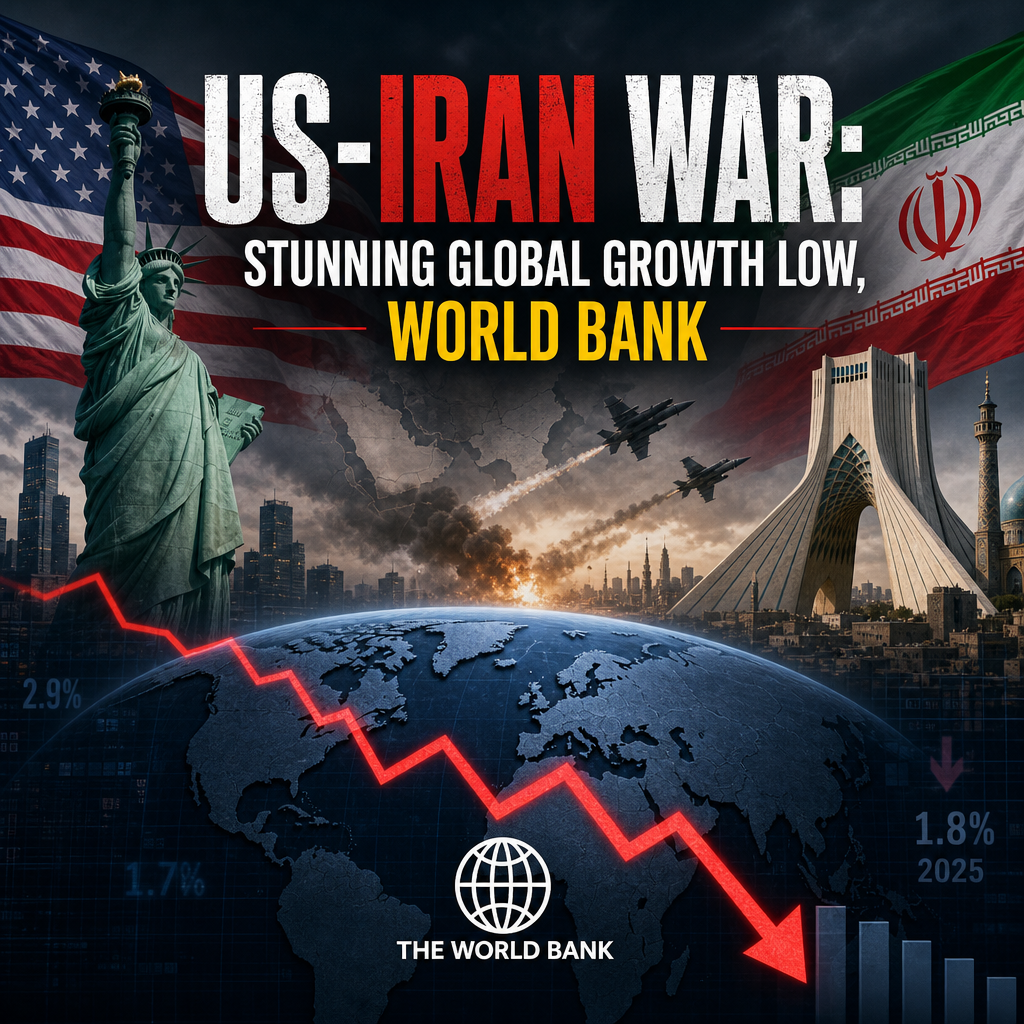
US-Iran war fears are no longer just a regional security issue; they are increasingly being treated as a global economic shock that could slow growth, rattle energy markets, and weaken confidence in the months ahead.
The World Bank’s latest warning, as reported by multiple outlets, is stark: if the conflict widens or disrupts shipping and energy flows, the world economy could slip into a weaker growth path at a moment when many countries were already struggling with high debt, sticky inflation, and fragile consumer demand. The headline figure—global growth falling to its lowest level since the COVID era—has drawn attention because it suggests the shock would not be limited to the Middle East. It would travel quickly through oil prices, freight costs, supply chains, and investor sentiment.



US-Iran war and the global growth warning
The core concern is simple: the world still runs on energy and trade routes that are vulnerable to conflict. Even a brief escalation in the Gulf can raise the cost of shipping through strategic corridors, push up insurance premiums, and send oil and gas prices higher. That matters whether a country imports energy directly or not, because higher fuel costs feed into transport, food, and industrial production.
The World Bank’s view, as reflected in the reporting, is not that war automatically causes a recession, but that it can amplify an already weak global environment. That distinction matters. Growth forecasts are usually built on assumptions of relative stability. Once those assumptions break, the downside can be fast and broad-based.




There is also a political dimension. In conflict reporting, the impact on markets often depends as much on expectations as on actual damage. If traders believe the confrontation could spread, prices can jump before any major disruption occurs. That can tighten financial conditions for developing economies and make borrowing more expensive for governments and businesses alike.
What different outlets are emphasizing
The coverage from Al Jazeera places the World Bank warning in a broader economic context, stressing that the war’s consequences may be felt most sharply by countries already exposed to inflation, debt stress, or fragile import bills. That framing underlines the human side of macroeconomics: when fuel and food become more expensive, households often feel the pain before policymakers can respond.
Sky News-style coverage tends to highlight the market reaction angle: the immediate effects on oil, shipping, and international trade routes, along with the possibility that Western governments will face pressure to stabilize prices and reassure investors. That lens is useful because it shows how quickly a military crisis can become a cost-of-living crisis.
RT’s reporting often focuses more heavily on the geopolitical consequences and the role of Western policy decisions in escalating or containing the conflict. That perspective can be valuable insofar as it reminds readers that wars rarely have a single cause, and that sanctions, deterrence, diplomacy, and military posturing all shape the economic fallout. Still, it is important to separate interpretation from evidence. The strongest economic warning in this case is not ideological; it is structural. Markets dislike uncertainty, and war creates plenty of it.
The likely channels of damage
A careful reading of the reporting points to several main risks:
– Higher oil prices if supply routes are disrupted or if markets fear wider instability
– Increased shipping and insurance costs in the Gulf and surrounding waterways
– Pressure on inflation just as many central banks are trying to keep price growth under control
– Slower trade and weaker investment as companies delay decisions
– Greater strain on emerging markets that import energy and carry high debt
These effects do not hit all countries equally. Energy exporters may benefit from higher prices in the short run, while import-dependent economies usually suffer. But even exporters can lose if instability reduces overall trade, discourages investment, or triggers broader sanctions and financial volatility.
Why the World Bank message matters now
The World Bank’s warning lands at a delicate time. The global economy is not in crisis mode, but it is vulnerable. Many advanced economies are still dealing with uneven recovery, while parts of Asia, Africa, and Latin America face slower growth and tighter financing conditions. In that setting, a major conflict can act like a multiplier of existing weakness.
That does not mean a worst-case scenario is inevitable. Diplomatic efforts, deterrence, and carefully managed de-escalation can limit the damage. Markets also often recover quickly if the conflict remains contained. But the possibility of even temporary disruption is enough to force economists to lower expectations.
The most balanced conclusion is this: the World Bank’s warning should be taken seriously, but not as a prophecy. It is a reminder that global growth is fragile and that geopolitical shocks can spread far beyond the battlefield. The world economy may not be headed for collapse, but it is clearly exposed to a conflict that could make a weak recovery even weaker.
In that sense, the real lesson is less about one war and more about the structure of the modern economy. A confrontation between the US and Iran would not stay local for long. It would move through oil, shipping, prices, and confidence—often faster than governments can react. And that is why the economic stakes are being watched so closely by institutions, investors, and ordinary households alike.